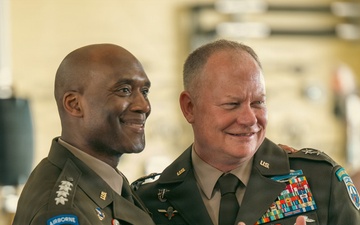
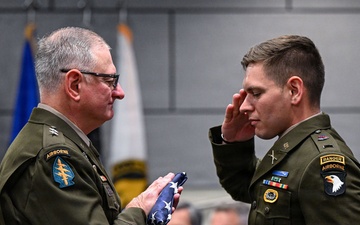
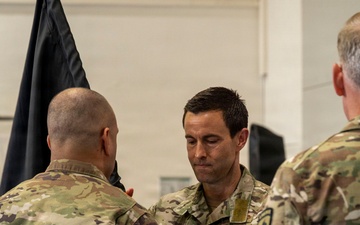
Special Operations Command-Korea holds a change-of-command ceremony during which U.S. Army Maj. Gen. Derek N. Lipson relinquishes command of SOCKOR to U.S. Army Brig. Gen. Matthew A. Valas. As the only Theater Special Operations Command in which U.S. and host-nation special operations forces are institutionally organized for combined operations, SOCKOR plans and executes special operations missions in support of the commander of United Nations Command/Combined Forces Command/U.S. Forces Korea during armistice, crisis and war. (U.S. Army video by Sgt. Joshua D. Talley)
Special Operations Command-Korea holds a change-of-command ceremony during which U.S. Army Maj. Gen. Derek N. Lipson relinquishes command of SOCKOR to U.S. Army Brig. Gen. Matthew A. Valas. As the only Theater Special Operations Command in which U.S. and host-nation special operations forces are institutionally organized for combined operations, SOCKOR plans and executes special operations missions in support of the commander of United Nations Command/Combined Forces Command/U.S. Forces Korea during armistice, crisis and war. (U.S. Army video by Sgt. Joshua D. Talley)
Special Operations Command-Korea holds a change-of-command ceremony during which U.S. Army Maj. Gen. Derek N. Lipson relinquishes command of SOCKOR to U.S. Army Brig. Gen. Matthew A. Valas. As the only Theater Special Operations Command in which U.S. and host-nation special operations forces are institutionally organized for combined operations, SOCKOR plans and executes special operations missions in support of the commander of United Nations Command/Combined Forces Command/U.S. Forces Korea during armistice, crisis and war. (U.S. Army video by Sgt. Joshua D. Talley)
Special Operations Command-Korea holds a change-of-command ceremony during which U.S. Army Maj. Gen. Derek N. Lipson relinquishes command of SOCKOR to U.S. Army Brig. Gen. Matthew A. Valas. As the only Theater Special Operations Command in which U.S. and host-nation special operations forces are institutionally organized for combined operations, SOCKOR plans and executes special operations missions in support of the commander of United Nations Command/Combined Forces Command/U.S. Forces Korea during armistice, crisis and war. (U.S. Army video by Sgt. Joshua D. Talley)
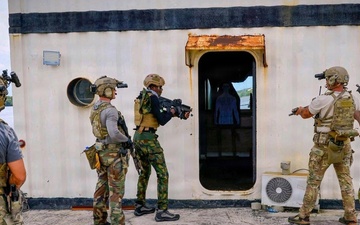
The 19th Special Forces Group (Airborne) and the Royal Moroccan Armed Forces’ Groupement des Forces Spéciales (GFS) completed a Joint Combined Exchange Training on May 16, 2026, near Tifnit and Agadir, strengthening Morocco’s ability to respond to evolving security threats and reinforcing the close defense partnership between the United States and Morocco.