MACDILL AIR FORCE BASE, Fla. – West Point Cadet Parker Brown chose a challenging path this summer, one that put him shoulder to shoulder with special operations engineers building the next generation of unmanned systems at the tip of the spear.
Brown, a rising junior majoring in electrical engineering with a concentration in robotics, spent his summer at U.S. Special Operations Command Central as a research intern with Task Force 179, SOCCENT's innovation task force at MacDill Air Force Base. The assignment, part of an Academic Individual Advanced Development program pairing service academy cadets with operational headquarters, gave Brown hands-on experience developing and flying unmanned aerial systems alongside experienced engineers and commanders.
"The battlefield is constantly changing," said Brown. "If we don't adapt accordingly, we're going to be left behind. As a cadet and future leader of American sons and daughters, it's important to be well versed in that knowledge base. I feel like I owe it to my future soldiers to have the background to be ready to fight."
Task Force 179 was stood up approximately two years ago as part of a command-wide push initiated by then-CENTCOM Commander Gen. Michael "Erik" Kurilla, who directed all components to establish innovation task forces to accelerate technology adoption across the enterprise. Navy Capt. Todd Fruehauf, director of Task Force 179 at SOCCENT, said the force's legacy acquisition processes simply could not keep pace with the speed of modern conflict, a reality SOCCENT Commander Maj. Gen. Jasper Jeffers has consistently emphasized.
"The way that we fought the past 20 years will not be the way that we will fight the next 20 years of conflict," Fruehauf said, echoing Jeffers. "Those legacy acquisition programs typically take five years plus from idea to solution. In our current way of fighting, that cycle of innovation is hours to days rather than weeks or years."
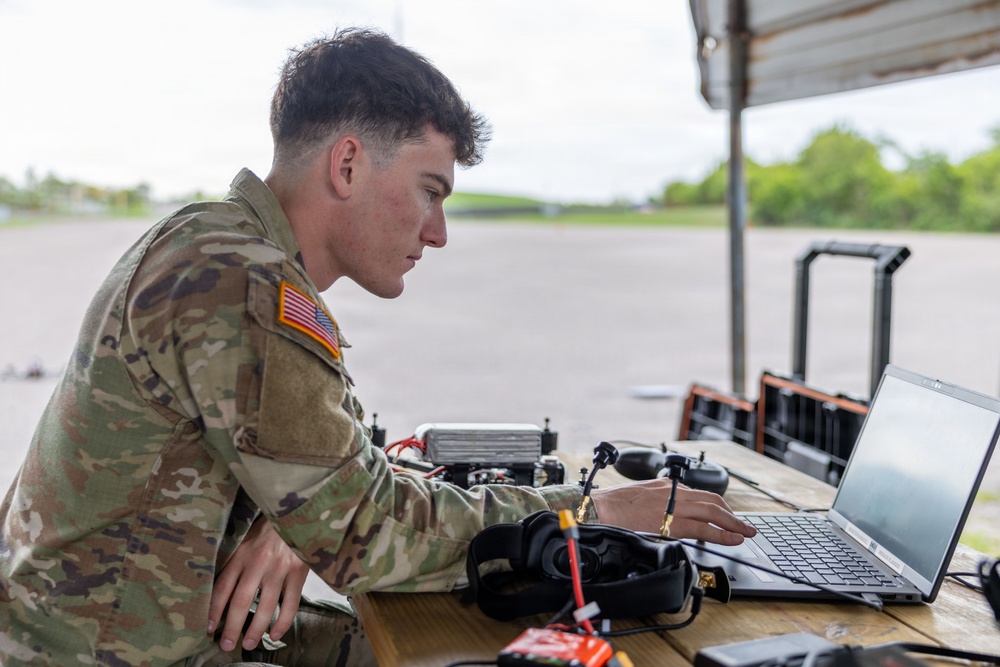
Brown's work centered on two UAS platforms being evaluated by the task force, a multi-rotor system and a fixed-wing variant, both capable of autonomous and manual flight. Working out of the task force's innovation workspace known as Spartan Forge, Brown modified drone configurations, integrated payloads and conducted live range flights to test his builds for intelligence, surveillance and reconnaissance capabilities.
Not every iteration worked, and that was the point.
"He was able to build drones while he was here and then go out to the range and actually fly them in employment to see how they worked," Fruehauf said. "Did it all work? No, it didn't. But at least he went through an iteration cycle. Whenever we fail here, we fail forward as we're doing innovation cycles. That's how we make technology more operationally relevant and more employable by our forces forward."
Brown's foundation in unmanned systems began before arriving at SOCCENT. At West Point's Robotics Research Center, he contributed to the development of courseware for the academy's AI 105 class, where six lessons are dedicated to building and programming drones for incoming freshmen. That background gave him a working technical baseline to build from once he arrived at the forge.
Fruehauf said the value cadets bring goes beyond technical skill. At SOF Week 2026, USSOCOM Commander Adm. Frank M. Bradley told attendees that the next generation of warfighter would be a PhD with a rifle. Fruehauf said Brown's time at SOCCENT was an early example of that vision taking shape.
"It's kind of like teaching your grandpa how to use an iPhone," Fruehauf said. "The younger generation comes with new ideas. They're exposed to more technology early. They grow up with tablets. Now I'm the old guy, and you have these fresh perspectives, very tech-savvy young people coming into our commands, and they have a lot to offer. We do well to listen."
For Brown, the assignment offered something most cadets do not access until well into their careers, an operational view of how the Army fights at the strategic and enterprise level, combined with the technical depth of working alongside engineers solving real-world problems.
"I'm getting more of an operational insight into the Joint Force, how it operates at higher levels," Brown said. "And at a lower level, I'm getting the technical insight working alongside engineers that are really broadening my perspective."
Fruehauf said Brown was the first cadet to take part in the pilot program during his tenure at the task force. The command is now looking to expand it across all service academies, with a long-term vision of tying cadet and midshipmen capstone projects to live operational problems at SOCCENT.
The command is also exploring ways to extend that pipeline into military graduate-level education, where thesis and research work could be tied directly to the same challenges.
Brown plans to carry what he learned back to West Point's Robotics Research Center and keep building on it.
"I'm leaving with a new knowledge base, a new perspective, new resources," said Brown. "I want to keep innovating and solving real world problems, and I feel like I owe it to my future soldiers to be ready."
| Date Taken: |
08.12.2026 |
| Date Posted: |
08.12.2026 05:56 |
| Story ID: |
572181 |
| Location: |
MACDILL AIR FORCE BASE, FLORIDA, US |
| Web Views: |
20 |
| Downloads: |
0 |
PUBLIC DOMAIN

This work, West Point Internship at SOCCENT, by SSgt Cutler Brice, identified by DVIDS, must comply with the restrictions shown on https://www.dvidshub.net/about/copyright.

 Subscribe






