
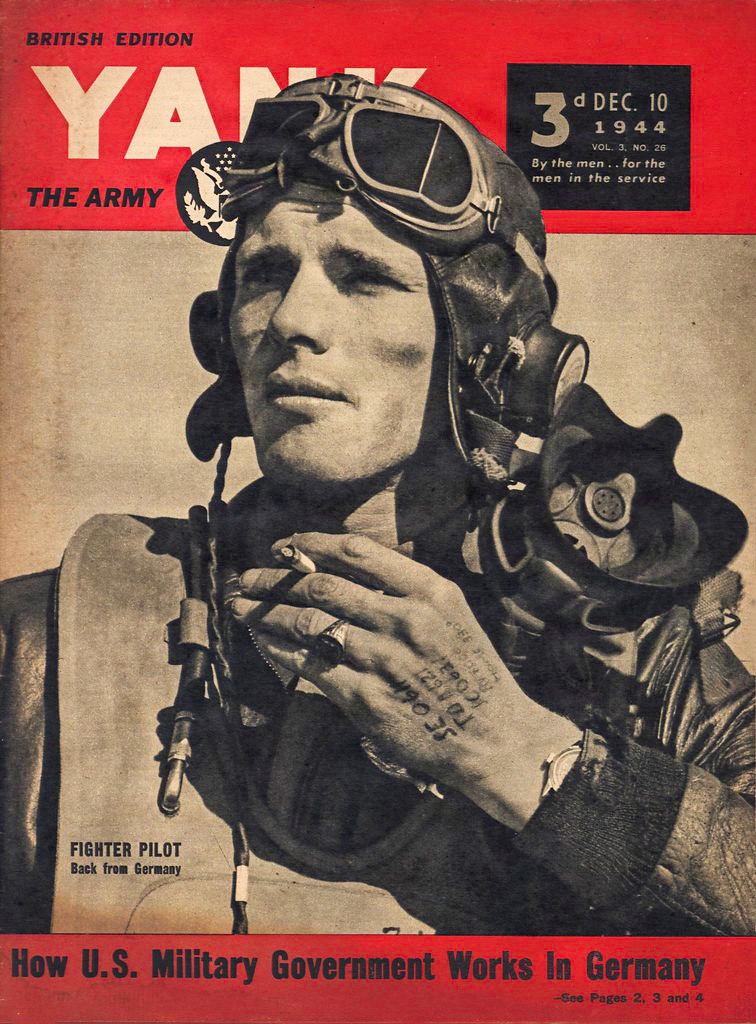
Courtesy Photo | Yank, the Army Weekly cover for December 10, 1944, British Edition. The United States...... read more read more
 Subscribe
Yank, the Army Weekly, was a catalyst for storytelling during World War II and quickly became a sensation after its initial publication, offering enduring insight into the character of the American fighting soldier. The magazine provided a candid, often irreverent perspective from the front lines – detailing harsh conditions, grueling battles, and the frequent mundane annoyances of a service member’s daily life.
“Yank was, in every sense of the work, a medium ‘by and for the enlisted man,’” wrote former Army Col. Franklin Forsberg, Commanding Officer of Yank. “Much of the credit is due to the intrepid, enterprising, courageous, and hard-working G.I. writers, editors, artists, photographers, production, circulation, and administrative staff.”
The first issue of Yank was published on June 17, 1942, and was 24 pages long, costing only a nickel. From 1942 to 1945, it was a global operation, with 21 weekly editions printed in 17 locations. During the war, it distributed over two million copies worldwide and became the most widely read publication in U.S. military history. The final issue was published on December 28, 1945.
Looking back 80 years to the conclusion of World War II, many of the war's stories and accounts are not only found in press reports, newsreels, and the magazine's archives but also in the work of service members who captured imagery with their own cameras. Oregon National Guardsmen stationed around the world would return home with photographs and artifacts, providing a living history and personal insight into the war fought on multiple fronts worldwide.
The creation of Yank Magazine
American journalist Egbert White, who had worked for Stars and Stripes during World War I, proposed the idea of Yank magazine to the Army in 1942, and General Frederick Osborn approved it, with the intent that enlisted men would cover and write the stories.
In May 1942, the magazine opened its headquarters at 205 East 42nd Street in New York. It was assigned under the direction of the Army Information and Education Division of the War Department’s Army Service Forces.
Yank operated its production workflow like a regular newsroom in civilian life, with officers serving only in an administrative capacity. By contrast, Stars and Stripes had an established editorial style for copy and news reporting, all overseen by officers. “Yank doesn’t want the kind of news copy a Stars and Stripes editor demands, and the Stars and Stripes isn’t interested in Yank’s type of lengthy illustrated magazine articles,” said Joe McCarthy, Yank’s managing editor.
To make the point, an editorial in the first issue of Yank stated its purpose for the readers. “Here’s the YANK brother. This is our newspaper, solely and exclusively for us in the ranks and for nobody else. It’s not G.I., except in the sense we are G.I. It’s ours alone…Because it is ours and because we are fighting men, it is here to reflect pride when we are proud, and anger when we are sore. It is OUR record of what we’re doing – in black and white.”
Over time, Yank’s workforce of 127 staff members would include correspondents, writers, photographers, editors, and artists dedicated to telling the stories of ordinary Soldiers during World War II.
How the War Influenced the Changing Media Environment
In many ways, establishing a new approach to journalism and storytelling with Yank mirrored the evolution of communication across various media during the late 1930s and early 1940s. Throughout the Great Depression years between 1933 and 1944, millions of Americans tuned in to radio broadcasts of President Franklin D. Roosevelt’s “Fireside chats,” in which he spoke with apparent familiarity about issues ranging from the New Deal and bank reform to Civilian Conservation Corps projects and America’s involvement in World War II. Through these direct conversations, Americans were part of the conversation about current affairs as the U.S. entered the war.
The Armed Forces Radio Services were established in the early days of World War II to meet the needs of American troops stationed around the world. Recognizing the importance of keeping service members informed and connected, the War Department began short-wave radio broadcasts as early as 1940. By 1941, entertainment programming was introduced to boost morale and provide comfort to those serving far from home. Service members could also receive special records called “Victory Discs” – featuring music, news, comedy, and talk, all recorded specifically for military personnel stationed overseas. The V-Disc program was launched in 1943 and was exclusively for service members, not sold commercially. For the fighting American G.I., every effort was made to fortify the mission.
For Americans at home, newsreel footage shown in cinemas brought fierce battles across six continents directly to civilian and troop-support audiences. Fox Movietone, Universal Newsreel, and British Pathe captured gripping combat scenes and home-front efforts – highlighting rationing and war bond drives. These reels brought the war’s intensity to life, and when paired with patriotic voice-overs, they brought iconic battles such as D-Day, Midway, and the Guadalcanal campaign to life. Despite taking weeks to be approved and released due to military procedures, newsreels steadily evolved into a powerful communication medium, with much of their footage shot by dedicated military photography units.
A distinct voice and a flair for impact
As a magazine, Yank covers were gallant with a poster-like presentation. On most covers, there was a single still, black-and-white image with a bold red banner featuring the YANK typeface in white lettering.
Yank magazine and the legendary The Saturday Evening Post shared editorial connections, evident in their publication styles. Egbert White, one of Yank’s founders, had previously worked at The Post, bringing his magazine experience, and was joined by Robert Martin Fuoss. Yank’s final editor, Scott Corbett, would later contribute to The Post, helping revive the periodical after the war. Combined with the Soldiers' production work, these influences helped give Yank a distinct look and voice. Over time, they have become collectors’ items.
Right away, service members had a connection to the magazine because its writing style was both traditional correspondence reporting and G.I. – conversational in tone and vernacular.
In his article "Nightmare Job in Italy," published on April 30, 1944, Army Sgt. Burtt Evans vividly described what the 36th Infantry Division faced in the early going during the Invasion of Italy.
“Italy wasn’t what the travel posters had cracked it up to be, all blue skies and crowds of pretty girls coming down the streets singing opera. It rained and kept raining until the weather got too cold for rain, and then it snowed. There was mud and slush everywhere, and men went around in the mud up to the tops of their leggings and sometimes up to their belly-buttons.”
Weaving himself into the operation, Evans kept the reader engaged with details he observed, the impact of the Americans’ actions, and his own diligence amid persistent enemy threats.
“I crossed the main highway, nicknamed ‘Hitler Road’ in the briefing, and joined a squad searching one of the large resort-type homes,” Evans reported. “Writing this story, I have dived dozens of times for shelter from the Jerry bombers hitting the beaches, but our air force is also much in evidence. Outside is a sign pointing to Rome.”
The terms “Jerry” and “Jap” were consistently used in Yank storylines as standard references for enemy combatants, with “Jerry” referring to Germans and “Jap” to Japanese. Long before social media postings and blogging became part of our daily interactions with current events, Yank was the authentic voice of Soldiers who were on point – in the thick of the action.
Attribution for individual Soldiers was another style consideration, with hometown recognition and unit assignments interlaced into stories and accounts. It was during a lone armed reconnaissance mission aboard a B-24 Liberator assigned to the 43rd Bomb Group, 403rd Squadron, Fifth Air Force that Army correspondent Sgt. Dave Richardson flew with the crew, colorfully recounting the mission and the men's unforeseen actions over the Japanese-held Solomon Sea, published in the Sept. 24, 1943, edition of Yank.
“As we are sailing over St. George’s Channel near Rabaul, we spot a tiny dot in the water off the cape. Lt. Francis E. Haag, our pilot and former Rutgers University student from Pelham, N.Y., changes course and descends to identify the vessel. It’s a 4,500-ton Jap freighter-transport heading north. Now Lt. William H. Spencer Jr., ex-telephone man from Roanoke, Va., takes over the command of the bomber from his bombardier’s perch. We make a bomb run at medium altitude. Two bright yellow demolition bombs tumble out of the bomb racks. Beside me, S/Sgt. Mike Nesevitch, a former coal operations manager from Olyphant, Penna., keeps his aerial camera clicking. The bombs describe a graceful, lacy curve at the ship below swerves sharply to the right,” Richardson wrote.
The magazine fostered a sense of global affiliation among Soldiers, allowing them to relate to shared experiences regardless of their individual roles – where sales associates now found themselves as aircraft crew chiefs, and carpenters as infantrymen. It helped them connect on “the ache of loneliness, the 'ache of exhaustion, the kinship of misery,” wrote Sgt. Debs Myers, a reputable staff writer at Yank. “Maybe he was white or black or yellow or red, and if he was on the line it didn’t make much difference, because a soldier on the line was so dirty you couldn't tell his color anyway.”
Along with the writing and photography, each copy of Yank featured a comics section that presented the everyday woes soldiers faced, often transformed into military humor, as in the “Sad Sack” Soldier, created by Sgt. George Baker for Yank, depicting many of the absurdities and awkwardness of military life. It debuted as a comic strip in the first issue of Yank in June 1942 and was so successful that it ran as a syndicated feature in newspapers until 1958, long after the war ended.
Drawings and sketches by artists appeared regularly in the magazine. Yank staff often created illustrations for specific stories or battle series, and the magazine also published artwork submitted by soldiers from the field. Many of these images showed intense battles or moments that cameras and words could not fully capture. Almost every issue of Yank included renderings like these.
Amid the stores and artwork, it was the pin-up photographs that sparked a much-anticipated sense of optimism, intended to boost morale among soldiers serving far from home. The Yank Pin-Up Girl featured Hollywood celebrities and famous models, giving a connection to home and the world they left behind. These images would make their way to barracks walls and into G.I. footlockers.
Photographers created images that were both playful and aspiring in style, taking service members back to a summer day at the beach or evoking nostalgia for a time before the war. The women photographed were depicted as “Strong yet approachable, glamorous yet relatable,” as noted in a 1945 Parade Magazine article about this feature in Yank.
Where Yank, the Army Weekly, met the Oregon National Guard
One of the many Yank Pin-Up Girls was Eugenia ‘Jinx’ Falkenburg, featured in the April 27, 1945, issue. Before her appearance in Yank, she had been traveling internationally, visiting military service members in various locations. During her tour supporting the war effort, she spent time with members of the 35th Photographic Reconnaissance Squadron, including Oregon National Guard personnel from the 123rd Observational Squadron.
Jinx’s modeling career took off after she met Paul Hess, a well-known advertising and motion-picture photographer, in 1937, and he photographed her for the cover of The American Magazine in August 1937. This led to other modeling offers and advertising campaigns, during which she graced the covers of over 200 publications in the 1930s and 1940s. Hess said that she was “the most charming, most vital personality I have ever had the pleasure to photograph.”
“The United Services Organization managed to send entertainers out to entertain troops far away from home all across the CBI (China, Burma, and India Theatre), which was the furthest theatre of war from the United States,” said Lt. Col. (ret.) Terrance Popravak, Jr., is the volunteer historian for the 142nd Wing. “It was a torturous route; they would leave from New York to Kunming (China), which is like 10,000 miles. Jinx was traveling with Hollywood actor Pat O’Brien, a troop of USO entertainers in the CBI, covering nearly 42,000 miles – getting out to the CBI and then within the CBI to all the military bases, making an extensive effort.”
That extra effort went well beyond the scheduled 54 shows, Popravak said, and they ended up performing 84 shows, including hospital visits that were not part of the agenda.
“Jinx was perhaps the most recognized female face in the United States, even before the war began, because she was photogenic – dynamic, attractive, athletic, and vivacious,” Popravak said. “She had played tennis both as an amateur and as a professional.”
On October 25, 1944, the USO troop performed at the U.S. Army Air Force Airfield in Yunnanyi, China, where Soldiers could also interact with the entertainers before and after the shows.
"Once you get going out there and see the guys, you want to stop and do a show everywhere, for everybody," Jinx said in an interview published in Yank’s Feb. 16, 1945 edition. “The men were wonderful to talk to and easy to talk to, and we tried to talk to everyone who wanted to talk or take a snapshot or play ping-pong.”
One of “those guys” was Sgt. Hank Larsen from Brookline, Massachusetts, was with the photographic reconnaissance section and had the chance to watch her play an exhibition tennis match against a Chinese girl. “Wow, she was beautiful! The Public Relations people moved her around a lot, but I was able to get a photo of Jinx and I together,” said Larsen. That photo would find its way to Larsen’s hometown newspaper, The Brookline Citizen, making the front page on Jan. 11, 1945.
“So there were about four or five guys who had their own cameras, capturing the experience of Americans sent far away to war in the China, Burma, India Theatre…they recorded the people, village life, and their own photographic tasks,” Popravak said, describing the wartime conditions and the mission of the 35th Photo Reconnaissance Squadron. The 35th flew the Lockheed F-5E photo-reconnaissance airplane, a modification of the P-38 Lightning fighter, in combat aerial reconnaissance operations in the CBI from September 1944 through August 1945.
While many from the Oregon Guard’s 123rd Observational Squadron were assigned to the redesignated 35th Photographic Reconnaissance Squadron, others were reassigned as early as 1942 and made their mark across the Pacific or in the European Theater. By the end of the war, the 123rd earned recognition for seven World War II campaigns.
Elsewhere in the Pacific, the 41st Infantry Division was making inroads in New Guinea when once again, Yank correspondent Sgt. Dave Richardson caught up with the unit. In the April 3, 1943 edition of Yank, he found the Soldiers describing the battle up Sanananda Trail during the rainy season.
“Getting supplies through to the American infantry in these positions was a major problem. Sgt. Owen D. Gasall, a husky supply man from Oregon, met his death this way. He had waded through the water skirting the Jap perimeter with a supply squad and bumped into a Jap machine-gun nest. He was shot through the helmet, but the bullet just grazed his head. He motioned his squad to make a wide detour and go on as he drew fire from the nest by tossing hand grenades at the gun slits,” Richardson noted in his article, "Sunset Division eclipse The Rising Sun."
Sgt. Owen, who was assigned to the 163rd Infantry Regiment under the 41st Infantry Division, was listed as killed in action on Jan. 6, 1943, and received the Silver Star and Purple Heart posthumously. He is buried at the Manila American Cemetery, Manila, Philippines.
Another hero Richardson reported for the story was Cpl. Carlton O. Tidrick of Belton, Montana, had been severely injured. He had been hit three times by machine gun fire and helped another Montana soldier, Pvt. Kenneth E. Paul returned to the unit’s position to receive life-saving medical treatment and report on the squad's contact with the enemy lines. “Concerning the rest of the team, Tidrick said, ‘If the others aren’t hit as badly as I am, they can wait and get back afterwards. If they’re hit worse than I am, they’re dead.’ Then he collapsed. Tidrick’s commander recommended him for the DSC (Distinguished Service Cross) and Silver Star,” Richardson wrote.
Cpl. Tidrick, also with the 163rd, would survive the war and was awarded both recommended honors, and after his passing at age 89 on July 7, 2011, he was buried at Arlington National Cemetery, Virginia.
On the Vanguard of History
“In telling and showcasing the amazing intricacies and Pacific Northwest representations in World War II that we have in our collection, we have such a surface level of information,” said Kathleen Sligar, Museum Director and Curator for the Oregon Military Museum (OMM), located at Camp Withycombe, in Happy Valley, Oregon. “We have excellent records up to mobilization of our service members, but then what’s missing is the stories and experience that we are constantly filling in, even now, after more than 80 years.”
Oregon is not alone in this ongoing quest to tell the stories of WWII and the conflicts that preceded it. Yet with the grand reopening of the OMM, the artifacts and displays help convey a significant chapter of that history. “Oregon had a huge representation (in the war) and a greater level of participation than other states per capita,” Sligar said. “I feel like the 41st is a significant component of World War II because we covered a huge swath in the Pacific Theatre.”
The 41st campaigns stretched across Papua, New Guinea, the Southern Philippines, and other island battlegrounds, where the “Jungleers” confronted the unforgiving conditions of the Southwest Pacific. Originally known as the Sunset Division, the 41st earned the nickname “Jungleers” for its relentless combat in the tangled jungles of WWII.
The 41st Infantry Division was also the first American Army Division sent overseas in World War II and served longer than any other. When the new Armed Forces Reserve Center at Camp Withycombe, adjacent to the Museum, opened in September 2011, it now houses the most extensive collection of 41st Infantry Division artifacts and displays.
“The Adjutant General at that time, Maj. Gen. Raymond F. Rees wanted not only to preserve the items and lineage of the 41st but also to tell their distinguished story to currently serving soldiers,” said Lt. Col. Stephen Bomar, Public Affairs Director for the Oregon Military Department. “Tracy Thoennes, who was the director of the Oregon Military Museum then, facilitated the displays and artifacts that are placed throughout the building. Each classroom is named after a significant battle, with a detailed display in each of those rooms.”
Yet in many ways, the intricate stories of Soldiers who served in World War II came home in personal photographs, journals, and souvenirs, or were sent home in postcards and letters. The OMM is continually adding to its collections from these sources as well.
“As we have been rotating out artifacts and images in the broad display at the museum, ‘We Our Oregon,’ this exhibit connects people and stories to these images and items,” said Katrina O’Brien, Director of Programs and Services for the Oregon Military Museum. “So two years from now, new stories will be added to the display as we go through photos, private donations, people’s papers, and new records that come to light. That’s where we got a lot of the current display, not from administrative records, because once they are federalized, we don’t get those records.”
This is where the collection of photographs and letters, like those from Oregon National Guard Sgt. Fredrick Hill of La Grande and Staff Sgt. Ray Wolford of Roseburg became an indispensable asset, preserving important images as historical records during WWII.
“We look at the unit’s official history for that time, which is more of a summary because it didn’t start for a couple of years. So it was up to those still in the unit to remember what they had done, and where they had gone,” Popravak said, while going over his detailed files, articles, and imagery at the 142nd Wing’s history office. “But we have photos, we have some information that tells us the story about the unit and how the war developed.”
In between missions, the photographers, photo lab technicians, and other camera enthusiasts of the unit produced images around the communities they worked in and details of everyday Soldier activities, from card games to print and darkroom procedures to aircraft maintenance.
Around 2008, a collection of photographs from the estate of Staff Sgt. Roy Wolford was donated to the 142nd Public Affairs office by his family during his time with the 35th PRS. The collection included original prints, some larger negatives, and in some cases – penciled notes written on the backs of prints. Over the years, many have been scanned, and Popravak has written new accounts of the unit while publishing some of these treasured pieces of history.
“They are captivating because they are so well preserved and give viewers a first-hand look at the everyday life of our (Oregon National Guard) service members and their contributions to the war,” Popravak said, but noted that having the proper film size and format was also an issue. “Because many of the men had their own cameras, they often relied on family members back home to send them film that would work with the commercial cameras they brought to war.”
From October 1943 to October 1945, Sgt. Hill served as the Photo Lab Chief for the 17th Photographic Reconnaissance Squadron, part of the 5th Air Force. The squadron was responsible for delivering vital photographic imagery of ongoing combat operations in the Southwest Pacific.
Due to the scarcity of extra film, Hill and his fellow soldiers devised a method to salvage leftover reconnaissance film, cutting it and repurposing it in film magazines for handheld cameras.
In his book, “Darkroom Soldier: Photographs and Letters from the South Pacific Theater, World War II,” Hill described how the photographic team repurposed the discarded film at the end of a spool. These pieces, too short for a whole mission, allowed them to document various aspects of war as they moved from location to location over the next two years.
Hill took hundreds of photographs during his two years overseas, and his lens captured everything from battle-worn aircraft and tattered ships to the faces and stories of his fellow service members, expansive landscapes, native communities, and animals in their natural environments.
On Jan. 14, 1945, Hill began a two-part letter home. “Hello, my Precious, I have been playing chess much of late. We have a heavy board and some of those neat molded plastic chessmen pieces on a conventional pattern,” he wrote, describing his leisure time. In the following paragraph, he jumped ahead to the mission. “I had to help Bernardo get the cameras ready for tomorrow’s mission, and when I got back, the lights were out. Oh well, I was nearly through writing anyway.”
These images, paired with personal letters sent home to his wife Martha, became the essence of his book, which was eventually published in 2009. Together, they offer an intimate portrait of a soldier’s experience far from home and add another layer to the history of the 123rd Observation Squadron.
“Soldiers like Fred Hill and Roy Wolford did a lot of work to capture so many aspects of their duty locations, while still doing their mission work that turned aerial imagery into topographical maps,” Popravak said. “It’s important to remember how well they performed their duty and how important the daily work was to the war effort.”
A reporter’s retrospect
During World War II, soldiers who carried a camera or a reporter's notepad created work in combat, camp life, or downtime that helped fill in the collective story of American service members during the world’s most significant conflict.
Many Yank staff correspondents who were on assignments during World War II were wounded or killed in action, including Cpl. Robert ‘Bob’ E. Krell, along with three other soldiers from the 17th Airborne Division, was killed in action after coming under small arms fire near Wesel, Germany, on March 24, 1945. He had filed his final story about the base camp in France just hours before departing to cover the “Talon Division’s” jump across the Rhine River. He was buried at Mount Carmel Cemetery, Glendale, New York, and was awarded the Purple Heart Medal posthumously.
On assignment in the Marshall Islands, Yank correspondent Sgt. Merle Miller and photographer Staff Sgt. John A. Bushemi, both of whom had opened Yank’s Pacific Bureau, came under mortar fire on Feb. 19, 1944, at Eniwetok Atoll. After the shelling stopped, Miller found that Bushemi had been hit with shrapnel and had already lost a lot of blood. “Johnny was conscious, joking with all of us until after he reached the transport [to the USS Neville]. He died less than three hours after he was wounded while Navy surgeons were tying the arteries in his neck. His last words were: ‘Be sure to get these pictures back to the office,’” Miller wrote of his comrades passing. He was the second of four Yank staff photographers killed during the war. He was awarded the Bronze Star Medal and the Purple Heart for his actions during the war and is buried at Mount Mercy Cemetery in Gary, Indiana.
Fred Hill, along with Fred Parish, was the last surviving service members of the original Oregon Air National Guard to attend the 75th Anniversary celebration of the 123rd Observations Squadron's formation, held at the Portland Air National Guard Base on April 18, 2016. Fredrick H. Hill passed away on July 24, 2016, at the age of 96, three months after the 75th historic milestone ceremony. He had donated more than 20,000 negatives of photographs to the Eastern Oregon University library in La Grande six years before his passing. The collection included approximately 1,000 World War II images.
The images provided to the Oregon Air National Guard’s 142nd [Fighter] Wing Public Affairs Department in 2008 from the Estate of Roy H. Wolford have become one of the best-preserved photographic archives from the early training periods of the 123rd Observation Squadron and the redesignated 35th Photo Reconnaissance Squadron, as many members were to serve in the China-Burma-India Theatre of Operations during World War II.
Today, one can travel over the Cascade Mountains from Portland to Seaside, Oregon, on the Sunset Highway, named in honor of the 41st Infantry Division and serving as a reminder of the division’s campaigns, not only for its service in the South Pacific during World War II but also for its mobilization with the American Expeditionary Force in France during World War I under the command of General John J. "Black Jack" Pershing.
With the final issue of Yank published on Dec. 28, as the final hours of 1945 wound to a close, Joe McCarthey, who had been with Yank from the beginning, would be the last person on staff as the magazine’s office officially closed on New Year’s Eve. And with the stroke of midnight, an extraordinary era of military storytelling came to a close.
-------------------------------------------------------------------------------------------------
Of Note: This Story is the third and final part of series of articles, commemorating the 80th Anniversary of the end of World War II: 1945-2025.
Key resources:
** A special thanks to* USAF (ret.) Lt. Col. Terrance G. Popravak, Jr., Historian with the 142nd Wing of the Oregon Air National Guard. As a volunteer historian, he has spent years researching, writing, and interviewing veterans, leaving an indelible legacy of resources for future generations.
| Date Taken: | 12.31.2025 |
| Date Posted: | 12.31.2025 18:59 |
| Story ID: | 555466 |
| Location: | SALEM, OREGON, US |
| Web Views: | 584 |
| Downloads: | 2 |

This work, “Yank, the Army Weekly” — Forging the Soldier's Perspective in World War II, by John Hughel, identified by DVIDS, must comply with the restrictions shown on https://www.dvidshub.net/about/copyright.


No keywords found.




