
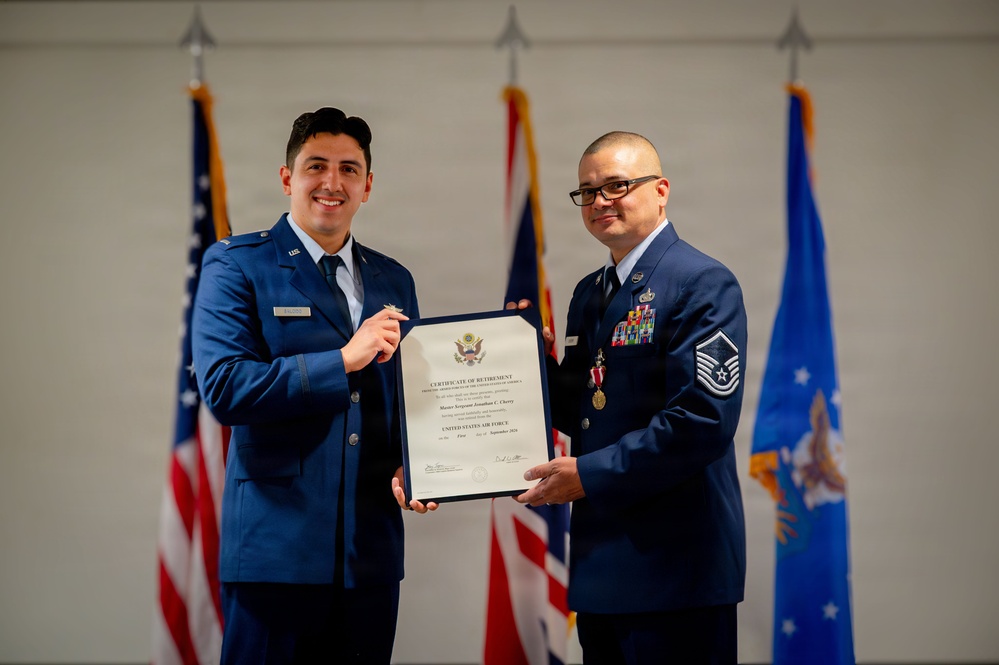
Photo By Airman 1st Class Chloe Masey | U.S. Air Force Master Sgt. Jonathan Cherry, 100th Logistics Readiness Squadron fuels...... read more read more
 Subscribe
“On behalf of the president of the United States and a grateful nation, please accept this flag,” the young honor guardsman said, as he carefully placed the heavy wool triangle into Master Sgt. Jonathan Cherry’s hands.
He accepted the flag with the same military discipline carried throughout his 23-year Air Force career. His family sat in the front row, tears filling their eyes. To those watching, the folded blue field and white stars represented the conclusion of his journey and a symbol of dedication, sacrifice and honorable service.
However, to Jonathan, the flag represented something much deeper. As he gripped the coarse fabric, he relived the moment when the very same aged and weathered flag was presented to his mother on the day of his father's funeral.
For the Cherry family, military service was never simply a career choice. It was a tradition passed down through generations, built on sacrifice, commitment and a shared desire to serve something greater than themselves.
Jonathan was one of four siblings who raised their right hand and volunteered to serve their country, following the example set by their late father, who served 20 years in the Air Force as a cryptologic specialist.
“Losing him reminded me that tomorrow is never promised,” Jonathan said. “His service and sacrifice inspired me long before I ever wore this uniform.”
For the first time in nearly a decade, the four siblings stood together in uniform. They hadn't gathered for a holiday or a family milestone, but for a final, shared duty: to honor Jonathan’s retirement.
For the occasion, the siblings, all veterans and all but one retired, pulled their uniforms from the closet one more time. Standing shoulder to shoulder, they paid tribute to their brother and the family tradition that connected them for decades.
“Our pride in serving runs in our blood,” retired Chief Master Sgt. Michael Cherry said. “We’ve served for five generations. We’ve had Cherrys serve in almost every single branch of the military, and I’m confident that will never change in the decades to come.”
During the COVID-19 pandemic, Jonathan was responsible for finding a way to protect his Airmen while ensuring the mission continued.
“Nobody had all the answers, so we had to adapt on the fly,” Jonathan said. “We split our 120-person shop into separate quarantine groups to keep people from interacting while ensuring the mission could continue. It taught me that leadership isn’t about solving every problem by yourself. You rely on the people around you, work together and find the best path forward.”
His leadership was tested again during the Operation Allies Refuge. As thousands of refugees arrived at Ramstein Air Base, he was responsible for managing fuel operations while supporting a rapidly changing humanitarian mission.
“During the Afghan drawdown, the refugee beddown area was set up right next to our work center,” Jonathan said. “We had people coming off the aircraft with gunshot wounds. At one point, someone was found carrying a grenade, and then there was an outbreak of some kind of illness. Every day seemed to bring a new challenge.”
For him, the mission extended beyond moving fuel. He had to balance protecting his Airmen with maintaining the operations that kept aircraft moving around the clock. Every decision carried consequences, requiring him to adapt quickly while leading his team through uncertainty.
Just months after arriving in Türkiye for a remote assignment, he faced another challenge unlike anything he had experienced before. Following devastating earthquakes that destroyed communities and claimed thousands of lives, he was selected to help coordinate the Air Force’s humanitarian response through the Wing Operations Center.
Although Jonathan’s career was rooted in fuel management, his leadership saw something beyond his technical expertise; they saw his ability to organize, communicate and bring people together. The role required him to coordinate information across multiple logistics functions and brief senior leaders throughout the response.
“Briefing one- and two-star generals every day was nerve-wracking,” he said. “But when you’re in that position, you realize it’s not about knowing every answer yourself. It’s about knowing your team, relying on the experts around you and making sure the right information gets where it needs to go. At the end of the day, we were able to help a lot of people.”
During his final years of service, he had to fight a new battle in which he would have no expertise.
In April 2024, while still on active duty after more than two decades in the fuels career field, Cherry was diagnosed with high-grade non-muscle invasive bladder cancer.
“In that moment, nothing else mattered,” Jonathan said. “Not my rank or my retirement. The only things that mattered were my family and hoping for more tomorrows.”
The diagnosis forced him to face uncertainty in a different way, not as a leader responsible for protecting a mission or his Airmen, but as an individual fighting for his own future.
When Jonathan talks about his career, he often refers to his “Ls and Ws.” To some, the phrase might sound like a reflection of wins and losses or a scoreboard of accomplishments and challenges. But after 23 years of service, his definition is different. They marked the moments that shaped him, the challenges that tested him and the experiences that changed the way he led. At the time, each one represented another chapter in a career defined by uncertainty, growth and service.
The “Ls” were never losses. They were lessons. The “Ws” were never just wins. They were the wisdom gained from those lessons.
Every challenge shaped the leader he became, and every success was built on the people who stood beside him. As Jonathan accepted the same flag that once honored his father, he realized his greatest accomplishment was not a medal, promotion or assignment; it was carrying forward a legacy of service and leaving behind lessons for the next generation.
“When I first joined, I thought success meant making the next stripe, then becoming an noncommissioned officer, then a senior NCO,” Cherry said. “After 23 years, I realized I was wrong. The greatest achievement of my career wasn’t a rank, a medal, or surviving another inspection. It was the people. Those who mentored, challenged, and trusted me, and the Airmen I had the privilege to lead. Because one day the rank comes off, the office belongs to someone else, and the medals end up in a shadow box. But the way you treat people is what they remember. That is your legacy.”
The legacy was never about one person’s service. His retirement was no longer just a symbol of an ending, but a physical bridge connecting 165 years of shared sacrifice. The uniform would go back into the closet, and the daily missions would cease, but the legacy remained untouched.
For the Cherry family, the watch was not ending; it was simply being passed to the next generation, bound by a quiet promise to always answer the call.
As Jonathan closed out his Air Force career, he carried more than a retirement flag. He carried the memories of every Airman he led, every mission he supported and every family member who came before him. For 165 years, the Cherry family has answered the nation’s call.
The uniform may change, but the promise to serve never will.
| Date Taken: | 07.29.2026 |
| Date Posted: | 07.30.2026 06:02 |
| Story ID: | 571074 |
| Location: | SUFFOLK, GB |
| Web Views: | 22 |
| Downloads: | 2 |

This work, The Cherry family: 165 years of military legacy continues, by A1C Chloe Masey, identified by DVIDS, must comply with the restrictions shown on https://www.dvidshub.net/about/copyright.


No keywords found.




