
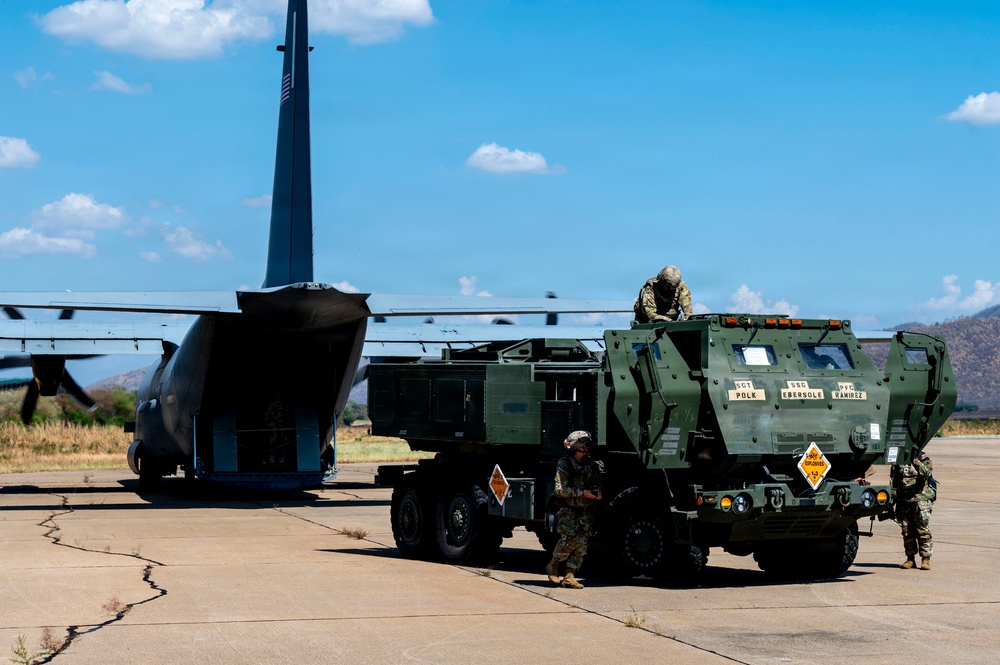
Photo By Tech. Sgt. Giovanni Sims | U.S. Soldiers assigned to the Bravo Battery, 1st Battalion, 94th Field Artillery...... read more read more
 Subscribe
LOP BURI, Thailand — U.S. Army Soldiers executed a High Mobility Artillery Rocket System Rapid Infiltration training mission, demonstrating the joint force’s ability to rapidly deploy long-range precision fire into austere and contested environments during Exercise Cobra Gold 2026, March 1.
The HIRAIN enables the High Mobility Artillery Rocket System to be transported by aircraft such as the C-130 or C-17 from a staging base to a forward location, where it can rapidly establish a firing position, deliver precision effects, and redeploy in a compressed timeline.
The concept reduces reliance on traditional ground convoys and expands operational reach across complex terrain.
“It allows us to move forward of the front line and extend our reach,” said U.S. Army Staff Sgt. Tino Saucedo, 1st Battalion, 94th Field Artillery Regiment, 17th Field Artillery Brigade launcher chief. “If we need to reach deeper targets or extend our presence as a show of force, HIRAIN lets us do that quickly.”
During the mission, Soldiers coordinated closely with U.S. Air Force aircrews to prepare the launcher for airlift. The HIMARS system is required to kneel by lowering its suspension to meet aircraft clearance requirements, before being backed onto the aircraft. Upon landing, the launcher is offloaded, repositioned, and prepared to execute its mission before being rapidly reloaded and extracted.
“We coordinate with the Air Force, kneel the launcher, load the HIMARS onto the aircraft, fly to the objective location, un-kneel, receive the mission, and prepare to launch,” Saucedo explained. “Then we re-kneel, load back onto the aircraft, and depart. It’s a very fast process.”
The speed of execution enhances survivability and responsiveness. According to Saucedo, crews can receive the mission and be loaded on an aircraft in less than a day, often completing loading procedures in significantly less time than planned.
“HIMARS is one of the faster artillery systems with a significant amount of force behind it,” Saucedo said. “We’re able to put strong rockets downrange quickly and relocate before the enemy can react.”
While tactical execution is critical, leaders emphasized the broader operational and strategic implications of HIRAIN in the Indo-Pacific region.
“The Indo-Pacific area of responsibility is made up of an archipelagic environment,” said U.S. Army Lt. Col. Travis Hertlein, 1st Battalion, 94th Field Artillery Regiment commander. “We’re often operating in small packages from islands with austere airports and limited life support.HIRAIN allows us to train to get into these locations and provide extended reach with 24/7 precision fire capability.”
The capability directly supports distributed operations and concepts such as agile combat employment. By integrating airlift and ground fires, HIRAIN provides flexibility that complicates adversary decision-making.
“It builds flexibility across multiple services and allows us to utilize each other’s assets to increase lethality and readiness,” Hertlein said. “It gives the enemy an additional dilemma to consider and allows us to be far more responsive than if we were limited to one traditional mode of movement.”
From the airlift perspective, executing a HIRAIN mission requires deliberate planning and coordination.
“Range, flexibility and mobility are the core advantages of HIRAIN,” said U.S. Air Force Maj. Blake Stokes, 317th Operation Support Squadron tactics chief and U.S. Air Force C-130J Super Hercules weapons officer. “We leverage the aircraft’s range to deliver HIMARS to locations that may be inaccessible via ground lines of communication, creating a new axis for precision joint fires.”
However, moving heavy tactical vehicles by air is not without challenges.
“Anytime you put a heavy tactical vehicle on an aircraft, it requires coordinated mission planning,” Stokes said. “Factors like takeoff and landing data, runway length, and weather all impact whether we can conduct the mission safely.”
Despite logistical complexities, the joint integration remains the defining strength of the capability.
“As a mobility aircraft, we’re useless without our user,” Stokes said. “Practicing these skills with our joint partners is critical if this capability is needed in a contingency or crisis.”
Beyond the technical execution, Cobra Gold provided an opportunity to strengthen multinational partnerships.
“The Thai Army has been extremely welcoming,” Saucedo said. “Working alongside our Thai counterparts and other branches continues to show how well we operate together to accomplish the mission.”
For Hertlein, the training also represents professional development for junior service members.
“This is an outstanding opportunity for Soldiers to work in a joint and multinational environment,” he said. “They gain confidence in their skills while building relationships with the services they’ll work with throughout their careers.”
As Cobra Gold continues, HIRAIN operations underscore the joint force’s commitment to maintaining credible, rapidly deployable precision fire capabilities across the Indo-Pacific region. Through continued integration of air mobility and artillery forces, U.S. and partner nations remain postured to deliver combat power quickly, flexibly, and decisively when called upon.
| Date Taken: | 02.28.2026 |
| Date Posted: | 03.02.2026 23:27 |
| Story ID: | 559244 |
| Location: | LOP BURI, TH |
| Web Views: | 451 |
| Downloads: | 0 |

This work, Allied Forces integrate rapid HIMARS capability during Cobra Gold 2026, by TSgt Giovanni Sims, identified by DVIDS, must comply with the restrictions shown on https://www.dvidshub.net/about/copyright.


No keywords found.




