
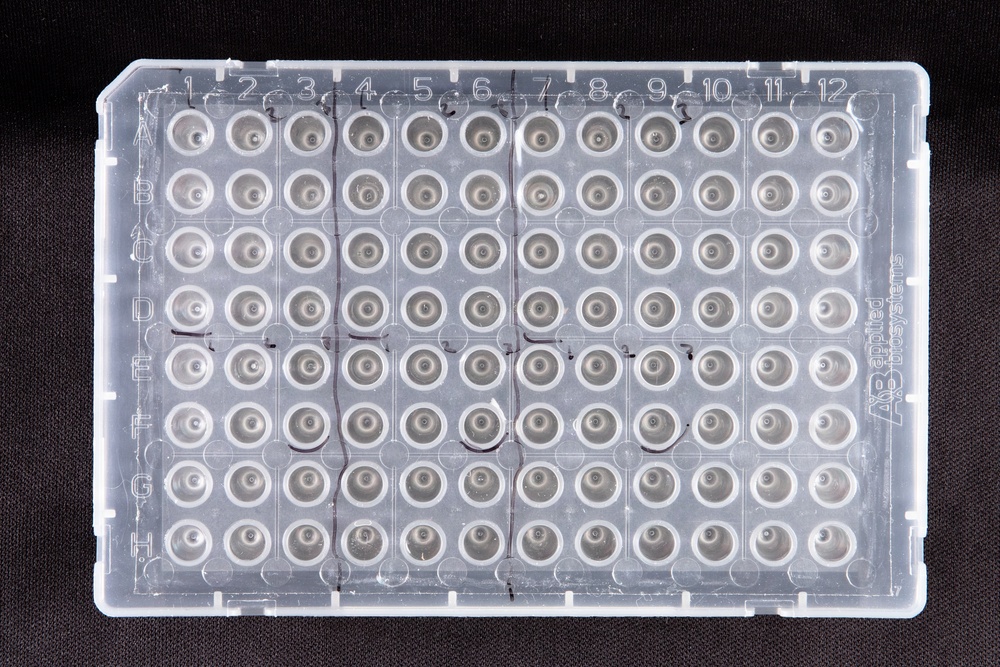
A microplate used at the 1st Naval Medical Laboratory in Liberia for an enzyme-linked immunosorbent assay (ELISA) test to detect the Ebola virus during the 2014-2016 outbreak. [NMHM 2015.0018.5] (National Museum of Health and Medicine Photo by Kevin Sommer Giron)
Extended caption: A micropipette was used to place small blood samples into each well, where antibodies would bind and cause a color change if the sample was positive for the Ebola virus. This method allowed for rapid testing of a large number of samples. This artifact was used during Operation United Assistance by U.S. Department of Defense medical support to assist the Liberian government in containing the epidemic during the 2014-2016 Ebola outbreak. Six medical laboratories, staffed with Army and Navy laboratory technicians, analyzed more than 4,500 blood samples in a four-month period, reducing the time to provide a diagnosis from seven days to about four hours, ensuring only patients with Ebola were placed in the Ebola Treatment Units.
| Date Taken: | 10.01.2025 |
| Date Posted: | 11.26.2025 13:27 |
| Photo ID: | 9411605 |
| VIRIN: | 251001-D-FY143-1013 |
| Resolution: | 3967x2645 |
| Size: | 3.78 MB |
| Location: | SILVER SPRING, MARYLAND, US |
| Web Views: | 18 |
| Downloads: | 2 |

This work, Ebola Response Equipment [Image 9 of 9], by Kevin Sommer Giron, identified by DVIDS, must comply with the restrictions shown on https://www.dvidshub.net/about/copyright.


No keywords found.





