
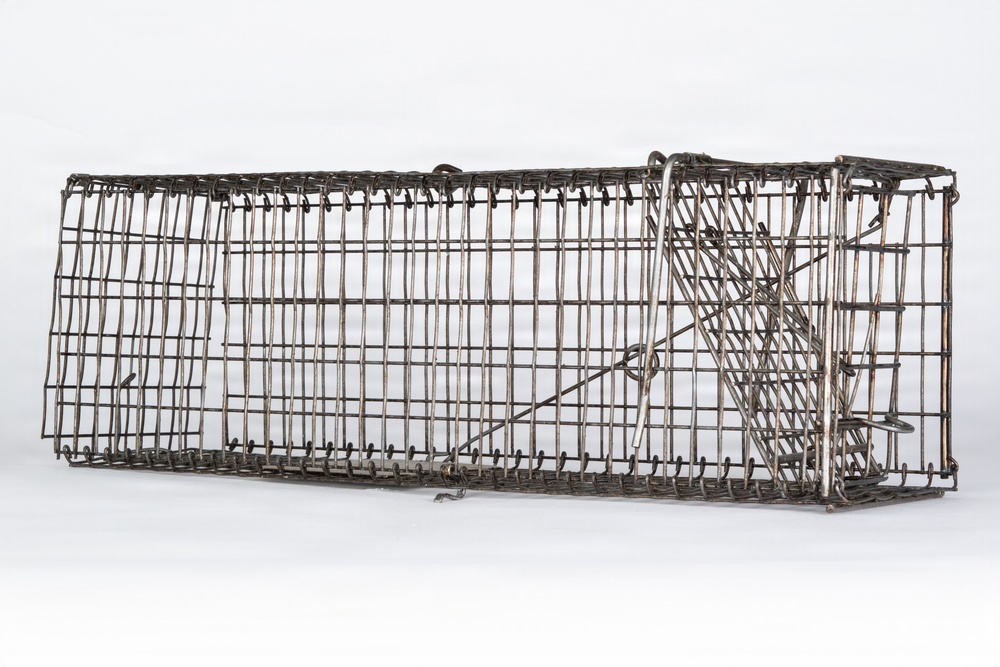
A metal wire live trap manufactured by the Tomahawk Live Trap Company. In 1995, it was used by an epidemiological team from the Centers for Disease Control to capture small mammals to identify a possible vector for the Ebola virus in Kikwit, Zaire (now Democratic Republic of Congo). This artifact is in the Historical Collections of the National Museum of Health and Medicine in Silver Spring, Maryland. [M-762.10249] (National Museum of Health and Medicine Photo by Kevin Sommer Giron)
Extended caption: Very little was known about the transmission of Ebola when an outbreak occurred in Kikwit, Zaire (now Democratic Republic of Congo), in 1995. It was the largest outbreak of the disease since it was first identified in 1976, giving scientists an opportunity to study how Ebola virus spread through the population. The Centers for Disease Control set up an epidemiological team to identify where the virus resided in nature to determine how it spread into the human population.
| Date Taken: | 10.01.2025 |
| Date Posted: | 11.26.2025 13:27 |
| Photo ID: | 9411602 |
| VIRIN: | 251001-D-FY143-1001 |
| Resolution: | 4690x3127 |
| Size: | 2.89 MB |
| Location: | SILVER SPRING, MARYLAND, US |
| Web Views: | 28 |
| Downloads: | 1 |

This work, Ebola Response Equipment [Image 9 of 9], by Kevin Sommer Giron, identified by DVIDS, must comply with the restrictions shown on https://www.dvidshub.net/about/copyright.


No keywords found.





