
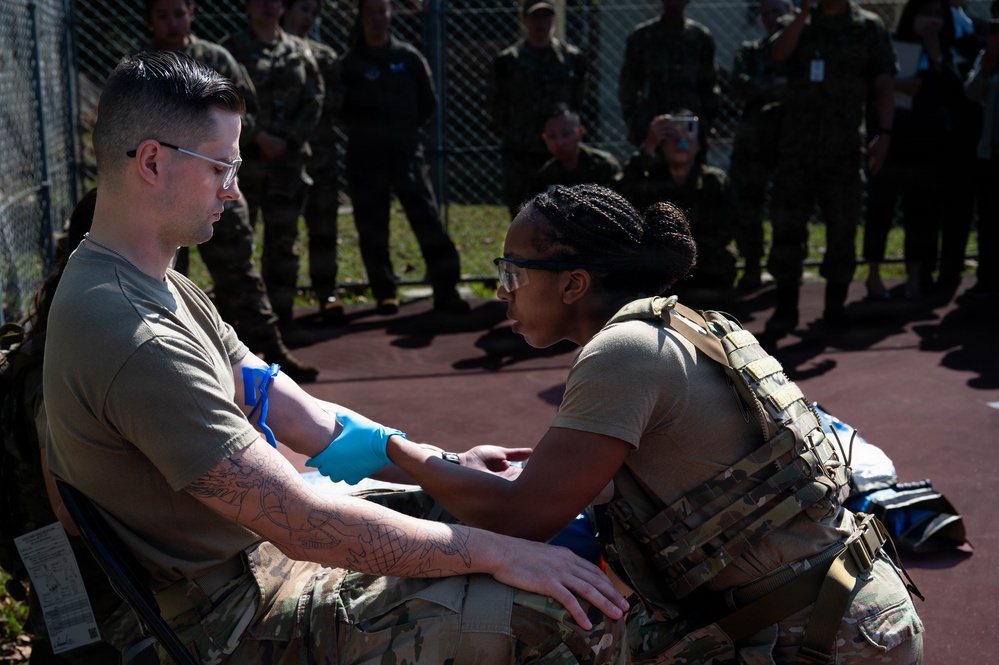
Photo By Senior Airman Jamal Berry II | U.S. Air Force 1st Lt. Darreauna Morris, right, a clinical nurse assigned to the 18th...... read more read more
 Subscribe
KADENA AIR BASE, Japan -- When an injured service member reaches the intensive care unit, there is no room for uncertainty.
Every decision made in the ambulance, every intervention in transit and every handoff between providers must align. In high-risk environments, confusion costs time and time can cost lives.
Closing those gaps was the purpose of the annual Nurse Symposium, hosted at Camp Foster, Japan, Feb. 19, 2026. The event brought together more than 100 medical professionals from three U.S. military branches and Japanese partner organizations to strengthen coordination across the full spectrum of care.
From emergency medical technicians to critical care nurses, participants represented each link in the medical chain — roles that often operate separately in daily routines but must function seamlessly during crisis response.
“I look forward to hearing from the 18th Aeromedical Evacuation Squadron,” said U.S. Air Force Senior Airman Blake Gray, 18th Healthcare Operations Squadron paramedic. “I don’t really know what they do, and I’d like to work with them one day. This is a chance to understand how we connect.”
Understanding that connection was central to the day’s events.
Joint Enroute Critical Care Nurses from Branch Medical Clinic Evans demonstrated a battery-powered mobile ventilator used during ambulance transport. Inside a tent configured to replicate the confined space of an emergency vehicle, they simulated stabilizing a patient with shrapnel wounds while preparing for transfer to a higher level of care.
Across the venue, medical technicians from the 18th Aeromedical Evacuation Squadron displayed aircraft transport equipment and explained the coordination required to safely move patients by air.
Airmen from the 353rd Special Operations Wing led instruction on Tier 4 Tactical Combat Casualty Care, allowing participants to wear operational gear to better understand the challenges providers face when treating wounded personnel in combat conditions.
“For a patient to receive proper care, everyone needs to understand what the next level of care can provide,” said U.S. Navy Lt. Ann Marie Vasquez, a joint enroute critical care nurse assigned to Branch Medical Clinic Evans. “You can’t transport a patient to a facility that isn’t prepared for them, and you can’t prepare if you don’t understand what’s coming.”
One of the most impactful demonstrations highlighted the Valkyrie Program; a contingency whole blood transfusion capability designed for austere or resource-limited environments.
During a live simulation, clinical nurses from the 18th Healthcare Operations Squadron performed the procedure in front of attendees, modeling a scenario in which traditional blood reserves were unavailable. The program enables providers to collect and transfuse whole blood in emergencies when conventional supplies are depleted.
“The Valkyrie Program is a backup plan for the backup plan,” said U.S. Air Force Capt. Brittany King, medical director for the program. “If we exhaust every standard resource, we still need a way to sustain life. That’s what this prepares us for.”
Additional briefings covered advancements in neonatal transport and psychological first aid, underscoring the breadth of medical readiness required in the Indo-Pacific theater. Leaders emphasized that rapid respiratory support and coordinated transport options are critical when caring for premature or critically ill infants during contingency operations.
By the conclusion of the symposium, what began as separate briefings and demonstrations had become something larger — a clearer, shared understanding of the medical continuum.
From the point of injury to definitive care, each role depends on the next.
As U.S. forces continue operating across the Indo-Pacific alongside allied partners, medical interoperability remains a cornerstone of mission success. Events like the Nurse Symposium ensure that when the call comes — whether in peacetime response or high-end conflict — providers operate not as separate units, but as one unified, lifesaving force.
Because in the moments that matter most, a cohesive team is the difference between survival and uncertainty.
| Date Taken: | 02.20.2026 |
| Date Posted: | 03.05.2026 01:07 |
| Story ID: | 559248 |
| Location: | CAMP FOSTER, OKINAWA, JP |
| Web Views: | 55 |
| Downloads: | 0 |

This work, U.S., Japanese providers align capabilities at Camp Foster Nurse Symposium, by SrA Jamal Berry II, identified by DVIDS, must comply with the restrictions shown on https://www.dvidshub.net/about/copyright.


No keywords found.




