
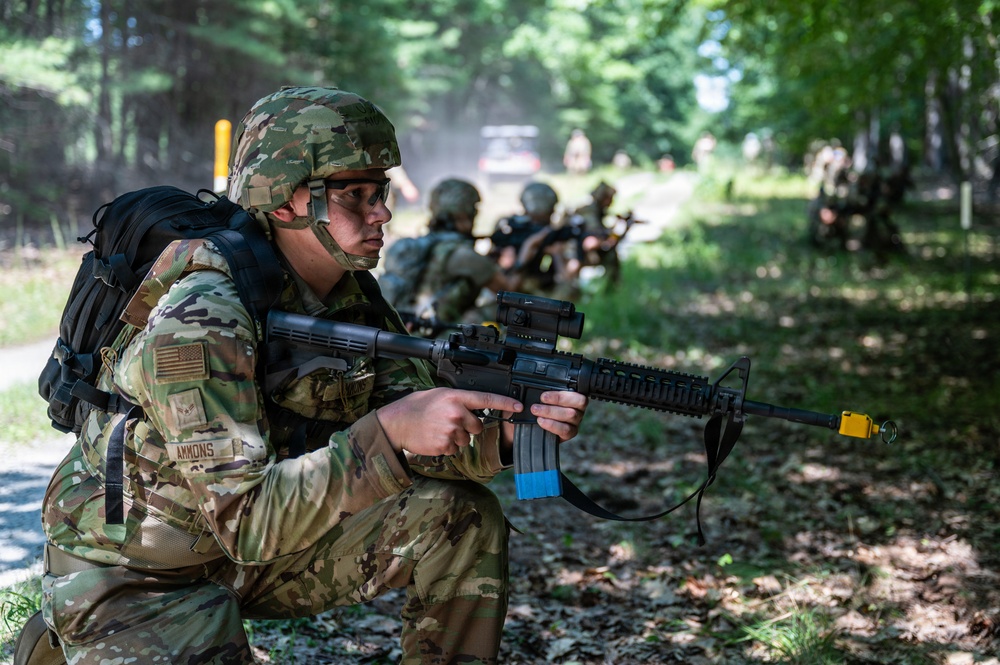
Photo By Senior Airman Gadiel Concepcion Adorno | U.S. Air National Guard civil engineers establish a defensive perimeter as part of...... read more read more
 Subscribe
Across the wooded training areas of Fort Devens, Air National Guard civil engineers spent the week doing more than building, repairing and maintaining infrastructure.
They moved through dense terrain carrying weapons and combat equipment. They navigated without relying on GPS. They operated tactical vehicle convoys, treated simulated casualties under fire and defended an air base against an opposing force.
For the nearly 200 Airmen participating in Patriot Forge II, each task supported a larger objective: preparing civil engineers to survive, adapt and continue enabling airpower in a contested environment.
Patriot Forge II, held Aug. 10-15, brought together Prime Base Engineer Emergency Force, or Prime BEEF, Airmen from the 101st, 102nd, 103rd and 157th Civil Engineer Squadrons, along with supporting personnel from their respective wings. Airmen from Maine, New Hampshire, Massachusetts and Connecticut trained side by side during the Region 1 field training exercise.
The six-day event was designed to establish a common baseline of expeditionary combat capability across the region and prepare civil engineers to support Agile Combat Employment and distributed airpower.
“Patriot Forge II is all about readiness,” said Lt. Col. Brett Bailey, commander of the 157th Civil Engineer Squadron and overall commander for the exercise. “That’s the biggest thing. We’re accomplishing our readiness requirements here.”
Civil engineer squadrons contain a wide range of specialties, including electricians, firefighters, plumbers, heavy equipment operators, emergency managers and water and fuels systems specialists. Their technical capabilities enable Air Force missions to operate from both established bases and austere locations.
Patriot Forge II focused on what Airmen may have to do before, during and after performing those technical jobs. The capabilities learned here are increasingly important as the Air Force prepares for operations from dispersed locations against sophisticated adversaries. Under Agile Combat Employment, forces may be required to operate with smaller teams, fewer resources and less predictable support than at a traditional installation.
Patriot Forge II used four daylong training modules: mounted operations, dismounted operations, land navigation and integrated base defense, to develop the combat skills that enable Airmen to get to the mission, protect the mission and continue the mission.
During mounted operations, Airmen learned the fundamentals of tactical vehicle operations before progressing into convoy scenarios. Students rotated through vehicle positions, including driver, radio operator and turret positions, requiring them to communicate and function as a crew while moving through unfamiliar terrain.
The training provided experience that many Airmen do not routinely receive during home-station drill weekends and reinforced that deployed teams may be assembled from multiple units.
“Patriot Forge II pooled personnel, vehicles, instructors and logistical support from across New England, creating a training event that would be difficult for any single squadron to execute independently,” Bailey said. “The scale of the exercise allowed units to leverage their collective resources while exposing Airmen to teammates they may not normally work with.”
The dismounted operations module took the training outside the vehicles as Airmen moved across Fort Devens’ South Post carrying approximately 50 pounds of individual combat equipment while practicing small-team movement, tactical communications and defensive techniques. When teams encountered simulated opposing forces, they were required to react, maintain security and care for simulated casualties.
The scenarios forced civil engineers to apply Tactical Combat Casualty Care, including tourniquet application and casualty carries, while simultaneously managing the surrounding threats and taking simulated fire.
Integrated base defense continued that progression as Airmen learned entry control point operations, defensive fighting positions, vehicle and personnel search procedures, and how to react to hostile contact. As the day progressed, classroom concepts transitioned into increasingly complex scenarios, including teams defending a simulated base against an opposing force.
“It’s everyone’s job to defend the base,” said Master Sgt. Jordan Thompson, a communications specialist with the 157th Civil Engineer Squadron and lead instructor for the base defense module. “The warrior mindset is very important. It’s not just going out and digging holes. Just because you get deployed to a location in which you feel safe, it doesn’t mean you are. You should always be ready.”
In the land navigation module, Airmen returned to basic tools that remain effective when modern technology does not.
After classroom instruction on map reading, route planning, compass use, and distance measurement, teams moved on to a roughly 300-acre course to apply those skills in wooded terrain.
For Staff Sgt. Elijah St. Pierre, a water and fuels systems maintainer assigned to the 157th Air Refueling Wing, the value was in preparing for the possibility that technology may not always be available.
“At any point, our adversaries could disable [GPS] communications and make it impossible for us to do our job normally, so we need to learn the manual side of it,” St. Pierre said.
The four modules were intentionally interconnected. A convoy may require tactical communications and casualty response. A dismounted patrol may require land navigation. A team moving into an austere location may become responsible for defending it.
Rather than training those skills independently, Patriot Forge II was designed to expose Airmen to multiple mission sets and require them to apply what they learned under increasingly stressful conditions.
Long training days, summer heat, combat equipment and unfamiliar responsibilities added pressure to the scenarios. The exercise also created opportunities for junior Airmen and noncommissioned officers to step into leadership roles they may not normally hold at home stations.
Senior leaders deliberately stepped back most of the time, allowing company-grade officers, junior NCOs and Airmen to make decisions, lead teams and work through problems. At the same time, cadre remained available to provide guidance. “Give them a safe space to figure things out and try new things so that when they’re put in situations downrange in the future, it’s not the first time they’ve experienced it,” Lt. Col. Bailey said.
Airmen were placed in teams with varying experience levels and, in many cases, people they had not worked with before. They had to establish trust, communicate and determine how to accomplish the mission while fatigued and under pressure.
The concept began in 2024, when Region 1 civil engineers conducted the first iteration of Patriot Forge at Fort Devens. That event served as a proof of concept for bringing multiple Prime BEEF units together for regional combat-focused training.
The 157th Civil Engineering Squadron served as the lead organization, while participating wings contributed instructors, equipment, logistics and planning support. Army National Guard partners from Maine and New Hampshire also supported movement to and from the exercise with their UH-60 Blackhawks, adding another layer of joint integration.
By bringing multiple units together under a common standard, Region 1 is testing a model for a more interoperable engineering force before those Airmen are called to deploy together.
The exercise also reflected the Air Force’s broader push toward Mission Ready Airmen who can contribute beyond the boundaries of a single specialty. Patriot Forge II did not replace the technical expertise of civil engineers. It built the combat skills required to enable that expertise when conditions become uncertain.
Patriot Forge II allowed New England’s Prime BEEF Airmen to practice those skills together, make mistakes in training, and build the confidence to operate when the next mission demands more than their primary specialty.
Leaders, planners, and cadre all agreed the result of Patriot Forge II was not a different kind of civil engineer but a better-prepared one.
| Date Taken: | 08.14.2026 |
| Date Posted: | 08.14.2026 16:12 |
| Story ID: | 572464 |
| Location: | MASSACHUSETTS, US |
| Web Views: | 20 |
| Downloads: | 0 |

This work, Patriot Forge II prepares Air National Guard engineers for contested operations, by MSgt Nicholas Perez, identified by DVIDS, must comply with the restrictions shown on https://www.dvidshub.net/about/copyright.


No keywords found.




