
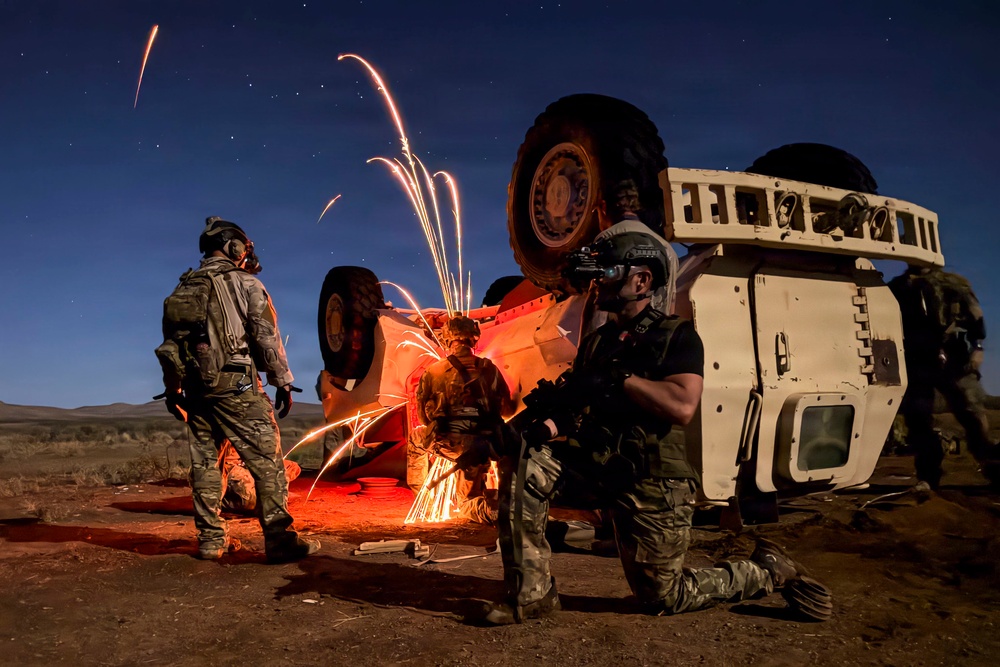
Photo By Staff Sgt. Jenna Bond | U.S. Air Force pararescuemen assigned to the 57th Rescue Squadron based out of Aviano...... read more read more
 Subscribe
DAVIS-MONTHAN AIR FORCE BASE, Ariz. — From July 17–31, the 57th Rescue Squadron earned certification as a personnel recovery task force during Exercise Savage Jackal, validating the unit’s ability to plan, command and execute full-spectrum personnel recovery operations in preparation for future deployments. The exercise evaluated the squadron’s ability to integrate air, ground and medical elements while conducting personnel recovery missions across Arizona, New Mexico and California. Training events included maritime recovery operations, military free-fall infiltrations, helicopter hoist insertions, casualty evacuation, vehicle extrications and sensitive item recovery. During the certification, the squadron completed 12 personnel recovery missions designed to evaluate mission-essential tasks across multiple environments. Approximately 40 members from the squadron’s pararescuemen, combat rescue officers, survival, evasion, resistance and escape specialists, joint terminal attack controllers and special warfare mission support airmen earned certification as part of the exercise. Approximately 75% of training events were conducted at night, challenging rescue forces to execute complex missions under limited visibility. "We primarily assess success or failure in a certification exercise by our ability to perform our mission-essential tasks to the appropriate standard in conditions that simulate what we expect to see on deployment," said U.S. Air Force Lt. Col. Haralambos Theologis, 57th RQS commander. "By seeing our forces respond to mission sets and threats they can expect to encounter in theater, we can gauge the effectiveness of our training plans and their readiness for deployment." "Savage Jackal brought together aircraft, command and control, rescue forces and joint partners to solve problems as one team. We identified gaps, improved how we operate and built confidence through repetition,” said Master Sgt. Wallid Zaioun, 57th RQS pararescueman team lead. “Most importantly, this exercise ensured we're ready to answer the call when someone is having the worst day of their life." The exercise also integrated U.S. Marine Corps MV-22B Ospreys alongside Air Force rescue assets, allowing crews to operate as a joint combat search and rescue task force during personnel recovery scenarios. "Working with the Marines and the MV-22B was a huge value added," Zaioun said. "The Osprey's speed, range and flexibility expand our options during personnel recovery missions." The exercise incorporated aircraft wreckage, partner forces, medical and technical rescue scenarios, enemy forces and supporting assets. Night operations added another layer of complexity, requiring rescue teams to rely on communication, discipline and adaptability while operating with limited visibility. "Everything gets harder at night. Even with night vision, you lose a lot of the visual cues you normally rely on,” Zaioun said. “Everyone has to know their job and trust the plan. Night operations reinforce the fundamentals and prepare us for the worst-case scenario." The results of Savage Jackal will help shape future training efforts and ensure the squadron continues to meet the demands of personnel recovery operations. "We have an obligation to Americans and partner forces in harm's way to ensure that those responsible for helping them on their worst day have the best skills and preparation possible," Theologis said. "The team leaves better prepared to tackle a wide range of contingencies with a thorough understanding of their strengths and weaknesses. Ultimately, the theater and the forces operating within it will be more secure because our teams were able to execute this training."
| Date Taken: | 07.31.2026 |
| Date Posted: | 08.11.2026 09:14 |
| Story ID: | 572032 |
| Location: | DAVIS-MONTHAN AIR FORCE BASE, ARIZONA, US |
| Web Views: | 19 |
| Downloads: | 0 |

This work, Exercise Savage Jackal certifies 57 RQS for future deployments, by SSgt Jenna Bond, identified by DVIDS, must comply with the restrictions shown on https://www.dvidshub.net/about/copyright.


No keywords found.




