
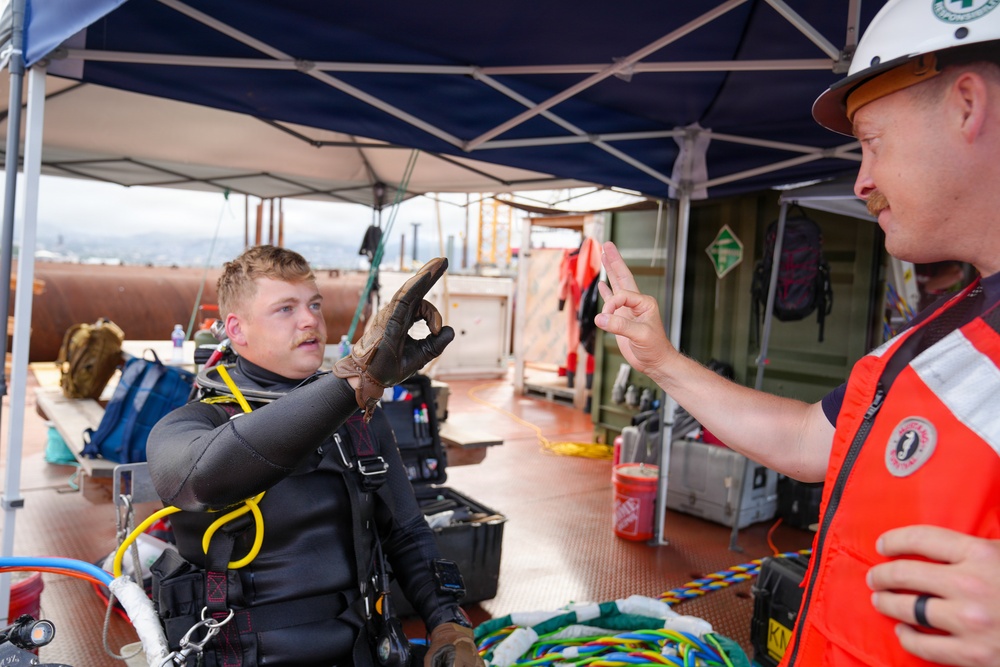
Photo By Jhewel Felipe | U.S. Navy Senior Chief Christopher Farmer, right, master diver for Construction Dive...... read more read more
JOINT BASE PEARL HARBOR-HICKAM, Hawaii -- Beneath Pearl Harbor, where visibility disappears and the only guide is touch, Seabee divers have been doing some of the most critical work on the Navy's largest military construction project, P-209.
Divers assigned to Construction Dive Detachment 2-4, Underwater Construction Team TWO (UCT-2), Underwater Construction Team ONE (UCT-1), and the Naval Facilities Engineering and Expeditionary Warfare Center (NAVFAC EXWC) Dive Locker, recently completed a mission supporting P-209, the future Dry Dock 5 at Pearl Harbor Naval Shipyard. Working in confined spaces and often in zero-visibility conditions, the team conducted underwater cleaning, excavation and sediment removal operations to prepare critical infrastructure for upcoming construction phases.
From late spring into early summer, the detachment supported the Officer in Charge of Construction Pearl Harbor Naval Shipyard (OICC PHNSY), the command responsible for executing military construction at the shipyard. Working alongside the project's construction contractor, Dragados/Hawaiian Dredging/Orion JV (DHO), the divers supported P-209, a key component of the Shipyard Infrastructure Optimization Program (SIOP). When complete, Dry Dock 5 will replace the shipyard's aging Dry Dock 3 with a modern waterfront facility designed to support Virginia-class submarines and future Navy vessels for decades to come.
While much of the project's activity is visible above the waterline, several critical tasks must be completed below the surface before construction can continue.
"Our detachment is currently executing underwater laitance and sediment removal at the Dry Dock 5 construction site," said Lt. j.g. Stephen Williams, officer in charge of Construction Dive Detachment 2-4. "We are essentially performing precision underwater excavation and quality control to clear the way for critical project milestones."
Throughout the deployment, the divers cleaned shoring walls, welded components and prepared underwater concrete and reinforcement structures for upcoming construction activities. Using high-pressure water blasting systems and diver-operated dredging equipment, the team removed compacted material while readying underwater infrastructure for the next phase of construction.
Operating underwater presents challenges rarely encountered by most construction crews. Visibility can disappear entirely, forcing divers to rely on touch, training and communication to complete their tasks. Divers must also carefully manage depth and time limits while working in an environment where mistakes can carry significant consequences. Tight working spaces, heavy equipment and complex construction environments require constant coordination between the diver below and the team supporting them above water.
"The work is physically demanding and often conducted in limited-visibility conditions where divers must rely on training, communication and teamwork to complete the task safely," said Master Diver Senior Chief Christopher Farmer. "Every dive requires detailed planning, disciplined execution and complete trust between the diver and the topside team."
For Construction Mechanic 2nd Class Jacob Rousseau, the mission offered a chance to apply new skills on a project unlike any he had encountered before.
A typical day began long before anyone entered the water. Divers prepared equipment, conducted maintenance and reviewed the day's objectives before beginning operations. Once in the water, divers executed their assigned tasks while other personnel monitored safety, maintained equipment and coordinated the effort.
On days when he was not diving, Rousseau gained experience in supervisory roles, managing watches and learning the responsibilities of diving supervision under the guidance of senior leaders.
"Working a job that's requiring a new task is great," Rousseau said. "You get to add a new tool to your belt."
One of the most memorable challenges came from learning to operate underwater dredging equipment in some of the most demanding conditions the team encountered.
"Utilizing the underwater pump and dredging was a first for me during this job," Rousseau said. "You could start in the mudline with zero visibility, unable to see the hands in front of your face, and after you've been pumping it all away, you're able to clear up that visibility and see what you've been working on."
The project also underscored the collaborative nature of large-scale military construction. Each day, representatives from multiple organizations, including OICC PHNSY, gathered to synchronize work across the job site. Construction crews, engineers, contractors and military personnel worked simultaneously to advance different portions of the project while keeping every activity aligned with the broader construction effort.
For Rousseau, witnessing that level of coordination was one of the deployment's most surprising lessons.
"Working on a project this size has been unique," he said. "I was surprised that so many jobs could be going on simultaneously with our own. We didn't encounter issues with getting in some other crews' way or vice versa. It was all organized in a way to allow all the different aspects of construction to be performed."
The experience also deepened working relationships between the dive team, OICC PHNSY and the broader civilian construction workforce, including DHO. That spirit of collaboration mirrors the Poseidon Corollary, a philosophy that emphasizes collective ownership and shared responsibility for mission success.
“The importance of this effort isn’t just in seeing how committed military engineers can contribute specialized capabilities on the Navy’s largest military construction project, but also in developing the key relationships and working methods between the world’s largest construction contractor and our military engineering force to better our capability to work together in future contingency operations across the Pacific,” said Lt. Cmdr. Mike Yeary, operations officer for OICC PHNSY.
By the end of the deployment, the detachment had completed 97 dives, accumulated more than 5,700 minutes of bottom time and removed more than 50 cubic yards of compacted material. The results helped prepare critical underwater infrastructure for the next phase of construction while showcasing the specialized capabilities Seabee divers bring to complex waterfront projects.
For Farmer, the numbers only tell part of the story.
"What makes me most proud is watching our Seabee divers consistently rise to the challenge and deliver results under difficult conditions," he said. "More importantly, they did it safely, professionally and as a team."
Although their work remained hidden beneath the harbor's surface, the divers played an essential role in advancing a project designed to serve the fleet for generations. Their efforts supported construction of a modern dry dock that will strengthen Pearl Harbor Naval Shipyard's ability to maintain and sustain the Navy's submarines and future vessels throughout the Indo-Pacific region.
For Williams, the mission reflects the unique role Seabee divers play across the Naval Construction Force.
"While much of our work is hidden beneath the surface, it is vital to the security of our nation," Williams said. "We are skilled construction divers who build where others cannot."
Beyond the dives completed and material removed, the deployment highlighted the value of partnership on the Navy's largest military construction project, P-209. Under the leadership of Cmdr. Charles Murdock, commanding officer of UCT-2, the detachment worked alongside OICC PHNSY, commanded by Capt. Chris Coggins, to support a critical phase of construction on the future Dry Dock 5.
Together, their efforts reflected the principles of Poseidon’s Corollary, demonstrating how military engineers, government professionals and industry partners can work together to solve complex challenges and strengthen fleet readiness throughout the Indo-Pacific.
| Date Taken: | 06.18.2026 |
| Date Posted: | 06.22.2026 14:07 |
| Story ID: | 568327 |
| Location: | JOINT BASE PEARL HARBOR-HICKAM, HAWAII, US |
| Web Views: | 721 |
| Downloads: | 1 |

This work, Working Where Others Cannot: Underwater Construction Team Brings Poseidon’s Corollary to Life at Future Dry Dock 5, by Jhewel Felipe, identified by DVIDS, must comply with the restrictions shown on https://www.dvidshub.net/about/copyright.


No keywords found.





