
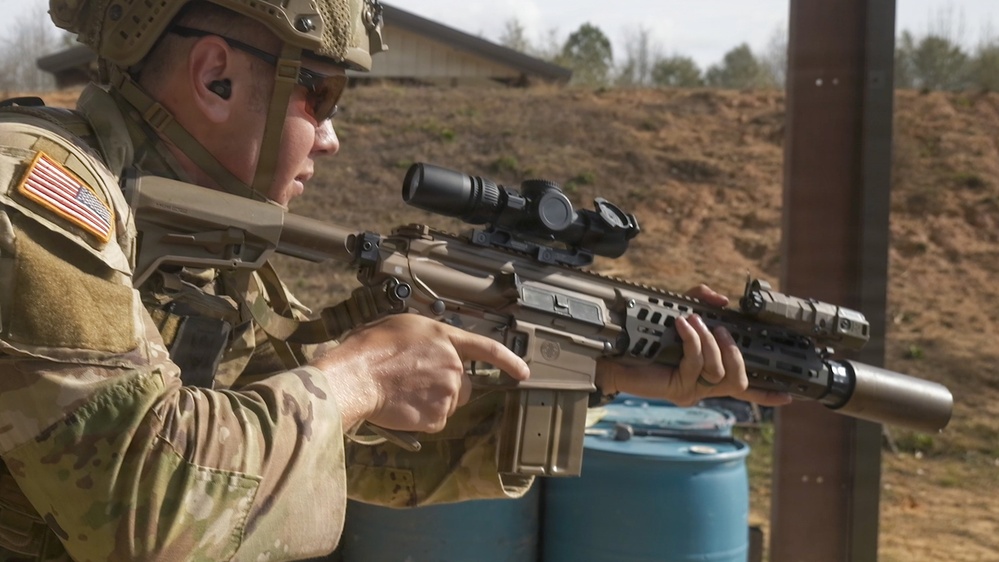
Photo By Aliyah Harrison | A U.S. Army Soldier with the Army Marksmanship Unit conducting rifle drills with the...... read more read more
 Subscribe
by Cheryl Marino
As the Army reshapes its acquisition enterprise to move faster and remain relevant in an increasingly contested operational environment, the Next Generation Squad Weapon (NGSW) program stands as a clear example of how Capability Program Executive–Ground (CPE Ground) is accepting and managing risk rather than avoiding it. Executed under accelerated acquisition pathways and fielded while testing and refinement continue, NGSW reflects a conscious leadership decision to prioritize speed, Soldier feedback and overmatch over the traditional pursuit of perfect certainty. In doing so, CPE Ground is demonstrating a modern acquisition mindset—one that treats risk as a tool to be governed and leveraged at the portfolio level, not a condition to be eliminated—while delivering tangible capability to the squad where it matters most.
The NGSW program did not begin under today’s acquisition construct. The program was initiated around 2017 and from the outset, it was designed to operate differently than previous major capability acquisitions. “I think this program from initiation before the new structure … leveraged that opportunity to be basically a pathfinder for some of the signature modernization programs of the time,” said Lt. Col. Bryan Kelso, Product Manager Soldier Weapons, CPE Ground. “Because of that groundwork, when we restructured again, they were already positioned to adapt to it because we were already doing a non-traditional approach.”
Rather than attempting to eliminate all uncertainty before fielding, NGSW leadership made deliberate decisions about which risks were acceptable and how they would be managed. Technical changes that did not affect operational performance—often described as changes “below the hood”—could be approved at the program level. Larger tradeoffs with potential operational impact were elevated for broader consideration.
“If there’s changes that we can make to the system that don’t really infringe on anything in the tier capability matrix, but they get after a performance increase, a weight savings, a cost savings we can internally, on the PM [product manager] side, make those determinations,” said Kelso. If the change is on a larger scale, that would require feedback from the requirement owner and from the operational force. “That’s when it goes up to the CPE and the PAE [Portfolio Acquisition Executive] and they look across the formation and will inform those decisions by buying small quantities and then putting them into their Soldier touch point type environment or the TIC [transformation in contact],” he said.
When tradeoffs touched requirements or Soldier employment, they were informed by data and escalated deliberately rather than deferred by default. This distinction allowed speed without recklessness. Risk was no longer something avoided through delay, but something explicitly owned, understood and managed.
A key enabler of that approach was CPE Ground’s use of non-traditional acquisition pathways as strategic tools. NGSW was executed as a Middle Tier Acquisition (MTA), which allowed the program to bypass traditional milestone structures and move directly into rapid prototyping and fielding. Just as importantly, it replaced a formal Joint Capabilities Integration and Development System (JCIDS) Capability Development Document (CDD) with a tiered capability matrix.
“Instead of having a formal approved CDD requirement document [which takes years traditionally to staff the requirement for an end item] … in the case of the MTA, we had a tiered capability matrix that was developed more rapidly,” Kelso explained. That single decision saved roughly two years of requirements staffing time. The matrix articulated what the Army desired rather than mandating inflexible thresholds. “Everything was desired. It wasn’t mandatory,” Kelso said. “We let industry inform what the best solution space was to achieve our overall objective.” This construct widened the solution space, encouraged innovation and enabled industry—both traditional and non-traditional—to make informed tradeoffs in pursuit of the Army’s goals.
Contracting mechanisms were tailored accordingly. The program used other transaction authority (OTAs) during prototyping, particularly with non‑traditional vendors, and transitioned to Federal Acquisition Regulation-based contracts for production where appropriate. Kelso emphasized for clarity that an MTA is a “pathway or strategy,” while an OTA is the “contracting mechanism or vehicle that allows you to leverage a more creative structure,” and the two were employed deliberately to balance flexibility with accountability.
Risk ownership at the program level was reinforced by portfolio-level decision-making mechanisms, most notably the Capability Trade Council (CTC). PAE Maneuver Ground—a portfolio of more than 180 programs encompassing nearly everything a Soldier wears or employs in combat, from next-generation weaponry to crewed and uncrewed platforms and robotic and autonomous systems—includes CPE Ground as a key organization within the portfolio and was directly involved in the CTC process, providing program-level insight during key deliberations. The CTC provided a streamlined alternative to legacy configuration steering boards, allowing senior leaders to make focused, data-driven decisions quickly.
“The Capability Trade Council is like a configuration steering board, but it’s very focused,” Kelso said, with only two decision-makers responsible for the final go or no-go.
The first-ever CTC was used to approve the transition from the M7 rifle to the M8 carbine. By the time the decision was briefed, leaders were not reacting to a concept; they were evaluating evidence.
“There was enough data at that time that they could comfortably make a decision. And they knew the risk and they knew the trade-off,” said Kelso. Soldier feedback, government testing and quantified performance impacts—such as modest range reduction in exchange for improved mobility—were all presented transparently.
This approach compressed timelines dramatically. Where similar decisions previously took a year or more, Kelso said “we can recommend a CTC, and it can happen rapidly. We get the decision in a month or less compared to years and then we pivot the program to go towards what the CTC now directs us to do.” By governing risk at the portfolio level, CPE Ground enabled faster outcomes without sacrificing senior oversight.
Perhaps the most consequential shift embodied by NGSW is the elevation of Soldier feedback from a late-stage validation activity to a core acquisition input. Iteration with real users occurred early and often. “By iterating with Soldiers and putting actual real things in the field to get feedback on as early as possible, not just PowerPoint slides or not just concepts,” Kelso said the program stayed grounded in operational reality. The M8 carbine is a clear example. “There was not a requirement per se for the carbine,” he said. But consistent Soldier input pointed toward the need for “a smaller, lighter weapon system.” In response, the program procured small quantities with research, development, test and evaluation funds, certified them for safe use, and placed them into operational units to gather informed feedback before committing to production.
More recently, the TIC construct has extended this feedback loop. Rather than short, scripted Soldier touch points, weapons and configurations are left with units for extended periods. “We’re able to get systems into the hands of Soldiers and leave them there for a longer term evaluation,” Kelso said, allowing feedback to mature as Soldiers train, qualify and employ the systems in normal cycles. Over time, Soldiers see that their input directly shapes outcomes: “They’re seeing that their feedback matters and … it’s directly responsive.”
The NGSW demonstrates that speed and discipline are not mutually exclusive. Through flexible pathways, portfolio-level governance and sustained Soldier engagement, CPE Ground is delivering capability at a pace rarely seen in major defense acquisitions. As Kelso summarized, “Utilizing flexible pathways and requirements with a very strong relationship with our key stakeholders is allowing our program to deliver capability at the speed of war.”
The results are tangible. Following the CTC decision to transition to the M8, the program moved from approval to accepting production systems in under two months. “That timeframe is not the norm at all,” Kelso said. “It’s orders of magnitude faster.” Enabled by flexible structures, active stakeholder alignment and trusted industry partnerships.
The NGSW is not an exception; it is a model. The same approach is already being applied to future efforts, ensuring that the lessons of deliberate risk ownership, rapid decision-making and Soldier-informed design continue to shape how the Army equips its formations. In an era where relevance depends on speed, CPE Ground’s experience with NGSW underscores a clear truth: Treating risk as a resource, rather than an obstacle, is essential to delivering overmatch when it matters most. For more information, go to https://cpeground.army.mil/.
CHERYL MARINO is a writer-editor at the U.S. Army Acquisition Support Center at Fort Belvoir, Virginia, providing contract support for Behind the Frontlines and TMGL, LLC. Prior to USAASC, she served as a technical report editor at the Combat Capabilities Development Command Center at Picatinny Arsenal. She holds a B.A. in communications from Seton Hall University and has more than 25 years of writing and editing experience in both the government and private sectors.
| Date Taken: | 05.11.2026 |
| Date Posted: | 05.20.2026 11:19 |
| Story ID: | 565546 |
| Location: | US |
| Web Views: | 176 |
| Downloads: | 0 |

This work, Faster Decisions, Better Outcomes: NGSW as a Model For Modern Army Acquisition, by Cheryl Marino, identified by DVIDS, must comply with the restrictions shown on https://www.dvidshub.net/about/copyright.


No keywords found.




