Photo By Kristin Savage |
U.S. Air Force firefighters from the 424th Air Base Squadron (ABS) and local Belgian......read moreread more
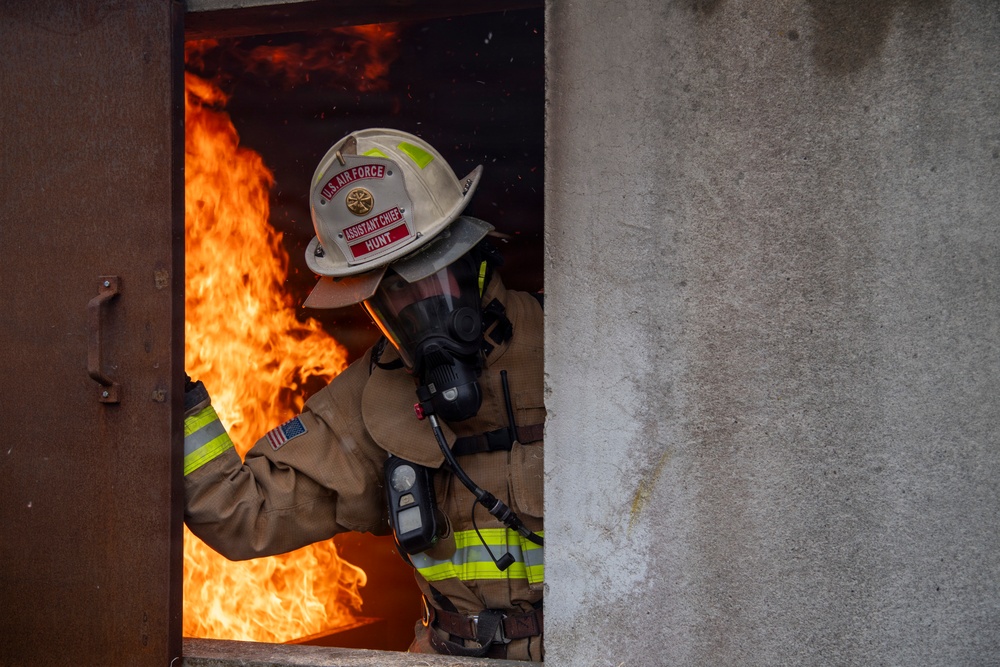
Photo By Kristin Savage | U.S. Air Force firefighters from the 424th Air Base Squadron (ABS) and local Belgian firefighter recruits merge their contrasting tactics in the heat of a live burn, on May 6, 2026, at Chièvres Air Base, Belgium. The flames inside the burning building provided more than just a training environment — they served as a forge for a stronger, more unified cross-border Alliance, ensuring both nations are ready to answer the call together. see less
| View Image Page
Chièvres Air Base, Belgium –When U.S. Air Force firefighters from the 424th Air Base Squadron (ABS) on Chièvres Air Base (CAB) and local Belgian firefighter recruits merge their contrasting tactics in the heat of a live burn, the result is an unbreakable partnership that guarantees mutual readiness.
The 424th invited local firefighter recruits to participate in a joint fire training exercise on May 6, 2026, at CAB, Belgium. Rather than sitting in a classroom, the students were thrown into action, tackling a rigorous training day that included a tour of the fire station, a simulated burning building scenario, and critical search and rescue operations.
Staff Sgt. Zachary Gager, 424th ABS Fire Department crew chief, led the training but noted he walked away learning new tactics himself. He observed the stark differences in methodology, particularly how European crews focus heavily on calculated water conservation, contrasting with the traditionally aggressive approach of American firefighters.
“The great part about being on a NATO base is learning different tactics,” said Gager. “This is my second time leading it, and I really love it. It’s just a really humbling experience to teach youth about firefighting.”
Cédric Reygaerts, USAG Benelux lead garrison fire protection specialist, recognized the vital benefits for both sides. The 424th firefighters had the opportunity to learn more about their Belgian counterparts and improve interoperability, while the young trainees experienced the intensity of U.S. military firefighting firsthand.
“If something happens here on Chièvres Air Base, we need the Belgian firefighters. One purpose is to check the communication during a fire because we know the language barrier is an issue,” Reygaerts explained. “The training also allows the firefighter students to see what it is to be a firefighter on CAB and provides them a better understanding of cooperation. One day, they might even apply to work on Chièvres Air Base.”
For Eden Lassoie, an 18-year-old Belgian firefighter student, classroom theories became reality the moment she stepped into the heat.
“My favorite part of today was when I saw the fire; I learned how to enter the burning building and learned how to extinguish it,” said Lassoie. “I loved learning the differences and getting to work with different people.”
Ultimately, the flames inside the burning building provided more than just a training environment—they served as a forge for a stronger, more unified cross-border Alliance, ensuring both nations are ready to answer the call together.