
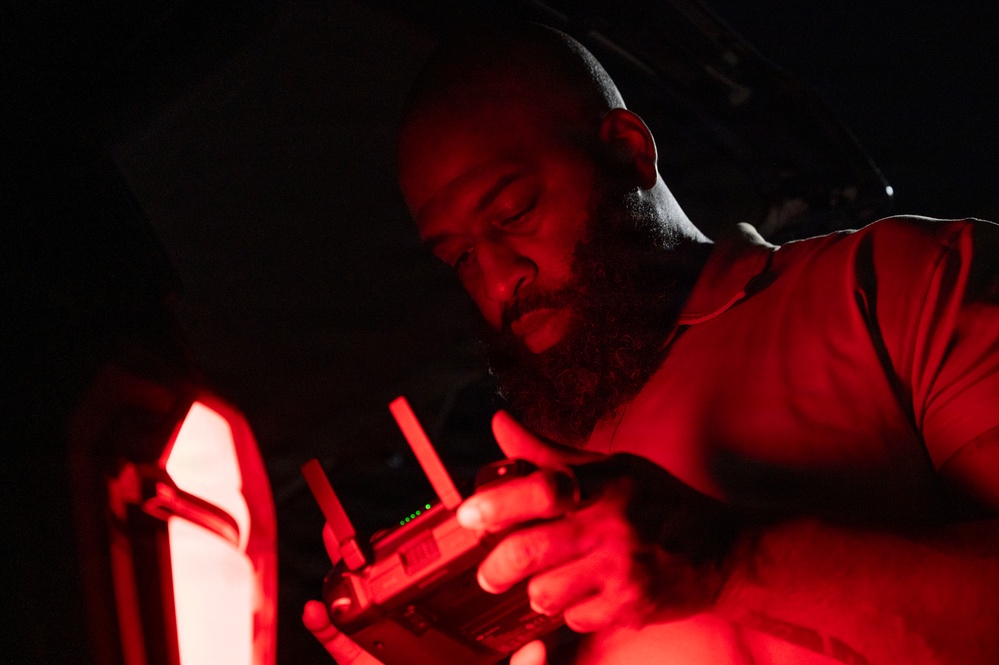
Photo By Hayden Hallman | Anthony Kavanaugh, a drone operator with a U.S. Army Unmanned Aerial Systems Mission...... read more read more
 Subscribe
JOINT BASE ANACOSTIA-BOLLING, Washington, D.C.– Threats to U.S. military installations and service members from small-Unmanned Aerial Systems (s-UAS) continue to grow in the modern age. To protect American warfighters, a specialized joint team spearheaded by Joint Interagency Task Force 401 (JIATF-401) conducted a critical test of counter-drone technologies at Joint Base Anacostia-Bolling, April 22-25.
The training involved representatives from the U.S. Army, U.S. Air Force and the Federal Aviation Administration, demonstrating the importance of interagency cooperation to safeguard the National Capital Region with streamlined policy, joint efforts, and a layered counter-UAS (c-UAS) defense.
Established by the Secretary of War in August 2025, JIATF-401 has one measure of effectiveness: to rapidly deliver state-of-the-art c-UAS capabilities to U.S. warfighters at home and abroad.
During the April training, an Army UAS mission assurance team assessed JBAB’s defenses and shared tactical lessons learned for future engagements around the globe.
“Drones pose a significant threat across various domains and environments,” highlighted U.S. Air Force Maj. Nicholas Cunningham, commander of the 11th Security Forces Squadron. “It will require the full weight of our teams to mitigate risks and exploitation, but we are committed to protecting Airman, Guardians, families and assets from the evolving presence of s-UAS.”
This training is one of many site surveys conducted across the National Capital Region to prepare for major events like America’s 250th anniversary, which requires the cooperation of multiple agencies, including the FAA, Department of Homeland Security and Department of Justice to ensure comprehensive airspace security.
“Drones are the defining threat of our time, and no single agency or branch of service can tackle the problem alone,” said U.S. Army Brig. Gen. Matt Ross, director of JIATF-401. “A whole-of-government approach that streamlines policies and processes across the joint force is vital to counter the threat of drones in the homeland.”
Increasing capability requires the right people, policy, permissions and training. To address this, JIATF-401 delivers training, tools and technology while cutting through red tape to give warfighters the authorities they need to defend the homeland against adversary drones.
“Cooperative training like this one involving all the branches of services is vital to a strong counter-drone defense,” shared Morgan Griffith, senior UAS pilot and analyst with U.S. Army Combat Capabilities Development Command.
JIATF-401 is also focused on integrating systems and rapidly increasing capabilities, including crucial kinetic defeat options that are part of a layered defense.
U.S. Northern Command is establishing specialized teams equipped with mobile ‘fly-away kits’ that can deploy within 24 hours to quickly combat threats. These kits include systems like Mobile Sentry for autonomous tracking, Pulsar for radio-frequency countermeasures and Anvil for kinetic neutralization.
“There is no single solution to every drone threat,” said Ross. “A layered defense gives our warfighters the ability to choose the right tool for the right circumstances.”
The Department of War is also focused on fielding options like directed-energy systems to increase counter-UAS capabilities.
Combining awareness, a variety of tools, and an integrated strategy keeps service members and military installations safe. “We are stronger together. Between industry partners, tactical operators, technological engineers and testing teams, everyone is needed to better protect people and assets from drones,” emphasized Cunningham.
Cunningham elaborated that building a layered defense supports operational resiliency in an evolving domain. “As adversaries create complex problems for the military to defeat, the joint force will also create complex problems for the adversary.”
Streamlining policies across the joint force, robust interagency cooperation and effective implementation remain vital for defending against UAS incursions. Ultimately, recent testing at JBAB demonstrates a broader commitment to advancing counter-drone strategies and protecting Americans at home and abroad.
| Date Taken: | 05.01.2026 |
| Date Posted: | 05.01.2026 15:26 |
| Story ID: | 564166 |
| Location: | JOINT BASE ANACOSTIA-BOLLING, DISTRICT OF COLUMBIA, US |
| Web Views: | 177 |
| Downloads: | 0 |

This work, Joint Task Force test advances drone defenses, by Hayden Hallman, identified by DVIDS, must comply with the restrictions shown on https://www.dvidshub.net/about/copyright.


No keywords found.




