
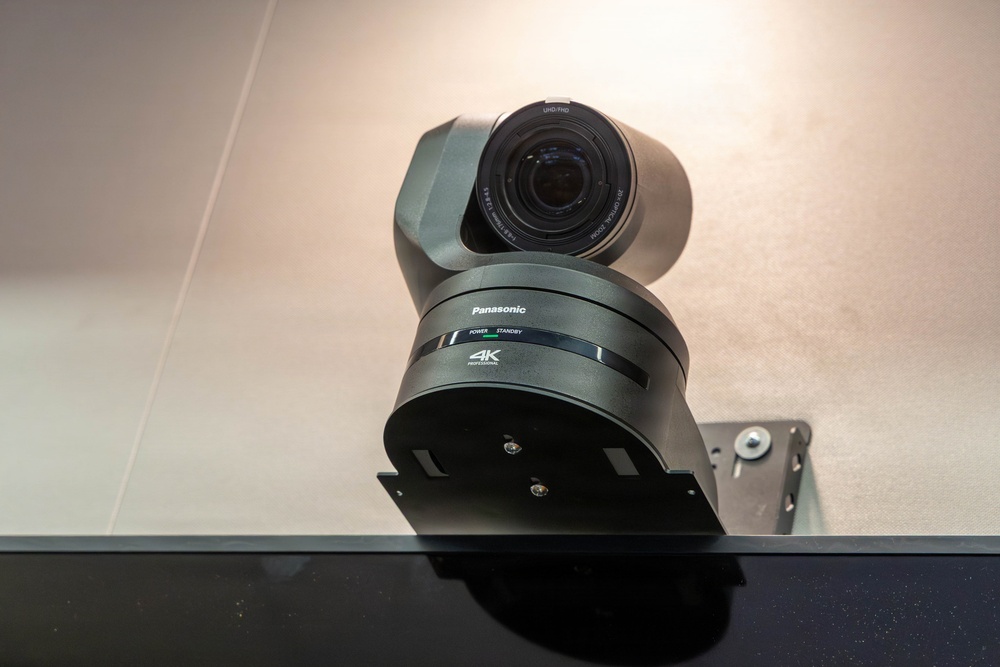
Photo By Lawrence Brooks | A close-up of one of the new Panasonic 360-degree cameras installed in the renovated...... read more read more
Urban planning of yesteryear placed many of the federal buildings that house the organizations tasked with doing the unseen federal work that improves the lives of the American citizen, as the beating heart of the downtowns in major and mid-size metropolises across the country.
Proverbially, this is what the emergency operations center (EOC) for the Kansas City District, U.S. Army Corps of Engineers, becomes when major disasters strike within its area of operations and beyond, according to emergency management specialist Stephanie Wedgeworth.
“We bring all the teams down here — resource management, contracting, engineering, operations, water management … during times of flooding, engineers either bring data in or communicate it from the field,” she said. “It’s a huge conglomeration of people inside and outside of USACE working together.”
If the emergency operations center is the heart, then the conference rooms spread across five additional floors of the sprawling Richard R. Bolling Federal Building are the ventricles, arteries, valves and veins that power daily district operations. That’s why the district has embarked on a project that involves sweeping renovations to 30-plus conference rooms and the EOC.
Logistics manager Will Ristom said the multi-million-dollar investment in new technology will undoubtedly improve workforce efficiency in meetings or briefings and is a commitment to long-term mission readiness.
“We’re trying to make technology work for everybody,” he said.
Remaining the standard bearer for emergency response
For years, the Kansas City District’s Emergency Management Branch has been a leader in emergency response for USACE — supporting responses to wildfires, floods and hurricanes both domestically and abroad.
Branch chief of the Readiness and Contingency Office, Jud Kneuvean, said these efforts to modernize technology in what he referred to as the “nerve center” of the Kansas City District are also part of a larger domestic plan to improve USACE’s emergency response readiness.
“This is part of a nationwide effort to upgrade emergency operations centers across the country. So, every district has some kind of activity going on,” he said. “Congress gave us $75 million specifically for these types of activities and we're making good use of it.”
He estimated that the renovations in the EOC are around $1.5 million, Nonetheless, the improvements couldn’t have come at a better time since the existing system had been in place for nearly 12 years, and they often encounter what Kneuvean called “glitches” in its functionality.
“The software was out of date, sometimes we got the blue screen of death, that kind of stuff. But by upgrading the technology and modernizing our interface will eliminate those issues,” he said.
Some of the new upgrades include a new high-resolution LED screen wall with improved graphics, modernized control systems with an improved user interface that enhances integration with Microsoft Teams and other external communication platforms and a new 360-degree camera system with voice tracking just to name a few.
For someone like Stephanie Wedgeworth, who stated that their normal shifts during emergency responses are 12 hours, the upgraded systems will enhance coordination, improving communication with field teams and federal partners such as the Federal Emergency Management Agency (FEMA) and state emergency management institutions the district regularly work with.
“We’ll have more capabilities than we’ve had in the past,” she said.
Work began in April with projected completion in May, a period that also includes a two-week period of system testing and validation. So, for the entire emergency management team, the upgrades ensure the district maintains its reputation as a leader.
“Kansas City District is kind of looked at as top of the line,” Wedgeworth said. “Other districts look at our emergency operations center as a benchmark.”
Simplifying meeting technology for the workforce
Beyond the emergency operation center, the renovation extends to more than 30 conference rooms — 18 small and 16 medium to large — where the focus is on usability and consistency.
Previously, rooms varied widely in setup that often-required users to troubleshoot connections or navigate complex systems that may have been tinkered with by previous users. The new approach standardizes technology across spaces, making them intuitive for employees of all experience levels.
“All the small conference rooms will be the same format,” said Benjamin Glaser, project management specialist. “You sit down and think, ‘I can grab this and plug it in.’”
Each room features simplified connectivity — often a single USB-C connection — along with integrated cameras, microphones and speaker systems optimized for hybrid collaboration.
“If you have a computer on your desk and you can see it on your screen, you can use all those conference rooms,” he said. “It’s going to make it super simple.”
The upgrades are also expected to reduce the common frustrations Will Ristom stated he often hears from colleagues in departments across the enterprise.
“This has been in the works for almost two years — and desired for probably five. [Finally], people will stop getting under the table and unplugging stuff. That has been the bane of our existence,” he said.
A complex effort behind the scenes
Delivering simplicity required significant coordination behind the scenes. The project involves multiple contractors, technical systems and strict security requirements to ensure compliance with federal standards, according to Ristom and Glaser.
“Trying to coordinate all these teams to make sure the technology is top of the line — it’s challenging,” Ristom said. “Security compliance also played a role since we have to verify the technology is not coming from an adversary supply chain.”
Logistics also played a major role. Crews removed and replaced large, heavy equipment — some projectors weighing up to 80 pounds — while working within the constraints of an older downtown facility.
“It was a heavy lift,” Glaser said. “Everything was big and awkward and cumbersome.”
The investment reflects the scale of the effort: approximately $2 million for the EOC renovation, with an additional $1.5 million dedicated to conference room technology and furniture upgrades as well.
Investing in USACE and its people
While the technology is central to the project, the people who use it remain at its core. For Wedgeworth, the upgrades are about more than systems — they’re about supporting those who respond when it matters most.
“I love the opportunity to be helpful to people,” she said. “I have a feeling that I’m making a difference and that I am a part of something good.”
That sense of purpose is shared by Ristom also, who said district teams see renovations as an investment in both mission and morale.
“Our pride is in this district,” he said. “Now we are fully free to support it the way we need to.”
With the final phases of installation and testing for the EOC takes shape and the conference room upgrades continue, Glaser said they are poised to deliver faster coordination, clearer communication and a stronger foundation for the Kansas City District’s overall mission.
In the month of April, Glaser and his team completed upgrades in eight small conference rooms and barring any major delays, is projected to complete four large conference rooms such as 204, before the end of fiscal year 2026.
“I want this district to be the best,” he said. “This is a big step in that direction.”
| Date Taken: | 04.29.2026 |
| Date Posted: | 04.29.2026 11:58 |
| Story ID: | 563898 |
| Location: | KANSAS CITY, MISSOURI, US |
| Web Views: | 47 |
| Downloads: | 0 |

This work, We’re replacing everything — screens, systems, all of it,” A closer look into command center and conference room renovations, by Lawrence Brooks, identified by DVIDS, must comply with the restrictions shown on https://www.dvidshub.net/about/copyright.


No keywords found.





