
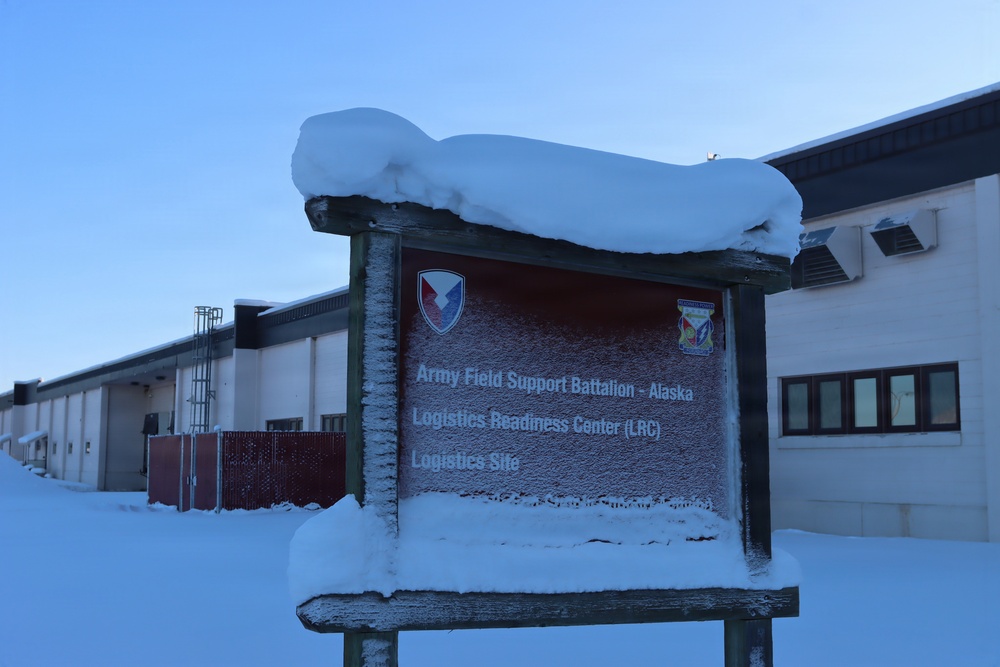
Photo By Aaron DeCapua | The Army Field Support Battalion–Alaska Logistics Readiness Center at Fort...... read more read more
ALASKA — In the unforgiving Arctic environment, where extreme cold, distance and terrain impose relentless demands on Soldiers and equipment alike, sustainment operations must function with precision, adaptability and speed.
During Joint Pacific Multinational Readiness Center (JPMRC) Alaska, the Logistics Support Element (Division), assigned to the 402nd Army Field Support Brigade under Army Sustainment Command, served as a conduit between the 11th Airborne Division and the Army Materiel Command enterprise — accelerating solutions that extended beyond the tactical level.
The 402nd AFSB, as Army Sustainment Command’s theater Army Field Support Brigade for U.S. Army Pacific, delivers enterprise sustainment across the Indo-Pacific through its Army Field Support Battalions in Alaska and Hawaii. For Army Field Support Battalion–Alaska, JPMRC represents a large-scale validation of its ability to integrate installation support, enterprise reach and field-level responsiveness in one of the Army’s most demanding environments.
Rather than acting as an additional layer of command, the LSE (D) provides access to enterprise-level capabilities designed to resolve sustainment challenges that exceed division-level capacity. By synchronizing with the 11th Airborne Division G-4 and working alongside AFSBn–Alaska sustainment professionals, the team translates operational friction into actionable requirements addressed through Life Cycle Management Commands and subject-matter experts across the Army.
“Our role during JPMRC was to connect division-level challenges to enterprise-level solutions,” said Maj. Makar. “When a problem exceeded the tactical level, we leveraged the Army Materiel Command network to resolve it rapidly.”
Lt. Col. Eric J. Erickson, commander of AFSBn–Alaska, explained that the LSE (D) provides capabilities not organic to the division’s sustainment structure.
“The LSE provides direct synchronization of Life Cycle Management Command representatives and enables effective command and control of enterprise-level sustainment capabilities,” Erickson said. “It connects the division to specialized expertise and resources that are not organic to the formation.”
That enterprise reach proved decisive when an electrical issue rendered a Light Medium Tactical Vehicle non-mission capable. After unit-level troubleshooting and evacuation procedures were completed, the LSE (D) engaged a Tank-automotive and Armaments Command Logistics Assistance Representative to diagnose and correct the failure. The vehicle was restored to operational status within 24 hours, preserving combat power during a critical phase of the rotation.
Enterprise integration extended beyond ground platforms. When communications degradation threatened connectivity across dispersed training areas, the LSE (D) exercised a call forward to engage Communications-Electronics Command subject-matter experts.
“We exercised a call forward and physically drove into the exercise area to work on a Very Small Aperture Terminal, or VSAT,” Makar said. “Due to the satellites’ equatorial positioning, the dish required precise re-triangulation. Until formations fully transition to next-generation systems, those terminals remain critical to operations.”
By rapidly connecting units to specialized expertise, the 402nd AFSB ensured communications — and therefore mission command — remained uninterrupted during the rotation.
Beyond resolving individual equipment failures, the LSE (D) and AFSBn–Alaska contribute to enterprise-wide readiness by identifying trends that extend beyond a single formation or rotation.
“We have the ability to operate at the enterprise level,” Makar said. “For aviation systems, we observed recurring issues with blower motors inside AH-64 cockpits. Those failures followed a predictable cycle. By providing that trend analysis to the Army Materiel Command enterprise, we help drive solutions that impact the entire fleet — not just one unit.”
Through digital tools and shared visibility platforms, the LSE (D) translates operational data gathered during exercises like JPMRC into actionable insights. Leveraging platforms such as Vantage and Maven, the team aggregates maintenance data, identifies recurring failure patterns and strengthens predictive sustainment efforts. Rather than reacting to equipment breakdowns, sustainment planners can anticipate demand signals and adjust support posture before readiness is degraded.
This enterprise feedback loop ensures lessons learned in Alaska strengthen readiness far beyond the Arctic. While sustainment processes remain consistent between garrison and exercise environments, the Arctic amplifies every variable.
“In Alaska, temperature changes everything,” Erickson said. “Extreme cold impacts maintenance timelines, equipment reliability and the way we manage personnel. We’ve conducted operations in temperatures as low as minus 50 degrees, with wind chills reaching minus 56. At those levels, work-rest cycles become critical — you might spend 15 minutes outside and require 45 minutes inside to recover. Even receiving a HIMARS system overnight requires thawing the equipment before we can safely begin maintenance. Sustainment here requires anticipation, adaptation and respect for the environment.”
These realities transform sustainment into a matter of survivability as much as readiness, underscoring the importance of AFSBn–Alaska’s daily mission in support of the 11th Airborne Division. Looking beyond the current rotation, Erickson said JPMRC provides measurable feedback for both installation-level support and enterprise integration.
“From an installation perspective, we’re examining policies and processes — particularly in areas like Central Issue Facility operations — to identify opportunities to streamline support and remove friction,” Erickson said. “From the LSE perspective, maintaining a fully integrated Logistics Support Element during JPMRC demonstrates measurable value to the division. It reinforces the importance of enterprise synchronization and positions us to refine that model moving forward.”
Exercises like JPMRC serve as validation points for both the battalion and the broader 402nd AFSB network, testing equipment endurance, sustainment systems and operational processes under extreme conditions. Ultimately, the LSE (D) and AFSBn–Alaska enable the warfighter by preserving time and combat power. “It saves time, preserves readiness and allows units to focus on warfighting skills,” Makar said. “We are strategic enablers, solving Army-wide problems at the point of friction.”
For leaders across the force, the message is clear: the 402nd Army Field Support Brigade and its subordinate battalions provide scalable, enterprise-connected sustainment designed to meet the combatant commander’s demand signal — in Alaska and across the Indo-Pacific.
| Date Taken: | 03.02.2026 |
| Date Posted: | 03.02.2026 21:15 |
| Story ID: | 559240 |
| Location: | FORT WAINWRIGHT, ALASKA, US |
| Web Views: | 155 |
| Downloads: | 0 |

This work, Precision Sustainment in the Arctic: 402nd AFSB’s LSE (D) Supports 11th Airborne During JPMRC Alaska, by Aaron DeCapua, identified by DVIDS, must comply with the restrictions shown on https://www.dvidshub.net/about/copyright.


No keywords found.





