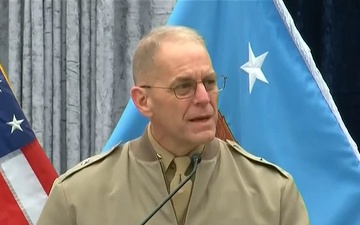
Secretary of War Pete Hegseth and his wife, Jennifer, host a Christmas Worship Service at the Pentagon, Dec. 17, 2025, featuring several special guests.
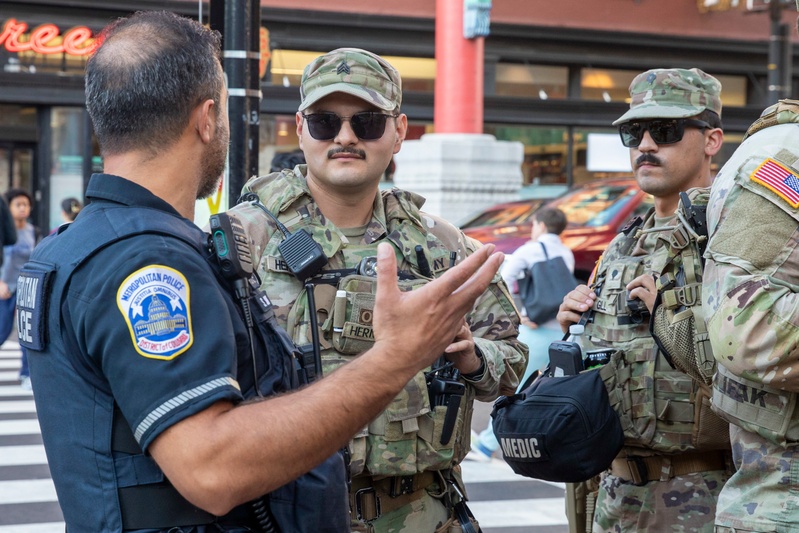
Army Sgt. Edwyn Hernandez-Mendoza, center, and Spc. Justin Gill, right, both assigned to the Georgia National Guard, speak with local law enforcement during a patrol near Capital One Arena in support of the D.C. Safe and Beautiful Task Force mission to ensure the safety of residents, workers and visitors in Washington, Oct. 1, 2025. (Army Sgt. Jalen Miller, National Guard)(251001-Z-NH807-2088)
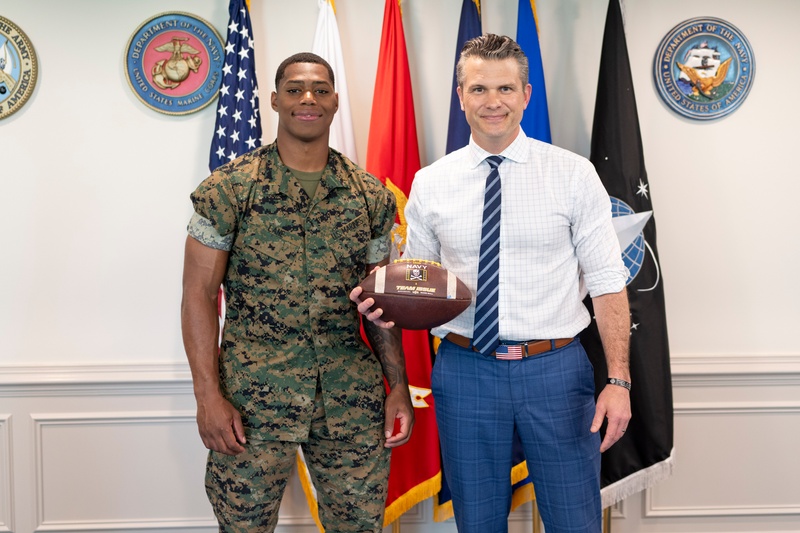
Defense Secretary Pete Hegseth lofted a football to the young officer and recent NFL draftee on the Pentagon steps, a first for the secretary at the iconic building. Lane, a newly commissioned Marine Corps officer and rookie defensive back for the Jacksonville Jaguars, was visiting the Pentagon with his family at Hegseth's invitation.
Hegseth praised Lane as an embodiment of service and opportunity.
"Think about all the kids that can look and say, not only can I serve my country, but I can excel at the highest of levels and make it to the NFL," he told Lane. "There's no better example of the American dream than that. … I'm looking at the personification of the American dream, truly."
Hegseth added that the former...
07.07.2025 | DISTRICT OF COLUMBIA, US |
Courtesy Story
As the U.S. military and its adversaries shift focus to the Arctic, working with partner nations in cold-weather regions to make sure our warfighters can survive those extremes has never been more important.
Batteries for cellphones and other small devices deplete quickly outside in the winter. To make sure warfighters are focused on the mission — and not the temperature or malfunctioning equipment — War Department experts are creating specialized technology and adapting current equipment to survive in frigid climates.
As the race to control the Arctic intensifies, more research is focused on how to optimize service member performance in the extreme cold. Researchers at the U.S. Army Research Institute of Environmental Medicine’s Military Nutrition Division in Natick, Mass., study physiological stressors that warfighters encounter to determine the best way to deliver the right nutrition and energy to increase warfighter lethality.
A lab in Natick, Massachusetts, tests recipes and evaluates commercial kitchen equipment specifically for naval vessel galleys to help make life easier for culinary specialists and to give more options to sailors on board.
The Armed Forces Recipe Service's food technologists, chefs and dietitians develop recipes for dining facilities on land, at sea and on the go, and they’ve already mapped out how to scale-up recipes to feed large contingents.
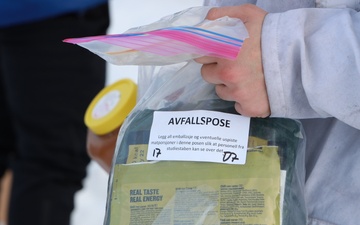
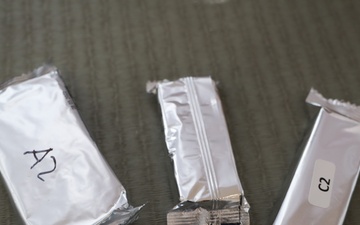
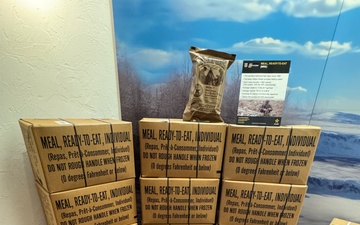
Every year, food scientists at the Army labs in Natick, Massachusetts, work to develop new components for meals ready to eat based on warfighter feedback received by each service to add variety or replace unpopular items.
War Department experts constantly research and implement new technologies to improve the food that supports service members’ ever-changing nutritional needs. A few new creations are helping to optimize warfighter performance during combat and recovery.
Service members need to be ready at a moment’s notice for anything that comes their way. They operate in extreme cold, extreme heat and at high altitudes, and they might be doing so with very little sleep for prolonged periods of time. All these factors can create unique stressors that call for varying nutritional requirements. At the Natick Army labs, experts develop rations and packaging to support warfighters and stay ahead of their...