
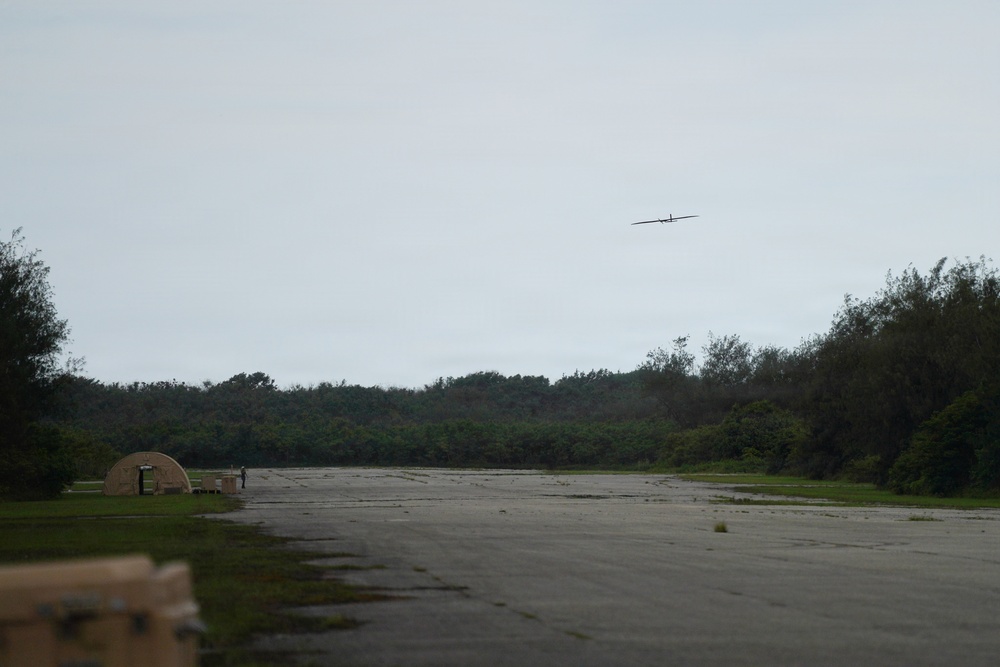
Photo By Sgt. 1st Class Ondirae Abdullah-Robinson | An Icarus Apollo R stratospheric fixed wing aircraft makes its landing approach at...... read more read more
NAVAL BASE GUAM, Guam – U.S. Soldiers assigned to the 3d Multi-Domain Effects Battalion (3d MDEB), 3d Multi-Domain Task Force, headquartered at Fort Shafter, Hawaii, collaborated with commercial industry partners to execute a series of forward technology experiments at Orote Airfield on Naval Base Guam from June 22 to June 25, 2026.
Conducted under the Pacific Multi-Domain Training and Experimentation Capability (PMTEC) as part of Exercise Valiant Shield 2026, the experimentation evaluated a suite of emerging autonomous systems, high-altitude balloons, and launched effects within an island-chain operational construct. The effort featured a dedicated Special User Demonstration focused on the Dragoon Cinder and Coriolis platforms, designed to expand joint-combined force options and reinforce integrated deterrence across the Pacific theater.
"Valiant Shield demonstrates our enduring commitment to a free and open Indo-Pacific," said Adm. Steve Koehler, the commander of the U.S. Pacific Fleet. "Exercising advanced multidomain capabilities with our allies ensures we continue to seamlessly innovate and operate together, project combat power together, and prevail over any challenge -- together."
Runway-Independent Autonomous Launch
During the Special User Demonstration, the unit evaluated several runway-independent aerial platforms designed to operate from highly confined littoral positions. Soldiers executed the autonomous lift-off sequence of the Cinder vertical take-off and landing unmanned aircraft system from a modular containerized vertical launch system.
The Cinder platform transitions from a vertical lift phase, shedding its launch propellers via parachutes, to horizontal fixed-wing flight, providing a unique option for future hybrid fleets. Additionally, the collaborative team loaded and launched the Red Wolf launched effect platform using a Kontio pneumatic launcher, validating forward theater staging configurations for projecting long-range precision strikes from austere positions. Immediate field cooperation on the flight line allowed engineering teams to observe system performance and receive direct technical feedback from tactical line units.
"Working directly with the 3d Multi-Domain Effects Battalion allowed us to see exactly how our vertical-launch capabilities integrate with a tactical unit in an austere environment," said Jason Douglas, a co-founder and the vice president of defense programs at Dragoon, the manufacturer of the Cinder and Coriolis aircraft. "The feedback we received on the flight line is critical for refining autonomous operations in confined littoral positions." This hands-on collaboration on the flight line laid the groundwork for scaling these capabilities across the broader force construct.
"The Capability Program Executive Office Aviation (CPE Avn) and the Uncrewed Aircraft Systems Project Management Office have successfully advanced the operational readiness of the 3d Multi-Domain Task Force through the delivery of Dragoon Systems," said Maj. John Lee, an assistant product manager with CPE Avn. "This low-cost, long-range (1,000km+) asset leverages pre-positioned containerized launchers to enable rapid, remote mass-employment, directly supporting the Department of War’s strategic objective of establishing Drone Dominance."
This close relationship between developers and operators extended across multiple weapon systems, enabling rapid adjustments to launch workflows.
"It was great to get out with the Soldiers and see firsthand how our systems are employed in the field," said Kevin Lord, an advanced electronic warfare strategy and requirements lead for L3Harris Technologies, the manufacturer of the Red Wolf launched effect platform. "The direct feedback from the 3d Multi-Domain Effects Battalion team was invaluable in helping us understand their requirements and capability gaps, ensuring we are developing, designing, and deploying solutions that truly meet their needs."
Stratospheric Sensing and High-Altitude Operations The demonstration also pushed boundaries vertically, focusing on high-altitude operations and human-machine teaming to expand maritime domain awareness.
U.S. Soldiers assigned to the Extended Range Sensing and Effects Company, 3d MDEB, inflated a high-altitude balloon to test stratospheric sensor capabilities and joint extended communication system capacity. This specific high-altitude balloon integration was facilitated through PMTEC, directly advancing Combined Joint All-Domain Command and Control concepts.
Dr. Andre Stridiron, the program manager for PMTEC, highlighted that the investment in these payloads directly supports regional strategic readiness.
"Experiments like this Army high-altitude balloon launch are exactly why PMTEC exists—to turn bold ideas into combat-credible capability," Stridiron said. "Partnering with U.S. Army Pacific on this high-altitude balloon experiment advances all-domain capabilities and strengthens integrated deterrence across the region." Concurrently, a separate solar-powered, long-endurance stratospheric system, the Apollo R glider platform, was evaluated during its autonomous recovery and landing approach at Orote Airfield.
"The Soldiers did fantastic," said Zach Williams, the head of strategy at Icarus, the manufacturer of the stratospheric fixed-wing aircraft. Williams noted that tactical environment constraints push systems to their absolute limits. "In a lab environment or even at a private test range, everything is controlled. At an exercise, you're constrained by space and time. It drives mission planning, and it drives the vehicle to operate at its margins at its absolute limit in order to adhere to the time and range constraints of the environment."
Transforming in Contact
Ultimately, this hands-on experimentation forward in the theater provides tactical line units the opportunity to directly shape future procurement and refine localized deployment concepts.
"Putting these advanced platforms directly into the hands of our Soldiers on the ground is the core of the Army's 'Transform in Contact' initiative," said Capt. Samantha Mohr, the commander of the Extended Range Sensing and Effects Company. "Our satellite communication systems operator-maintainers and crew members are building high-level tactical proficiency under realistic Pacific conditions. Testing these capabilities forward on Guam allows us to turn raw sensor data into an immediate common operating picture, ensuring our joint force leaders can make precise decisions at the speed of relevance."
An assessor from the U.S. Army Space and Missile Defense Command noted that the lessons learned from forward experimentation are already being implemented to improve the future force.
Exercise Valiant Shield 2026 continues through July 1, 2026, preparing the joint and combined force to rapidly respond to crises and contingencies across the spectrum of operations from humanitarian assistance and disaster response to armed conflict.
| Date Taken: | 06.25.2026 |
| Date Posted: | 08.28.2026 17:41 |
| Story ID: | 573388 |
| Location: | NAVAL BASE GUAM, GU |
| Web Views: | 7 |
| Downloads: | 0 |

This work, Army Soldiers pioneer new autonomous tech, high-altitude systems during Valiant Shield 26, by SFC Ondirae Abdullah-Robinson, identified by DVIDS, must comply with the restrictions shown on https://www.dvidshub.net/about/copyright.


No keywords found.





