
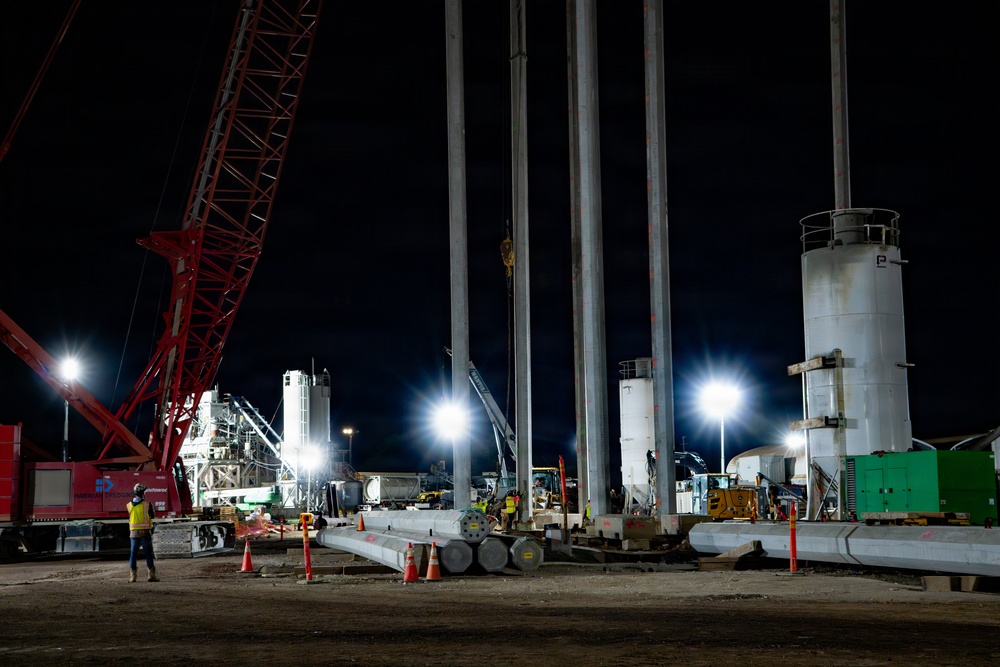
Photo By Jhewel Felipe | Multiple 137-foot crane rail piles stand ready for installation during overnight...... read more read more
JOINT BASE PEARL HARBOR-HICKAM, Hawaii – Few sailors will ever have the opportunity to support the Navy's largest military construction project. For a team of Seabee Engineer Technicians from Amphibious Construction Battalion ONE (ACB-1), led by Capt. Javier Lopez-Martinez, commanding officer of ACB-1, that opportunity came through a four-month overnight assignment with Officer in Charge of Construction Pearl Harbor Naval Shipyard (OICC PHNSY), led by Capt. Chris Coggins, commanding officer of OICC PHNSY, supporting construction of the future Dry Dock 5 (P-209).
Working overnight shifts from March through July 2026, the sailors joined OICC PHNSY engineers, construction managers and contractor personnel in providing engineering oversight, quality assurance, safety monitoring and project coordination during critical phases of overnight construction.
P-209, the future Dry Dock 5, is a cornerstone of the Navy's Shipyard Infrastructure Optimization Program (SIOP). Once complete, it will replace the aging Dry Dock 3 and provide Pearl Harbor Naval Shipyard and Intermediate Maintenance Facility (PHNSY & IMF) with its first new dry dock in nearly 80 years, expanding the Navy's ability to maintain and modernize submarines and other vessels throughout the Indo-Pacific.
But the project isn't just building infrastructure. It's building the next generation of Seabee Engineer Technicians.
For Engineering Aide First Class Daniel Julian, the assignment's greatest value came from working alongside civilian engineers and construction managers while gaining firsthand experience in the planning and coordination required to execute a project of this scale.
"This unique opportunity aligns with the redesign of the Naval Construction Force, particularly with Seabees and contractors working together on the Navy's largest military construction project," Julian said.
The partnership exemplified Poseidon's Corollary, a philosophy embraced throughout OICC PHNSY. Poseidon's Corollary recognizes that naval readiness depends on three interconnected elements: operational forces, resilient infrastructure and a capable workforce.
Senior Enlisted Leader Chief Petty Officer Randy Ramos, who also serves as an engineer technician at OICC PHNSY, said the overnight operation demonstrated that philosophy by pairing Seabees with government engineers and contractor personnel.
"The Seabees became an extension of our quality assurance team during critical overnight operations," Ramos said. "Their oversight helped verify contractor work met Navy engineering standards while giving them firsthand experience with large-scale military construction management."
Throughout the assignment, OICC PHNSY personnel, ACB-1 Seabees and industry partners worked side by side to deliver critical infrastructure while simultaneously developing the Navy's future engineering workforce.
Builder Second Class Charles Loucraft, an OICC PHNSY engineer technician, said the assignment exposed the Seabees to engineering oversight responsibilities rarely encountered during traditional construction assignments while supporting quality assurance during critical concrete placements and other waterfront construction activities. Steelworker Second Class Anastasia Fagins said the experience challenged common assumptions about the Seabee mission.
"Not every Seabee mission involves swinging hammers or operating heavy equipment," Fagins said. "This assignment puts us in the middle of engineering operations, monitoring safety, tracking quality control points and coordinating with civilian teams. It shows a side of what Seabees can do that most people never see."
"There are rare opportunities to support a project of this scale from the engineering side," she said. "It gave us a completely different perspective on how major military construction projects come together."
Steelworker Second Class Connor Harkins said the assignment opened his eyes to aspects of construction work rarely visible from a traditional Seabee billet.
"This project gave me experiences I never would have had in a typical Seabee role," Harkins said. "Working alongside the OICC PHNSY engineer technicians showed me the inner workings and behind-the-scenes coordination that drives a project of this scale."
That sense of purpose extended to the team's daily approach to work. Utilitiesman Second Class Jaime Orobio said what stood out most wasn't any single task, but the attitude the OICC PHNSY team brought to every shift.
"What makes me proud of OICC PHNSY is that they genuinely care about doing their best work," Orobio said. "They show up, work hard every single day and never get complacent."
Ramos said the project represented more than the construction of a new dry dock.
"The most important takeaway is that this project represents a seamless fusion of military precision and world-class engineering, where active-duty Seabees and civilians work hand in hand to build the future of our national defense," Ramos said.
As construction of P-209 continues, its impact is already evident in two ways: through the infrastructure taking shape below the waterline and the next generation of professionals being developed above it.
Long after construction is complete, P-209's legacy will extend beyond the dry dock itself. It will endure in the knowledge, partnerships and shared experience forged among the military, civilian and industry professionals who came together to advance the future of naval readiness.
| Date Taken: | 07.01.2026 |
| Date Posted: | 07.13.2026 16:47 |
| Story ID: | 569847 |
| Location: | JOINT BASE PEARL HARBOR-HICKAM, HAWAII, US |
| Web Views: | 369 |
| Downloads: | 0 |

This work, Learning Beyond the Build: Seabee Engineer Technicians Take on a Once-in-a-Generation Assignment, by Jhewel Felipe, identified by DVIDS, must comply with the restrictions shown on https://www.dvidshub.net/about/copyright.


No keywords found.





