
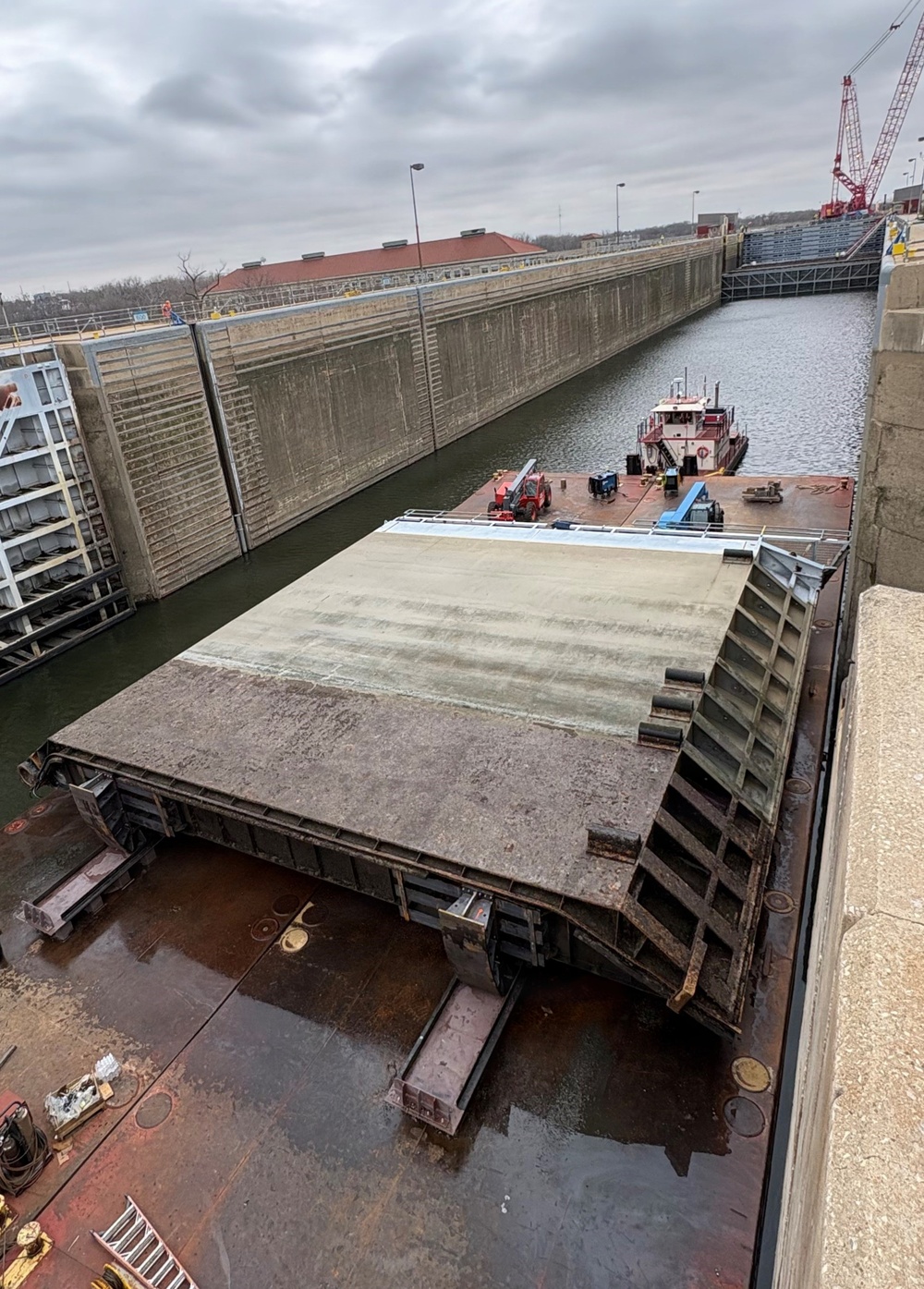
Courtesy Photo | A nearly 60-foot-tall miter gate removed from Lockport Lock is laid flat on a barge,...... read more read more
For more than 90 years, the Lockport Lock and Dam has served as a critical gateway on the Illinois Waterway, connecting the Great Lakes to the Mississippi River and supporting one of the nation’s most important inland navigation systems. Beginning March 31, however, the lock chamber temporarily fell silent as the Rock Island District began a major repair project designed to ensure the lock’s continued reliability for decades to come.
The scheduled closure, which ran through May 19, allowed crews to replace cracked pintle sockets on the downstream miter gates. This repair, officials say, was essential to the long-term integrity of the structure.
“These pintle sockets act as the primary hinges for the lock gates, and at Lockport they support some of the tallest gates on the Illinois Waterway,” said Cam Klein, chief of the Illinois Waterway Maintenance Section for the Rock Island District. “With a maximum lift of 39 feet, the structural forces on these gates are immense, so maintaining those components is absolutely critical.”
The need for the repair was discovered during a planned dewatering in 2025, when crews were installing new upstream gates and identified cracks in the existing pintle socket assemblies. The downstream gates have been in service since 1986 without major rehabilitation.
To keep the lock operating safely while permanent repairs were designed, engineers applied a carbon fiber-reinforced polymer wrap around the damaged hinge assemblies. The temporary reinforcement allowed commercial navigation traffic to continue moving through the lock while replacement components were fabricated.
During the closure, crews fully removed the cracked pintle sockets and installed newly designed replacements intended to simplify future maintenance efforts.
“The original sockets were welded directly onto the gates,” Klein said. “This time we installed a two-inch plate that’s both welded and bolted into place, allowing the new pintle socket to be bolted on instead of welded. If another replacement is ever needed in the future, the process will be much quicker and more efficient.”
Klein says the cracking stemmed largely from deterioration between the wall quoin blocks and the gate quoin blocks, which are the components responsible for transferring water pressure forces from the gates into the concrete lock walls. Over decades of operation, corrosion and water flow gradually increased the gap between the surfaces, forcing the gates to flex beyond their intended tolerances.
“As that gap increases, more stress gets transferred into the pintle assemblies and other structural components,” Klein said. “Those additional stresses are what ultimately led to the cracking we observed.”
In addition to replacing the pintle sockets, crews completed a series of other repairs and upgrades while the chamber was dewatered. Work included adjustments to service and emergency lift gate seals, installation of new concrete pads and ultra-high molecular weight polyethylene blocks, rehabilitation of strut arms on the lower miter gates, and replacement of existing I-bars.
The project highlights the collaborative capabilities of the Rock Island District’s maintenance workforce. Personnel and equipment from both the Illinois Waterway and Mississippi River Project Offices supported the effort, along with supplemental maintenance personnel from the St. Paul District.
“Jobs like these truly showcase the Rock Island District’s capabilities when both rivers come together,” Klein said. “Both maintenance sections bring diverse skill sets to the project, and both teams have learned from each other throughout the process.”
Although the Lockport facility falls in the Chicago District’s geographic area of responsibility, the Rock Island District retains maintenance responsibilities for the site, adding another layer of coordination.
“It creates challenges from a planning standpoint because we’re working with another district that may have different processes and procedures,” Klein said.
“There’s more coordination involved with engineering, operations and safety sections, but everyone involved worked together well to keep the project moving forward,” Klein added.
The temporary closure represented a short-term disruption for a waterway system that moves approximately 630 million tons of cargo annually, generates an estimated $350 billion in economic output and supports nearly 1 million jobs nationwide. The repairs are an investment in preserving the reliability of a system that remains vital to the nation’s economy.
| Date Taken: | 05.28.2026 |
| Date Posted: | 05.28.2026 11:35 |
| Story ID: | 566309 |
| Location: | LOCKPORT, ILLINOIS, US |
| Web Views: | 340 |
| Downloads: | 0 |

This work, Preserving the Future: Major Maintenance Repairs at Lockport Lock, by James Finn, identified by DVIDS, must comply with the restrictions shown on https://www.dvidshub.net/about/copyright.


No keywords found.





