
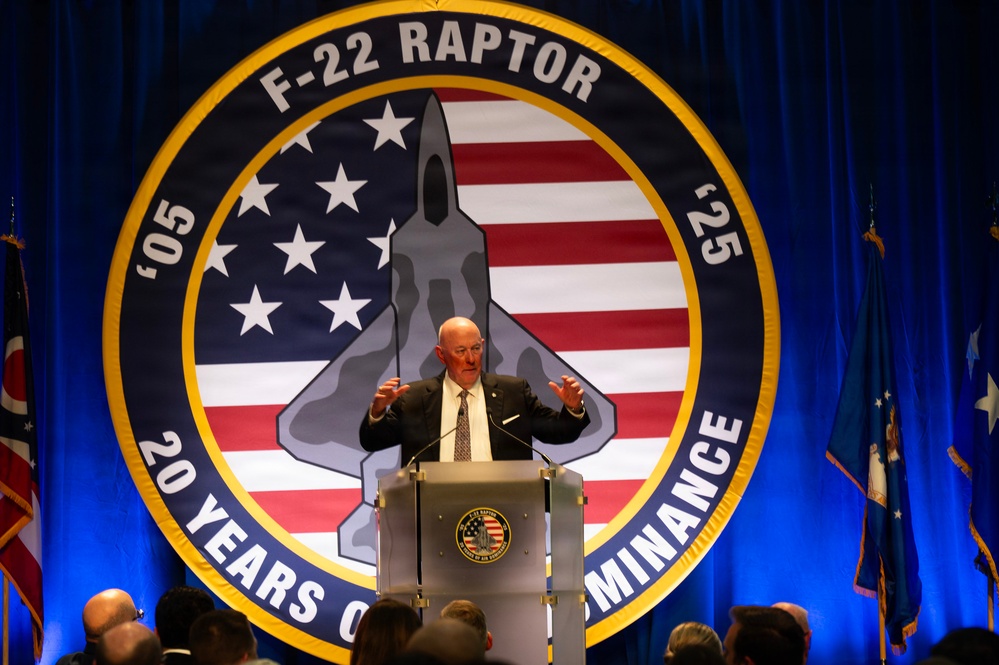
Photo By James Varhegyi | Retired Gen. T. Michael “Buzz” Moseley, who served as the 18th Air Force Chief of...... read more read more
 Subscribe
The Air Force Life Cycle Management Center’s F-22 Program Office, in partnership with the Dayton Development Coalition and Jobs Ohio, hosted a celebration at the National Museum of the United States Air Force on April 1, commemorating the F-22 Raptor’s 20 years of air dominance.
The event featured a distinguished list of guest speakers including, the DDC’s CEO Jeff Hoagland, the President and CEO of Jobs Ohio J.P. Nauseef, Nancy Pendelton, Vice President and Division Chief Engineer, https://www.boeing.com/defense, Jill Albertelli, President https://www.rtx.com/en/prattwhitney/products/military-engines, the F-22’s Program Office’s Deputy Director Brian Machuca, and retired Col. OJ “Slider” Sanchez who is currently the Vice President and General Manager for Lockheed https://www.lockheedmartin.com/en-us/who-we-are/business-areas/aeronautics/skunkworks.html ®. The event’s featured speakers included Lt. Gen. Linda S. Hurry, commander, Air Force Materiel Command, and retired Gen. T. Michael “Buzz” Moseley, who served as the 18th Air Force Chief of Staff.
Prior to the evening celebration, members of the F-22 Program Office and their families were treated to a private pet-the-jet event, where they could see the Raptor up close and talk with the pilots, Ringer and Hijack from the 71st Fighter Training Squadron, Joint Base Langley-Eustis, Va., who flew the stealth fighter in for the event. This was especially memorable because many of the F-22 workforce had never before seen the jet they had dedicated years of their lives supporting.
A flyover of the Raptor from the 71st kicked off the evening celebration.
From Concept to Combat
Born from Cold War anxieties and proven in post-9/11 conflicts, the F-22 Raptor has become one of the most capable fighters ever built, pairing stealth and raw performance in a package no rival has yet fully matched.
Conceived in the early 1980s as the Air Force’s Advanced Tactical Fighter, the Raptor was designed to counter a new generation of Soviet aircraft and surface-to-air missiles with unprecedented agility and low observability.
In 1986, the program entered its demonstration and validation phase, leading to two competing prototypes: Lockheed’s YF-22 and Northrop’s YF-23, both of which first flew in 1990.
After a flyoff-style evaluation, the Air Force selected the YF-22 in 1991 and awarded engineering and manufacturing development contracts to a Lockheed/Boeing team and engine maker Pratt & Whitney.
What followed was an intensive design and test campaign that included roughly 44,000 hours of wind tunnel testing and thousands of material trials before the first production-representative airframe took to the sky.
The Raptor emerged as a technological leap. It combined stealth shaping with advanced radar-absorbent materials, supercruise capability that allowed it to sustain supersonic speeds without afterburner, and extreme maneuverability enabled by thrust-vectoring nozzles and a highly integrated flight control system. The first F-22A was unveiled in 1997, and after extended operational testing, the jet formally entered U.S. Air Force service in December 2005. By then, its original mission had subtly shifted: in addition to air superiority, it was expected to carry out precision ground attack, electronic warfare, and intelligence, surveillance, and reconnaissance tasks using its powerful sensors and data links.
During his speech, Machuca highlighted the Raptor’s mission expansion and the collaborative, dedicated effort required to keep the United States at the forefront of aviation history. He emphasized the program’s motto, First Look – First Shot – First Kill, by outlining the fighter’s role in the Global War on Terrorism, countering Russian and, currently, Iranian forces, deterring China, and inspiring fear in adversaries by making the skies too dangerous for them to operate in.
Machuca thanked all the Raptor Nation, including the engineers, maintainers, and industry partners who transitioned the F-22 program from concept to reality. He also thanked the myriad of people who tirelessly work to provide a critical deterrent against global adversaries through their continuous modernization efforts.
Gen. Hurry echoed Machuca’s words when she described the Raptor Nation’s military-civilian teamwork as foundational not only for the F-22 program, but also to the broader Air Force mission.
“We drive speed. We drive Warfighter Readiness. We drive continuous modernization that makes our Air Force the greatest in the world. We clearly cannot do any of this without our industry partners. It is truly a team sport,” Hurry said. “From concept development during the height of the Cold War to operations today, the Raptor has given America unquestioned air-to-air advantage against any and all adversaries.
This program leads the way in fifth-generation interoperability. It can partner with collaborative combat aircraft for unmatched performance in the most contested of airspaces. This gives options to our nation's leaders and provides assurance for our joint partners that our Air Force controls the skies.”
If the Raptor’s development was long, its production run was surprisingly short. Initial plans called for hundreds of aircraft, but post–Cold War budget pressures and debates over cost versus need steadily whittled down the buy. A 2009 decision by the Obama administration and Congress capped production at 187 operational jets, and the final F-22 was delivered in 2012, leaving a total fleet of 195, including test aircraft.
The Raptor’s combat debut came in September 2014, when F-22s joined the opening night of airstrikes against Islamic State targets in Syria, striking a command-and-control facility with guided munitions. In the months that followed, Raptors flew more than 200 sorties over Syria, dropping hundreds of precision bombs, providing close air support, and using their sensors to coordinate the wider air campaign.
Beyond direct strikes, they played a quieter but influential role: during a later “combat surge,” F-22s were credited with deterring nearly 600 Syrian, Iranian, and Russian aircraft from aggressive maneuvers in crowded airspace, underscoring their value as a high-end presence platform.
For his part, keynote speaker Gen. Moseley played a pivotal role in developing the F-22. From his days as a major in the fighter mafia to declaring the Raptor Initial Mission Capable (IOC) in 2005 as the Air Force’s 18th Chief of Staff, his unwavering advocacy ensured the Raptor became the foundation of American air superiority.
During his talk Moseley traced a direct lineage from the pioneeringWright brothers, who did their work at Huffman Prairie, just a few short miles from where the celebration was occurring,to the courageousEscadrille Lafayette pilots of World War I, to the engineers who developed today’s premier stealth fighter. By highlighting theconcept of air dominance, Moseley argued that controlling the skies is not only a legal mandate but is a strategic necessity that prevents the stagnant, high-casualty ground slaughter seen in uncontested airspaces.
“Because of its unmatched ability to control the skies, the F-22 is referred to as the ‘Invincible Air Machine,’ said Moseley”. “It was specifically designed to provide essential air superiority for the entire joint military team. It is the modern apex predator stretching from a long legacy of American air dominance beginning with the very first American combat aviators in World War I through all the legendary aircraft that we are surrounded by here in this museum, and that brought us to today.”
An Enduring Legacy
Today, the F-22 remains the Air Force’s premier air-dominance fighter even as next-generation programs loom on the horizon. Though earlier plans envisioned beginning retirement soon, recent budgets allocated billions of dollars through the end of the decade for upgrades such as new stealthy fuel tanks and an infrared search-and-track system, signaling that the Raptor will likely stay in frontline service well into the 2030s.
Three decades after its first prototype flight, the aircraft that began as an answer to Soviet threats has instead become a hedge against emerging rivals, its record defined less by the number of bombs dropped than by the airspace no adversary has dared to challenge.
| Date Taken: | 04.01.2026 |
| Date Posted: | 04.10.2026 11:59 |
| Story ID: | 562446 |
| Location: | WRIGHT-PATTERSON AIR FORCE BASE, OHIO, US |
| Web Views: | 120 |
| Downloads: | 1 |

This work, First Look – First Shot – First Kill: The Raptor Nation’s 20 Years of Air Dominance, by James Varhegyi, identified by DVIDS, must comply with the restrictions shown on https://www.dvidshub.net/about/copyright.


No keywords found.




