
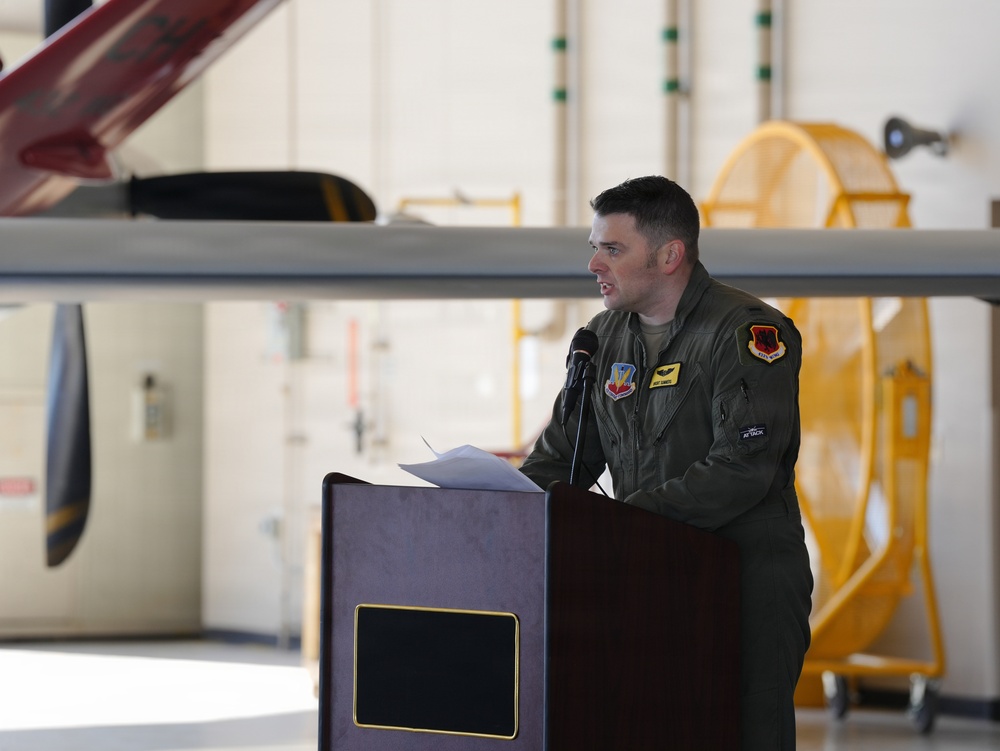
Photo By Senior Airman Renee Blundon | U.S. Air Force Lt. Brent Summers, 489th Attack Squadron MQ-9 pilot, presents opening...... read more read more
SHAW AIR FORCE BASE, S.C. – The 25th Attack Wing activated the 42nd Attack Squadron during a ceremony at Creech Air Force Base, Nevada, March 6, 2026. The activation signals a renewed investment in the MQ-9 Reaper community, increasing capacity across the remotely piloted aircraft (RPA) enterprise to deliver immediate and sustained advantages to combatant commanders operating worldwide.
The 42nd ATKS “Forty-Deuce” is one of the Air Force’s oldest squadrons with roots tracing back to the 42nd Aero Squadron in 1917 and was the first squadron to fly the MQ-9 Reaper. Before its planned dormancy in January of 2020, its Airmen generated 180,000 combat hours and 11,246 sorties in support of operations like INHERENT RESOLVE and FREEDOM SENTINEL.
The inactivation was a strategic pause, positioning the MQ-9 community to better prepare remotely piloted weapons systems in contested environments of the future. U.S. Air Force Col. Landon Quan, 25th ATKW deputy commander, the then-squadron commander for the 42nd ATKS once said, “We will cease to exist for a little bit but I’m confident we will come back and be stronger than ever.”
That prediction has now come to fruition. The 42nd ATKS, a combat flying squadron for the 25th ATKW, will once again conduct conventional MQ-9 operations in support of overseas contingency operations.
“A lot of things have changed in the community and will continue to change, but there are great Airmen who are willing to do great things to serve their nation,” said Quan. “This activation postures the wing to fit into a two-phase, 6-month Air Force Force Generation cycle, enabling those great Airmen for increased high-end training which bolsters overall readiness for global tasks.”
From a strategic perspective, the activation improves force presentation and combat readiness across the MQ-9 fleet. The additional squadron enhances battlespace awareness, shortens response times to dynamic targets and improves integration with joint and allied forces. This added resilience allows the broader RPA force to shift postures more effectively within the AFFORGEN cycle, delivering sustainable readiness and responsive capabilities to joint force mission priorities.
The stand-up was a monumental effort, requiring experienced personnel to be sourced and integrated, infrastructure to be prepared and new operational workflows to be established to ensure the squadron was combat-ready from day one. By alleviating pressure on legacy squadrons, the enterprise achieves improved long-term deployment rotation sustainability, ensuring the MQ-9 remains a cost-effective, high-endurance platform well into the era of peer competition.
“The 42nd ATKS brings a legacy of conventional operations into ACCs lead conventional MQ- 9 wing,” said Quan. “Having that experience provides a truly unique opportunity and enables squadrons to prepare to enter theaters and to training enabling continuity of operations and expertise in those areas of operations.”
The return of the “Forty-Deuce” reinforces the RPA community’s role as a vital enabler for U.S. and partner objectives. It delivers persistent ISR and strike support where and when it matters most while building a more robust and adaptable MQ-9 force for the challenges ahead.
| Date Taken: | 03.26.2026 |
| Date Posted: | 03.27.2026 14:10 |
| Story ID: | 561458 |
| Location: | US |
| Web Views: | 230 |
| Downloads: | 1 |

This work, Strategic Resurgence: 42nd Attack Squadron Rises from Dormancy, Fortifying MQ-9 Enterprise, by SrA Kylie Barrow, identified by DVIDS, must comply with the restrictions shown on https://www.dvidshub.net/about/copyright.


No keywords found.





