
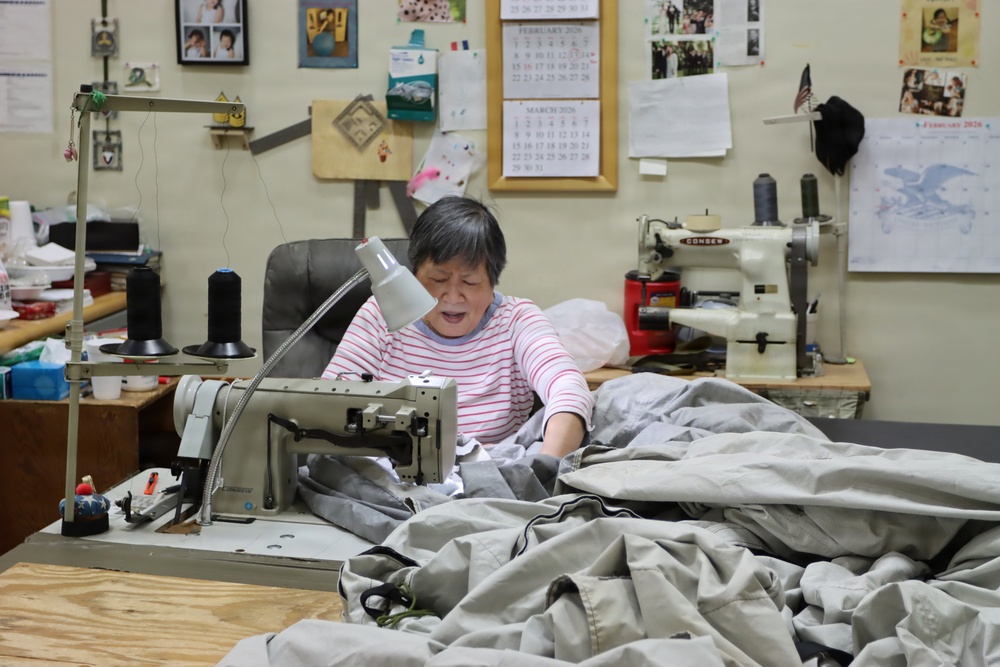
Photo By Aaron DeCapua | FORT WAINWRIGHT, Alaska — Jui-Lien Czyzewski, a fabric worker with the Logistics...... read more read more
FORT WAINWRIGHT, Alaska — In the Arctic, readiness and survivability are inseparable. Extreme cold, persistent moisture and unforgiving terrain place demands on Soldiers and equipment rarely encountered elsewhere in the Army. Equipment failures are not inconveniences — they can directly affect safety, endurance and mission success.
Sustaining that level of readiness requires more than supply systems and maintenance schedules. It demands specialized expertise.
Lt. Col. Eric J. Erickson, commander of Army Field Support Battalion-Alaska, said innovation in the Arctic is defined by immediacy and practicality.
“Innovation here is mission-driven,” Erickson said. “It might look like fabrication capability at Fort Wainwright that allows us to solve problems immediately instead of waiting on outside support. In this environment, there is no backup plan. You either figure it out, or you go without.”
For more than 24 years, Jui-Lien Czyzewski, a fabric worker at the Fort Wainwright Logistics Readiness Center under Army Field Support Battalion-Alaska, has provided that capability. Her technical skill and craftsmanship play a critical but often unseen role in supporting Arctic formations operating in one of the Army’s most demanding environments.
When leaders from the 402nd Army Field Support Brigade and Army Sustainment Command visited her shop Feb. 9, 2026, Czyzewski was engaged in the detail-oriented work that has defined her career. Projects underway included custom fabrications supporting unit requirements and repairs to a tent system destined for Soldiers preparing for a Joint Pacific Multinational Readiness Center rotation.
At installations supporting Joint Pacific Multinational Readiness Center exercises, operational tempo and environmental stressors increase equipment demands. Fabric systems, shelters and extreme-weather gear experience accelerated wear, often requiring immediate repair to remain serviceable.
“JPMRC doesn’t replace our steady-state mission — it adds to it,” Erickson said. “We’re already operating at a high tempo across three installations. Exercises like JPMRC allow us to synchronize support at scale and reinforce the systems we use every day under increased demand.”
“If it’s made from fabric, vinyl or thread, she’s the one who can make it happen,” said Ryan Krueger, Logistics Readiness Center chief of maintenance.
Czyzewski’s expertise extends beyond routine alterations. She performs specialized repairs on high-value equipment that would otherwise require costly replacement or shipment to external vendors. Among the most demanding tasks is the repair of firefighter protective equipment, a process requiring manufacturer certification due to the life-safety nature of the gear.
That capability carries significant readiness and resource stewardship implications across the installation. Firefighter bunker gear, including coat and pants, costs more than $3,800 per set. Having certified repair capability at Fort Wainwright extends the lifespan of this equipment, reduces replacement costs and preserves operational readiness for emergency response personnel. The same expertise supports Central Issue Facility operations, where salvageable items can be restored rather than discarded.
“Approximately 97 percent of our workforce is civilian,” Erickson said. “They are the foundation of our mission. Without specialized skills like fabric repair, we would be replacing equipment instead of extending its life. Arctic readiness depends on their expertise.”
Maj. Gen. Eric P. Shirley, commanding general of Army Sustainment Command, emphasized the operational value of specialized sustainment capabilities during the visit.
“The precision and technical skill required for this kind of work is remarkable,” Shirley said. “Capabilities like this directly enable readiness by extending equipment life, preserving resources and ensuring Soldiers can operate effectively in extreme conditions.”
Czyzewski is perhaps best known for her meticulous work ensuring the serviceability of vapor barrier boots, commonly known as “bunny boots,” a cornerstone of Arctic Soldier protection. Each year, approximately 6,800 pairs move through her shop for inspection, testing and repair. Even minor material failures can compromise insulation and introduce moisture, rendering boots unserviceable in subzero conditions.
Beyond repairs, her work includes custom fabrication projects tailored to unit needs — protective covers, liners, ahkio sled modifications, tent repairs and equipment adaptations designed specifically for Arctic use. These projects support units preparing for cold-weather operations by ensuring critical equipment remains functional in Alaska’s demanding environment.
In Alaska, distance and climate amplify every sustainment challenge. Replacement items are not always readily available, and transportation timelines are extended. On-site expertise becomes a decisive readiness multiplier. For more than two decades, Czyzewski’s craftsmanship, technical knowledge and commitment to excellence have ensured equipment supporting Arctic Soldiers remains functional and mission-ready.
In the Arctic, those outcomes matter.
| Date Taken: | 03.02.2026 |
| Date Posted: | 03.03.2026 19:41 |
| Story ID: | 559242 |
| Location: | FORT WAINWRIGHT, ALASKA, US |
| Web Views: | 99 |
| Downloads: | 0 |

This work, Sustaining Arctic Readiness: Jui-Lien Czyzewski’s Enduring Impact at Fort Wainwright, by Aaron DeCapua, identified by DVIDS, must comply with the restrictions shown on https://www.dvidshub.net/about/copyright.


No keywords found.





