
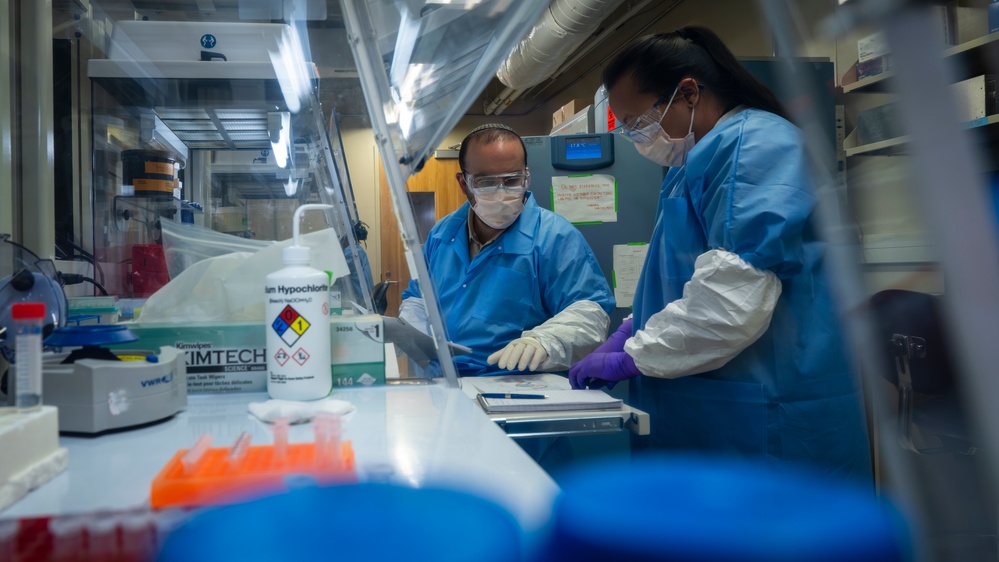
Photo By Staff Sgt. Noah Coger | Mandalay Singleton (right), Armed Forces DNA Identification Laboratory past accounting...... read more read more
DOVER AIR FORCE BASE, Del. -- Two scientists from the Israel Defense Forces (IDF) Genomic Laboratory trained at the Armed Forces Medical Examiner System’s Armed Forces DNA Identifications Laboratory (AFMES-AFDIL) over the course of seven days, Nov. 17-26, 2025.
The two scientists gained more insight into AFMES-AFDIL’s newly developed Single Nucleotide Polymorphisms (SNPs) Next-Generation (DNA) Sequencing method (NGS-SNP). The NGS-SNP method amplifies approximately 95 thousand nuclear SNPs and sequences them for use in several different applications. In the case of AFMES-AFDIL, the process is used to help determine the identity of missing or unknown service members from World War II, the Korean War, Vietnam and the Cold War. The method was developed to work with highly degraded and chemically treated samples.
“The beauty of this method (SNPs) is that it turns anyone who's within four generations of a missing service member, meaning a first cousin once removed, a great aunt or uncle, whether through the paternal or maternal side, doesn't matter, that individual can become a nuclear reference,” explained Dr. Timothy McMahon, Department of Defense DNA Operations director. “So, it has a lot more strengths than the current Short Tandem Repeat (STR) methods that your state and local crime labs use.”
The NGS-SNP method of identification can prove especially useful in the case of a mass-casualty event or over the course of an active conflict where traditional STRs do not work. It is resolving cases that have been stalled for years because there wasn’t an appropriate reference available to help distinguish the identities between two people. In 2024, the Defense POW/MIA Accounting Agency (DPAA) made 172 new identifications. In 2025, the DPAA accounted for 321 unknown service members, a 25 percent increase. This increase was due to the NGS-SNP method that AFMES-AFDIL brought online in February of this year.
“After the events of October 7th, there was a large number of fatalities both with Israeli civilians and military,” said McMahon. “We assisted with some very difficult samples that were severely charred. The training of the IDF scientific staff allows the transition of cutting-edge scientific methods and knowledge that will help the IDF with other types of mass disasters or conflict scenarios.”
For Reouven Berdugo, IDF Genomic Laboratory for Casualty Identification director, this was his third time coming to AFMES to learn and share knowledge with AFDIL.
“Every time I’m here, I learn different methods that they have developed, accredited, and validated, that we can bring back and implement it in our laboratory,” said Berdugo. “Previously, we learned a new method for extracting DNA from bones, like we had, unfortunately, during the war, that were difficult to extract in the natural way. Here, we learned about two methods, the Demin method and the Dabney method for DNA extraction. Once we learned about it, got the related standard operating procedures (SOPs), and brought it home, we successfully managed to do it ourselves. That helped us during the war to identify some samples, that without this method of extraction, we would have not been able to do.”
The two organizations have been partnering for over 10 years. The ongoing collaboration is about the exchange of valuable information as well as training on some of the most up-to-date methods for genetic sequencing.
“In 2015, a delegation from the IDF came to AFMES to learn about developing a DNA laboratory capability,” said McMahon. “I presented lectures to them for about a week on DNA and how to develop a DNA Forensic Laboratory, and then we assisted the IDF with setting up their first DNA identification laboratory.”
These exchanges allow the two to better understand each other’s mission, which can further shape processes and assist in planning for different scenarios.
“They are charged to do a lot of the same things we do, but slightly different,” said McMahon. “For example, it has been explained to me that a Rabbi is the only one who can present a finding of death and identity. And, they have certain constraints due to their religion, like, they can only take the smallest possible portion of a sample and then they have to identify the individual within 24 hours.”
These unique circumstances can lead to new developments that can be mutually beneficial, ultimately leading to developments that grow their unique missions and assist other laboratories around the world.
“For our mission, the benefit is they develop things that are different from ours,” said McMahon. “We're sharing information with regards to potential deployable lab capabilities. For example, after October 7th, they were using rapid DNA instruments. These are instruments that proved to do fresh tissue and bone very well and it’s only 90 minutes per sample. If something was to occur and AFMES had to deploy to another site, these instruments are deployable and can support continuity of operations plans.”
This time around, the guests learned about new methods for kinship analysis for missing or deceased soldiers from prior conflicts.
“Since the creation of the Jewish state in 1948, we have a series of missing dead soldiers,” explained Berdugo. “We are looking to identify them using distant relatives like cousins, second cousins, something like that and our current methods may not be strong enough.”
With SNPs, kinship analysis can be performed using distant family members, not just close or maternally related individuals. This allows for the comparison of samples of relatives as distant as the fourth degree, for example, a great-grand niece could be used to identify an individual.
“This can be very helpful for us,” declared Berdugo. “Hopefully what we will be learning here now, we can bring home. It might take a while to implement it because it's a difficult operation, but it will be worth it once it’s complete.”
The training has been beneficial for both the guests and AFMES-AFDIL staff by giving trainers, DNA technicians, and analysts the opportunity to provide training, manage, and work with individuals outside the organization, as well as creating a training program specifically for rapid learning.
“We were tasked with creating a new training program for our SNP process,” explained Suzanne Shunn, AFDIL Training and Education manager. “This included both building training lectures, teaching them the concepts behind our processes, as well as organizing time to observe those processes and get the hands-on experience within our labs.”
For all involved, the experience has been a success.
“The team here, everyone, every lab technician, every scientist is very kind,” said Berdugo. “They know their stuff, know how to instruct and are very professional. They're very, very great to work with.”
Both are looking forward to future engagements and the potential to expand the partnership.
“It's great having them here,” said McMahon. “It's great having a partner like that and knowing that if we need them or they need us, we’re both there.”
| Date Taken: | 12.09.2025 |
| Date Posted: | 12.09.2025 11:03 |
| Story ID: | 553517 |
| Location: | DOVER AIR FORCE BASE, DELAWARE, US |
| Web Views: | 217 |
| Downloads: | 0 |

This work, AFDIL partners with IDF Genomic Laboratory, by SSgt Noah Coger, identified by DVIDS, must comply with the restrictions shown on https://www.dvidshub.net/about/copyright.


No keywords found.





