
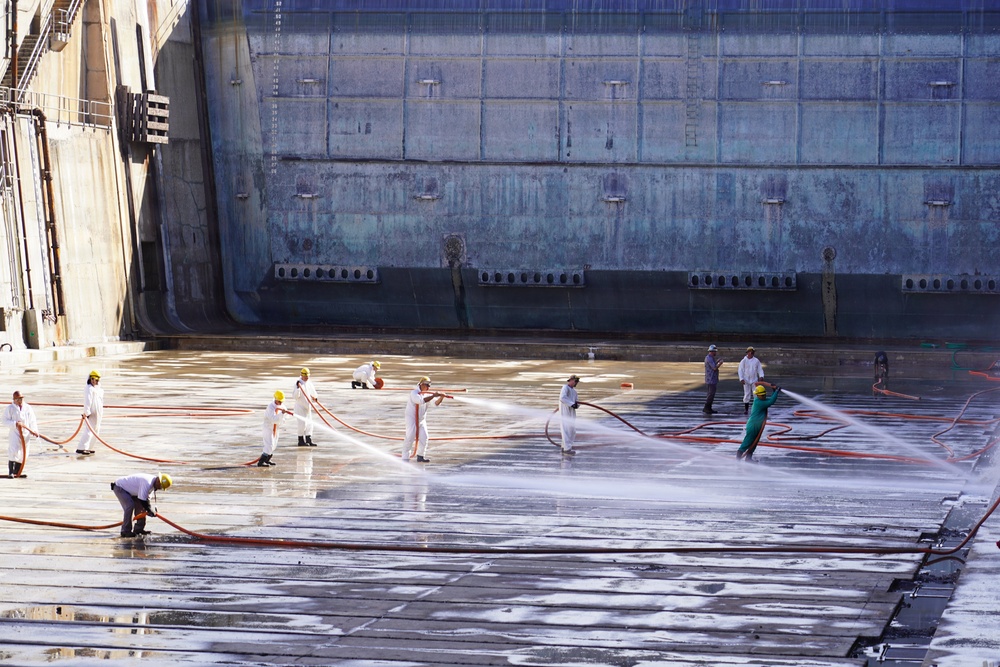
Photo By Justice Vannatta | Workers perform a basin washdown of Dry Dock 2 immediately following dry dock...... read more read more
PEARL HARBOR, Hawaii - Shipyard workers at Pearl Harbor Naval Shipyard and Intermediate Maintenance Facility (PHNSY & IMF) recently completed a rapid two-week turnaround of historic Dry Dock 2. The operation involved undocking a U.S. Navy submarine and immediately preparing the dock structure to receive a second vessel. This expedited schedule required precise coordination across multiple industrial departments to meet strict fleet readiness timelines. Preparing a dry dock for a submarine requires a unique docking keel block pattern tailored to the specific hull design and structural configuration of the incoming vessel. Shipwrights configured and positioned more than 100 individual keel, side, and roll-off blocks. Because of the variation in submarine configurations, reusing the block layout from the previous vessel was not an option. The blocks, composed of heavy concrete bases topped with specialized timber capping, must withstand thousands of tons of downward force once the dock is dewatered. "The block sizes range from 3,000 to 48,300 pounds," said Christophe Jackson, Code 900F.31 dry docks and piers branch head. "It’s an incredible amount of weight to move to within one-eighth of an inch in all three dimensions. An operation of this magnitude leaves zero room for error." The compressed two-week timeline left only a few days to identify and resolve any structural or mechanical deficiencies within the dry dock. Because key components such as flooding valves, sluice gates, and caisson seals can only be fully inspected and serviced when the dock is empty or during active flooding and dewatering, the maintenance window was highly restricted. Engineering technicians worked around the clock to certify the dock's integrity before the next vessel arrived. This high-stakes operation relied on coordination among several non-visible support departments. Riggers from Code 740 manually manipulated the massive steel caissons, the floating gates that seal the dry dock entrance, using heavy-duty ropes and winches. These personnel operated under demanding physical conditions, managing the heavy structures while contending with shifting harbor currents and coastal winds to ensure a precise seal against the dock sill. Concurrently, pumpwell mechanics and electricians from Shop 99C managed the critical flow of water. Flooding and dewatering Dry Dock 2 requires the controlled movement of more than 12 million gallons of seawater. Working in underground pumpwells, the team monitored high-capacity drainage pumps, electrical switchgears, and valves to safely lower and raise the water level, keeping the vessel stabilized as it drafted onto the block build. Construction on the starboard rail of Dry Dock 2 temporarily disabled the portal crane typically used to operate flooding components. To maintain the project schedule, Code 740 Rigging and Equipment Operations deployed a mobile truck crane to handle the flooding gear. Below the surface, the shipyard's diving department conducted real-time underwater inspections, verifying block alignments and clearing debris to prevent hull damage during the landing phase. Compounding the logistical complexity, the shipyard integrated a third major evolution into the two-week schedule. The team coordinated the transfer of one of the Dry Dock 2 caissons to Dry Dock 4 to undergo a mandatory 10-year overhaul. This required towing the massive steel barrier across the harbor and aligning it into the secondary dock, running parallel to the ongoing docking and undocking preparations at Dry Dock 2. The successful execution of these three major naval engineering evolutions within a compressed timeframe ensures that Dry Dock 2 remains fully operational to support the U.S. Navy's Pacific Fleet. The integration of shipwrights, riggers, pumpwell operators, and divers highlights the industrial capability required to maintain undersea superiority.
| Date Taken: | 08.13.2026 |
| Date Posted: | 08.13.2026 19:43 |
| Story ID: | 572385 |
| Location: | PEARL HARBOR, HAWAII, US |
| Web Views: | 36 |
| Downloads: | 0 |

This work, The Impossible Turnaround of Dry Dock 2 at PHNSY, by Justice Vannatta, identified by DVIDS, must comply with the restrictions shown on https://www.dvidshub.net/about/copyright.


No keywords found.





