
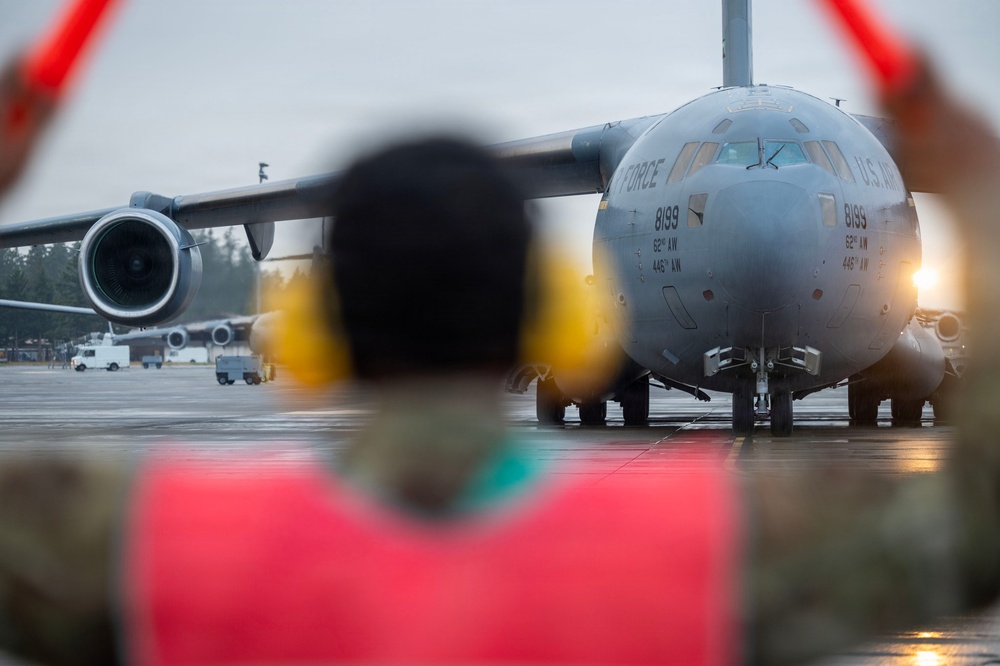
Photo By Senior Airman Benjamin Riddle | An Airman assigned to the 62d Aircraft Maintenance Squadron’s Phoenix Aircraft...... read more read more
Joint Base Lewis-McChord provides 40 C-17 Globemaster III’s to the Joint Force, executing nearly 34% of Air Mobility Command’s airlift operations. With that level of support, it’s vital that each C-17 remains fit to fly. That’s where the 62d Airlift Wing’s Aircraft Maintenance Units come into play.
AMUs are tailored organizations under the 62d Aircraft Maintenance Squadron designed to meet the specific needs of each 62d AW flying unit. The Dragon AMU assigned to the 8th Airlift Squadron and the Knight AMU assigned to the 4th AS ensure vital maintenance needs are met at home station and abroad. While all of the AMUs can support any C-17 at JBLM, they typically deploy with their associated squadrons, fostering continuity downrange.
To prepare for future and on-going combat and humanitarian operations, the 62d AMXS has stood up a third AMU to support their last flying squadron: the 7th Airlift Squadron, now supported by the Phoenix AMU.
“It's important to have three AMUs because when it comes down to how our C-17s are allocated for missions, it allows us to better prepare,” said Senior Master Sgt. David King, 62d AMXS superintendent for the Phoenix AMU. “It also aligns us with our deployment cycles. When we train, when we equip, when we prepare, we're doing those things with the airlift squadrons we’re matched with. When our active bin comes up, we've already built that team and family over the last 18 months, so when we step out that door, we’re prepared.”
The inception of the Phoenix AMU equalizes capabilities across the JBLM C-17 fleet. More directly, it allows the various maintenance Airmen under the 62d AMXS to align under one banner, supporting the 7th AS without pulling away from the other two AMUs.
“We're trying to ensure that the three AMUs are mirrored when it comes to people, the aircraft, and the mission,” King said. “There's not one that's specialized or has different capabilities. The three AMUs have the same number of personnel, same career fields, same number of aircraft, same type of aircraft. If one unit leaves, we don't run out of capability.”
The Phoenix AMU not only provides more capability, but also opportunity for improvement.
“We’re posturing ourselves as a test bed and taking a lot of the ideas of the junior enlisted and trying to see if they can work,” said Master Sgt. Eric Peters, 62d AMXS production superintendent for the Phoenix AMU. “We’re trying to be as open to feedback and new ideas as possible. We’ve been successful in some ways, unsuccessful in others. We’re hoping to take all of these lessons learned and culminate them into better maintenance practices for everyone.”
One of the ideas the Phoenix AMU has experimented with is aligning shifts to allow Airmen to communicate with one another before a shift change. This also enables networking between Airmen within the AMU, who may not have known one another previously due to conflicting schedules.
“Each shift comes in two hours before the last shift leaves,” said Staff Sgt. Morcussio Campbell, 62d AMXS dedicated crew chief for the Phoenix AMU. “In the past, you may have had people on the schedule for eight hours, five days a week, but because there isn't on the line turnover, they end up staying 10 hours anyway. It alleviates a lot of stress. It also forces us to work together and learn each other's jobs.”
Another advantage of the new schedules is allowing Airmen to network with neighboring career fields, something that will ultimately aid readiness when downrange. These changes are part of a larger mentality which encourages a level of trust between Airmen of different career fields. That trust has become a core value embedded within the Phoenix AMU, one that is not only reinforced by culture, but has been deliberately outlined in the doctrine that guides the AMU.
“We’re specifically trying to write into our doctrine that we’ll trust people until proven otherwise,” said Peters. “We’ll have that solid relationship so that when push comes to shove and things are time critical, we can trust each other to execute the mission.”
A large part of that culture was developed when the Phoenix AMU received its first major project: the acceptance of aircraft 8199.
“In 2020, aircraft 8199 took a nosedive while downrange, and ended up going to depot repair for five years or so,” said King. “During that time, they not only repaired all of the structural damage it received, but they ended up taking a bunch of parts off to utilize elsewhere in the fleet. 8199 almost served as a proof of concept for our ability to take a jet that’s been broken down for so long and bring it back to a serviceable aircraft.”
Although the capabilities of the Phoenix AMU mirror its two counterparts, the resurrection of aircraft 8199 was no simple task.
“When you tear a plane down to that level, there's a lot of hesitation around flying it because it hasn't flown for years,” said King. “I think standing up a third AMU comes with that same unease, that same anxiety. The expectation is that it’s going to fail. There were definitely some shortcomings that we didn't know we had until we stood up. We applied that same resilience to 8199. We said, ‘Let's keep fixing this, let's keep nurturing it, and then eventually it will fly.’”
Within roughly a month of the aircraft returning to JBLM, it was ready to fly again.
“It was hundreds and hundreds of manhours,” said Peters. “8199 just happened to be the C-17 that was down for a long time, had the most maintenance work to be done, and happened to be the first one we had to accept when we were brand new. Standing up a new AMU and then having that significant challenge to kind of throw ourselves at was crucial to proving to ourselves that we are a full maintenance team, and we can do this.”
With the successful revival of aircraft 8199, the Phoenix AMU is ready to support the 7th Airlift Squadron, and the 62d Airlift Wing, anytime, anywhere.
“At the end of the day, we as a squadron owe mission deliverables,” said King. “We’re still the 62d AMXS supporting the 40 C-17s at JBLM. For us, the change comes in the culture. Forging with trust, mastering the pace, and rising to the challenge are our three cultural items that tie into this idea of the phoenix. For some reason, we tend to align our value with how much we are giving as maintainers, which is something we're trying to change over here. When you deploy and you go TDY, you rarely talk about the location. You more or less talk about what you overcame. After everything, that's what we’re talking about. It's about preventing burnout, and encouraging resiliency, demonstrating that nothing is beyond repair.”
| Date Taken: | 07.22.2026 |
| Date Posted: | 07.22.2026 22:53 |
| Story ID: | 570556 |
| Location: | JOINT BASE LEWIS-MCCHORD, WASHINGTON, US |
| Web Views: | 168 |
| Downloads: | 0 |

This work, Maintaining Airlift Effectiveness: 62d AMXS stands up Phoenix AMU, by TSgt Blake Gonzales and SrA Benjamin Riddle, identified by DVIDS, must comply with the restrictions shown on https://www.dvidshub.net/about/copyright.


No keywords found.





