
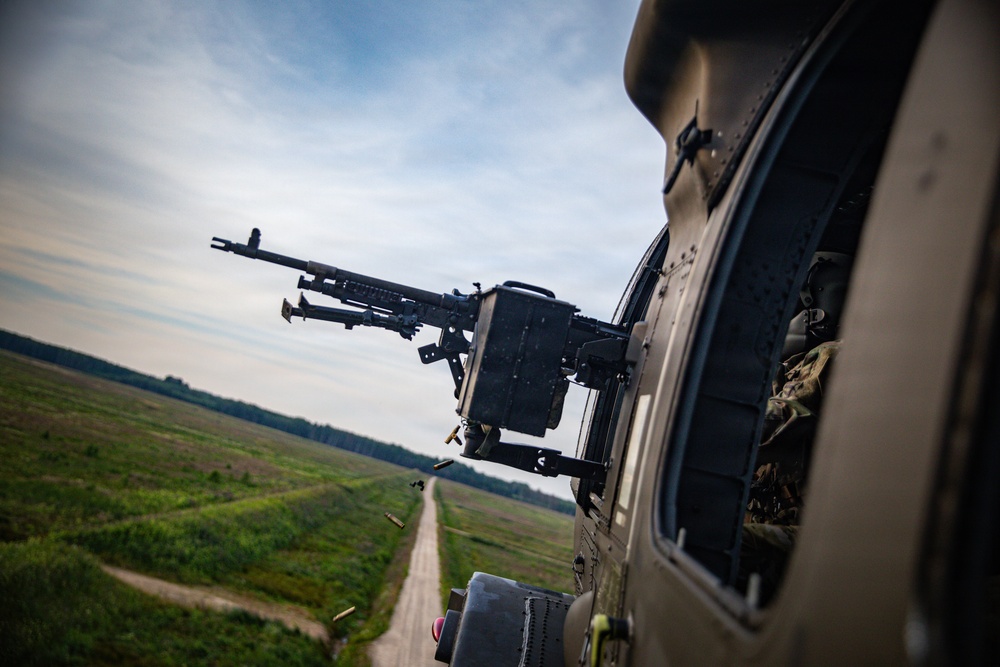
Photo By Sgt. Max Elliott | U.S. Army Sgt. Madison Albers, a UH-60 Black Hawk helicopter crew chief assigned to...... read more read more
 Subscribe
LIELVĀRDE AIR BASE, Latvia — Before the first round left the barrel, the floor of the hangar disappeared beneath brass.
Linked 7.62 mm ammunition ran in ribbons across the concrete, thousands of rounds belted by hand and coiled into cans, each destined to feed a machine gun mounted in the door of a UH-60 Black Hawk helicopter. For the Soldiers of Bravo Company, 3rd Assault Helicopter Battalion, 1st Aviation Regiment, 1st Combat Aviation Brigade, 1st Infantry Division, the work was the quiet start of one of Army aviation's most demanding tests: the aerial gunnery qualification.
Flown over several days in mid-July 2026, the qualification moves through a series of graded tables. Early tables let crews rehearse the range dry and fire blanks to learn target locations; the live-fire tables that follow put pilots and crew chiefs under evaluation together, by day and by night, first as individual aircraft and then as multi-ship formations.
"They all fall under the aerial gunnery umbrella," said 1st Lt. Alejandro Robles, an air assault platoon leader with the battalion. "Table III (3) is a dry run, where you go through the course, and then you go through 4, 5 and 6 for day and night."
The Black Hawk is a utility aircraft built to move Soldiers, equipment and sling-loaded cargo, not an attack platform. But the door guns give crews a way to defend the aircraft, and the qualification keeps a perishable skill sharp.
"We only do this every six months," said Spc. Joseph Grandy, a Black Hawk Repairer and flight instructor with the battalion who coaches newer crew chiefs on the M240 machine gun. "Maybe you go all the way through your initial training as a crew chief, and you've never even touched a machine gun. For those new guys, it's really their first time hands-on."
Grandy's job in the air is to talk those gunners onto their targets, correcting a burst that lands too high or too low, or walking a Soldier through a weapon malfunction mid-flight. "It's really fulfilling to be able to see new guys go from being a maintainer to operating in the aircraft as part of the crew," he said.
The training also looks ahead. Robles said the Latvian military flies its own UH-60 aircraft, and the battalion has a range scheduled in August to begin training Latvian crews on the same early tables. "It's gonna train up the Latvian soldiers so that they can start doing Tables 2 through 6 as well," he said, "and kind of get an idea of what we do."
For Robles, on his first deployment as a platoon leader, he said the qualification came down to the people who made it happen: the pilots planning and flying, the crew chiefs on the guns, the support Soldiers in the tower and at the refuel point.
"I'm just really proud of all the cohesiveness that we had today that made it all happen," he said. For the crews, the qualification is less about seeking a fight than being ready for one. The Black Hawk carries Soldiers, not the fight to the enemy, but the guns in its doors mean the crew is never without an answer. "We're not an attack platform, we're a utility platform," Grandy said. "But we have to be able to defend ourselves if needed."
Six months from now, they'll do it again, because the day you need the gun is not the day you learn it.
| Date Taken: | 07.13.2026 |
| Date Posted: | 07.23.2026 08:07 |
| Story ID: | 570291 |
| Location: | LV |
| Web Views: | 14 |
| Downloads: | 0 |

This work, Belts, blades and Black Hawks: 1st Infantry Division aircrews qualify on aerial gunnery in Latvia, by SGT Max Elliott, identified by DVIDS, must comply with the restrictions shown on https://www.dvidshub.net/about/copyright.


No keywords found.




