
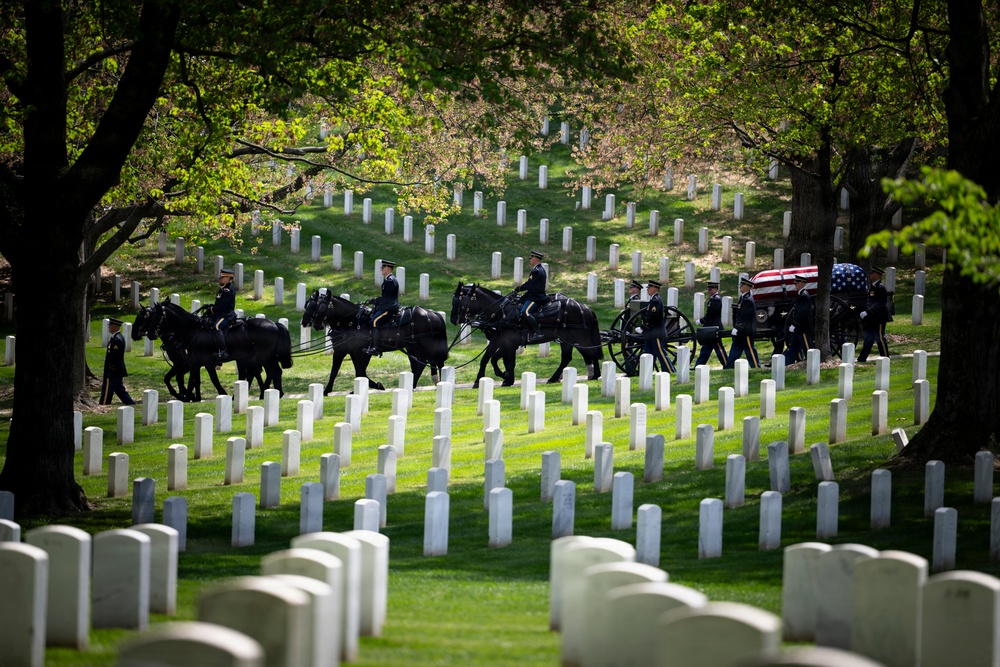
Courtesy Photo | Soldiers from the 3d U.S. Infantry Regiment (The Old Guard), the Caisson Detachment...... read more read more
It’s a solemn sight. You have read about it, seen it in books, online articles, even on television. But something about today, this moment, defies articulation. You are surrounded by people, yet only one figure moves: the sentinel pacing his measured line. His footsteps are the only sound you truly register, even as birds chatter and distant traffic hums.
Then a bright ray of light breaks over your shoulder as the sun edges above the horizon. Morning has arrived. With it comes a heavy realization: the grandeur isn’t just in the marble sarcophagus before you or the endless rows of white headstones stretching across the hills. It’s everything. The weight of memory. The cost of service. The quiet dignity of a nation remembering its own.
For a brief moment, time seems to stand still at the Tomb of the Unknown Soldier.
As our Nation celebrates its 250th birthday, we find ourselves standing at the intersection of memory and celebration. There is much to honor and reflect upon as this milestone nears. Triumphs and trials, moments of unity and moments of reckoning, and hope carried forward by generations. It is a celebration, but also a solemn remembrance and a quiet anticipation of the future.
Few places on Earth hold these emotions so completely as this moment at our Nation’s most hallowed tomb. It is where the lives and legacies of generations gather and remind us of that foundation upon which our Nation stands.
Following the conclusion of World War I, the Nation was struck with grief as it reckoned with the over 53,000 lives lost during the conflict. That grief was deepened by the thousands of American families who had no grave to visit, and by the many who fell in Europe whose identities were lost to the brutality of modern warfare. On March 4, 1921, Congress approved the burial of a single unidentified Soldier. That same Armistice Day, he was laid to rest in the plaza of the Memorial Amphitheater. This single Soldier represented all who never returned.#_ftn1
Since then, the Tomb has grown to include Unknowns from later conflicts, each chosen to represent the countless lives whose stories ended far from home. The marble sarcophagus placed in 1932 bears a simple yet powerful inscription: “HERE RESTS IN HONORED GLORY AN AMERICAN KNOWN BUT TO GOD.”
The Tomb has been guarded without interruption since 1937.#_ftn2 The presence of the sentinel signifies the Nation’s promise of remembrance and a quiet assurance that some stories must never be allowed to slip into silence. Together, the guard and the Tomb stand as symbols of a Nation that observes, values, and protects its history while honoring all those whose lives helped shape the freedoms we know today.
For that reason, history is more than a record of events. It is the architecture of our national identity. It creates continuity that, without it, would fracture our sense of who we are and who we hope to become. It explains how we arrived at this moment with the institutions we built, the values we inherited, the conflicts we endured, and the triumphs we achieved. It reminds us that our shared identity was not formed in an instant but shaped over generations by people whose stories echo in the world around us and influence our lives.
While cemeteries hold the memories of those who have closed their final chapter, many stories are still being written by the living. Our Nation was built by people from every walk of life, each leaving their mark in different fields and different ways. Together, their stories form the identity that we share as Americans.
We owe it to those who came before us to remember their stories. It is not simple nostalgia. It is the act of learning about those who came before us that keeps their memories alive and honors their legacies. This includes the farmer who took up arms alongside General George Washington during the American Revolutions, and the nurses who followed men across Civil War battlefields to provide medical treatment. It includes the railroad workers who laid track across unforgiving terrain to connect distant towns, and the schoolteacher who spent long evenings by lamplight preparing lessons for the young minds who would carry the Nation forward.
Our history is a mosaic of stories just like these; stories that give shape to our identity and continuity to our journey. They remind us that the American story is not finished, and that each generation adds another chapter.
When we think of these chapters, we often find ourselves focused on events. Yet it is the individuals that shape those events and turn them into the history that invokes the American spirit. Their stories remind us that progress is rarely the result of a single moment, but of countless acts of dedication that are carried out across generations. Their impact is felt everywhere.
One such individual was Norman Borlaug. He spent years in fields and research stations developing crops that could withstand disease and drought. His work helped prevent future famines in distant places and improved food security at home, marking one of the most significant transformations in agriculture in generations. His efforts proved that innovation in quiet corners can change the course of history.#_ftn3
The stars grew closer thanks to the work of Mary Jackson. She devoted her engineering career to improving the aerodynamics and performance of aircraft and spacecraft. Working behind the scenes, she contributed to research that advanced our Nation’s capabilities in the skies and beyond. From Apollo to Artemis, her influence remains visible today.#_ftn4
Another example takes us to the bloody and smoky battlefields of the American Civil War. Clara Barton moved among the wounded and the fallen who lay scattered across the fields, navigating the chaos to offer care where it was needed most. Her commitment to service continued long after the guns fell silent, laying the foundation for the American Red Cross, an organization that would continue to bring comfort and relief to communities in times of crisis long after her chapter ended.#_ftn5
These individuals came from different places, worked in different fields, and lived in different eras, yet their stories tell of the great American tale. They are but a small fraction of this story; a cross-section in time. Their lives remind us that the Nation’s story is written not only by those in positions of authority, but by those whose dedication, skill, and compassion shaped the world around them.
Stories of the American experience are not preserved by memory alone. They require specialists who can gather, interpret, and present the past in ways that strengthen our national understanding. Across the United States, librarians, museum technicians, historians, and archivists work every day to ensure that these stories are told with accuracy, dignity, and meaning. They carry the weight of a grateful Nation’s promise to remember. If our history were a great performance, each of them would hold a vital role in bringing it to life.
Archivists and librarians safeguard the written record. They locate the documents left behind, organize them, and preserve the evidence that allows future generations to understand the events that shaped our country. In many cases, they hold the very threads from which the larger story is woven.
Historians take those threads and follow them across battlefields, landscapes, and moments of brilliance. They study the details, interpret the evidence, and give voice to the past. If history is a symphony of many melodies, it is the historian who conducts them into a coherent and compelling whole.
Representing the full spectrum of museum staff, the museum technicians create spaces where curiosity begins. Museums serve as places of learning and remembrance, where artifacts, stories, and experiences come together in ways that spark interest and deepen understanding. They are the stage and the lighting that allow history to be experienced in full view.
Though their roles differ, their responsibility is the same: to those who came before them. Together, they ensure that no one is lost in the vast sea of history. Without their work, the promises we make, the identity we hold dear, and the very fabric of who we are would begin to fracture.
Time has been moving forward all along, even as it felt suspended in the quiet of the morning. You are reminded of that truth when the first notes of Taps drift across the marble. The sound pulls you back into the present. A crowd has gathered now, yet the solemn stillness of the place lingers in the late-May air.
Then the volleys crack through the silence. Three sharp reports that roll across the hillsides like a shockwave. In that moment, the world begins to turn again. But the echoes remain: the quiet notes, the sharp blasts, the reflection they stirred. You carry them with you as you leave this place.
This is not a scene crafted for effect. It is the fulfillment of the great promise to those who came before us. As a grateful Nation, we pay attention and remember.
May we carry their stories with the same quiet strength they carried this Nation.
#_ftnref1 “The Unknown Soldier of World War I.” The Last Salute: Civil and Military Funeral, 1921-1969. United States Army. 2 NOV 2019. #_ftnref2 “The Changing of the Guard.” Arlington National Cemetery. 17 JUL 2016. #_ftnref3 Rajaram, S. “Norman Borlaug: The Man I Worked with and Knew.” Annual Review of Phytopathology. pp17-30. #_ftnref4 “Mary W. Jackson – NASA.” National Aeronautical and Space Administration. 2 JAN 2024. #_ftnref5 Barton, William E. The Life of Clara Barton Founder of the American Red Cross. 1922.
| Date Taken: | 06.26.2026 |
| Date Posted: | 06.28.2026 13:47 |
| Story ID: | 568865 |
| Location: | US |
| Web Views: | 166 |
| Downloads: | 1 |

This work, America 250: Pause, Reflect, Remember, by Mark Struve, identified by DVIDS, must comply with the restrictions shown on https://www.dvidshub.net/about/copyright.


No keywords found.





