
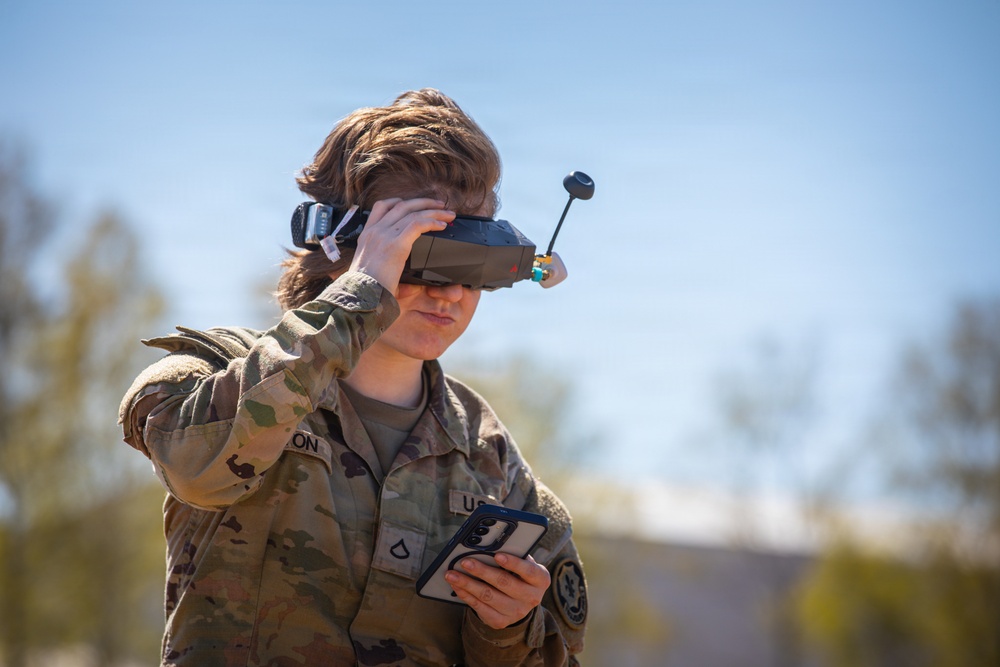
Photo By Sgt. Max Elliott | Pfc. Hailey Paton, an infantryman assigned to Echo Troop, 2nd Squadron, 2nd Cavalry...... read more read more
 Subscribe
PABRADĖ TRAINING AREA, Lithuania – U.S. infantry Soldiers from the 2nd Cavalry Regiment and paratroopers from the U.K. Parachute Regiment prepare for the force-on-force phase of Project Flytrap at Pabradė Training Area, Lithuania, May 2. Project Flytrap integrates autonomous and unmanned ground vehicles, first-person view drones and counter-unmanned aerial systems on the simulated battlefield.
The day marked the third consecutive day of preparation and system integration for the exercise, which included an exercise briefing attended by U.S. Soldiers and U.K. paratroopers participating in the force-on-force portion of Project Flytrap. Soldiers spent the remainder of the day conducting drone familiarization, operating unmanned ground vehicles and rehearsing C-UAS procedures in preparation for the upcoming engagement.
Among those preparing was Spc. Arthur Tugman, an infantryman assigned to 1st Squadron, 2nd Cavalry Regiment, who has taken on the role of unmanned ground vehicle operator for the exercise, a mission set outside his traditional infantry duties.
"My role in Flytrap is to serve as an unmanned ground vehicle operator, where I operate various unmanned ground vehicle platforms to transport equipment, Soldiers, unmanned aerial systems and counter-unmanned aerial systems to wherever they are needed," Tugman said.
The integration of infantry Soldiers into UGV operations reflects a broader theme running through Project Flytrap; placing emerging technology directly in the hands of warfighters regardless of their primary specialty, and using their feedback to drive rapid improvements across the force. Project Flytrap hopes to organically assimilate these new duties to Soldiers already assigned to units.
Tugman said the speed at which his unit has been able to absorb and operate the new systems has been one of the more surprising aspects of the exercise.
"Something I learned that I didn't expect was how fast the United States Army is able to integrate new systems into warfighting tactics," he said. "I'd say this equipment is very easy to use. I'm able to pick it up, turn it on, and send it wherever it needs to go, as far as it needs to go, as fast as it needs to go."
That ease of use, Tugman said, has direct implications for how the soldiers could employ these systems at scale across the force.
"If all our technology works the way it's supposed to, we will preserve manpower as well as accomplish the mission faster and more effectively," he said.
For Tugman, the measure of success extends beyond the exercise itself. He described his goal as helping establish repeatable, standardized procedures for integrating C-UAS and UGV capabilities into 2nd Cavalry Regiment's formations; procedures he hopes will eventually be adopted Army-wide.
U.S. and Allied forces conduct Project Flytrap as part of a series of linked exercises, including Sword, Saber Strike, Immediate Response, and Swift Response, which transform experimentation into capability. During Flytrap, Soldiers integrate counter-unmanned systems, AI-enabled command and control, and live data networks to move faster, decide faster, and fight more effectively across all domains.
| Date Taken: | 05.02.2026 |
| Date Posted: | 05.03.2026 07:30 |
| Story ID: | 564222 |
| Location: | PABRADE, LT |
| Web Views: | 263 |
| Downloads: | 0 |

This work, Project Flytrap puts emerging tech in warfighters’ hands, by SGT Max Elliott, identified by DVIDS, must comply with the restrictions shown on https://www.dvidshub.net/about/copyright.


No keywords found.




