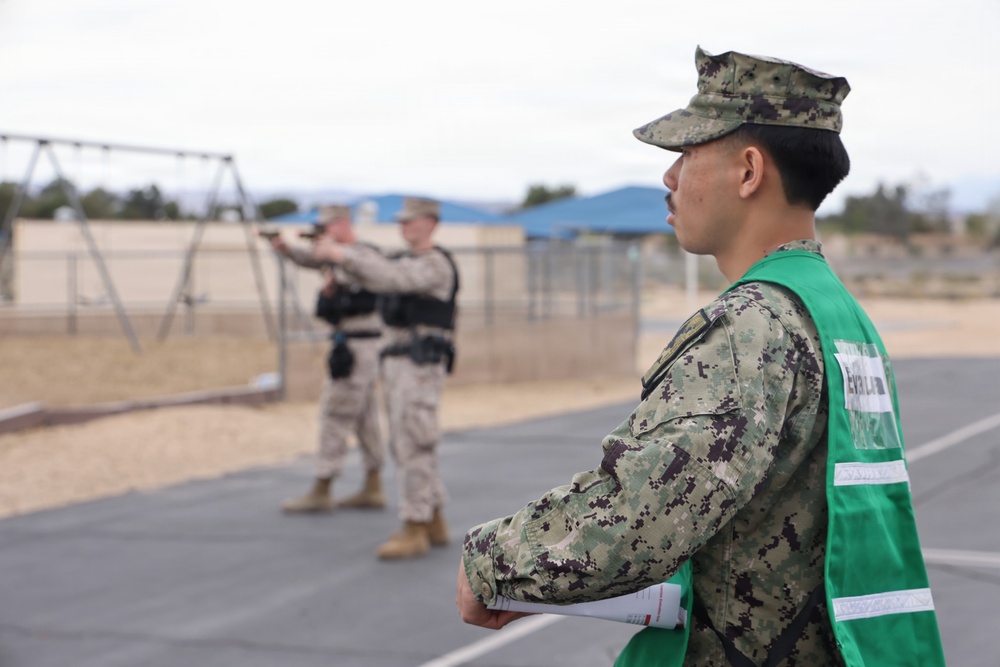
TWENTYNINE PALMS, Calif. — A simulated active shooter and bomb threat scenario unfolded March 31, 2026, aboard Marine Corps Air Ground Combat Center Twentynine Palms, challenging first responders to manage multiple casualties and a complex, evolving threat environment.
Among the evaluators was Master-at-Arms 3rd Class Thuan Nguyen, the sole Sailor embedded alongside Marine Corps law enforcement to assess the response in real time.
The training scenario, conducted at Condor Elementary School, was designed to replicate a complex, real-world emergency, testing how Provost Marshal’s Office (PMO) personnel and first responders would react under pressure in a time-sensitive, high-risk situation. The exercise included multiple simulated casualties and culminated with PMO personnel successfully de-escalating the situation and talking the acting suspect into surrendering.
Nguyen, assigned to Navy Medicine Readiness and Training Command (NMRTC) Twentynine Palms, evaluated the performance of a designated unit across several operational areas during the drill.
“My primary responsibility was to assess a unit across three key areas: patrol operations, incident response, and support services,” Nguyen said.
Working alongside Marine Corps law enforcement personnel, Nguyen gained insight into PMO procedures while also offering a Navy perspective on tactics and coordination.
“I learned that PMO utilizes different tactics and protocols compared to its counterpart in the Navy’s military police,” Nguyen said. “I believe this presents an opportunity for PMO to have someone give insight from an outsider perspective, which ultimately will create an understanding for both parties.”
Throughout the exercise, Nguyen observed how units operated within a structured response framework, with each team executing preassigned roles to manage the evolving situation — from initial response to casualty care and scene control.
“I noticed that each of the responding units had preassigned tasks and duties,” Nguyen said. “Seeing them all work together was very interesting and insightful.”
The complexity of the scenario — combining an active shooter, a potential explosive threat, and multiple casualties — highlighted both strengths and challenges in the response, particularly in maintaining clear and consistent communication across units.
“One of the primary challenges I observed was the communication among various units,” Nguyen said. “Communication is always key in these situations and is probably one of the most difficult aspects.”
Nguyen said his Navy law enforcement training provided a strong foundation for evaluating the response, particularly in areas requiring standardized procedures.
“The Navy law enforcement training standardized tactics and procedures consistent with all Department of War training requirements,” Nguyen said. “This enabled me to evaluate the response across various functional areas, including active threat response, tactical medicine, use of force protocols, physical security measures, and incident management practices.”
Exercises like this not only test response capabilities, but also strengthen interoperability between Navy and Marine Corps personnel operating in a shared environment.
“This exercise will enhance both the Navy and Marine Corps to mutually understand each other’s preplanned responses,” Nguyen said. “Ensuring cross capability during future operations.”
Nguyen also pointed to the realism of the scenario as a key factor in its effectiveness, crediting role players for helping create an immersive training environment.
“I would like to acknowledge the Marine who portrayed the suspect,” Nguyen said. “She demonstrated excellent professionalism and brought a high level of authenticity to the performance, making the scene particularly memorable.”
The scenario carried through the full continuum of care, with simulated casualties transported by first responders to Naval Hospital Twentynine Palms, where corpsmen and emergency care staff responded as they would in a real-world incident.
“This exercise showed how Navy Medicine comes together during a mass casualty scenario, from initial response to care provided at the hospital,” Nguyen said.
For NMRTC Twentynine Palms, exercises like this strengthen interoperability between Navy Medicine and Marine Corps forces while providing valuable cross-training opportunities that enhance overall readiness.
| Date Taken: |
04.27.2026 |
| Date Posted: |
04.27.2026 18:14 |
| Story ID: |
563713 |
| Location: |
TWENTYNINE PALMS, CALIFORNIA, US |
| Hometown: |
BRADENTON, FLORIDA, US |
| Web Views: |
88 |
| Downloads: |
0 |
PUBLIC DOMAIN

This work, Sailor sharpens skills during active shooter drill at MCAGCC Twentynine Palms, by Christopher Jones, identified by DVIDS, must comply with the restrictions shown on https://www.dvidshub.net/about/copyright.