
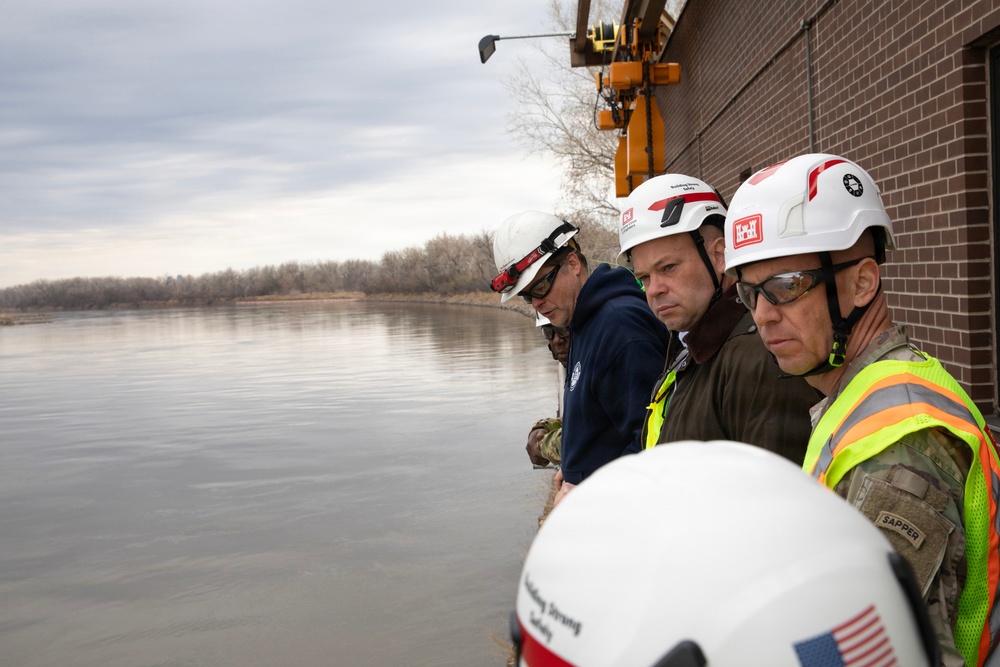
Photo By Joshua Plueger | Assistant Secretary of the Army for Civil Works Adam Telle and U.S. Army Col. Robert...... read more read more
OMAHA, Neb. — Federal leaders toured the Missouri River corridor April 9 to assess power generation and flood protection infrastructure and discuss future risk reduction efforts in Nebraska.
Assistant Secretary of the Army for Civil Works Adam Telle joined Nebraska Sen. Pete Ricketts and Maj. Gen. Jason E. Kelly, U.S. Army Corps of Engineers deputy commanding general for civil and emergency operations, during the visit, which included project briefings, a river tour and meetings with regional stakeholders hosted by the U.S. Army Corps of Engineers, Omaha District.
The tour focused in part on recovery from Nebraska’s historic 2019 floods, which damaged more than 500 miles of levees across 60 levee systems in five states and caused more than 50 breaches stretching up to 2,000 feet. The Missouri River at Nebraska City remained at or above flood stage for 270 consecutive days.
Since then, USACE has invested more than $1 billion to repair and strengthen levee systems across Nebraska, Iowa, Kansas, Missouri and South Dakota. The majority of that work is now complete, with construction continuing on remaining projects including the R-562 levee system near Peru, Nebraska, which sustained heavy damage in 2019 and has been under active construction following a contract award in November 2025.
"The Corps of Engineers has worked for decades to make the Missouri River an asset for the state of Nebraska," Telle said. "It's more work every day, but we're so thankful to have leaders like Sen. Ricketts advocate for that so the Missouri can be safe, prevent flooding, enable navigation and supply water to the communities who need it."
Ricketts explained the scale of the 2019 flooding in stark terms.
"You look at the Platte River coming into the Missouri River, it's maybe 12,000 cubic feet per second. It went up to 250,000 cubic feet per second during that 2019 flooding," Ricketts said. "That's a tremendous amount of increase in water coming through so I wanted to really impress on the secretary some of the flood events we see here and why it's so important to have that flood mitigation."
The visit began at MidAmerican Energy’s Walter Scott Energy Center in Council Bluffs, Iowa, where officials discussed how river operations support regional power generation. The Missouri River provides cooling water critical to energy production, making reliable flows essential to both the power grid and surrounding communities.
Officials also discussed challenges in balancing the river’s many uses, including flood control, navigation, hydropower and municipal water supply. In recent years, ice jams during drought conditions have disrupted flows and temporarily reduced power generation.
From Council Bluffs, the group traveled to Bellevue, Nebraska, where they boarded a boat to view levee systems along the river. District leadership provided an overview of how water management decisions are made across the Missouri River Basin.
The lower Missouri River operates without locks or routine dredging. More than 7,000 bank stabilization structures help maintain a 300-foot-wide, 9-foot-deep navigation channel that supports about 200 million tons of commerce each year.
“The investment we've made in this river system since 2019 is significant, but what matters most is that it works. That when the next major water event comes, the communities on both sides of this river have the best possible protection we can provide," said Col. Robert Newbauer, district commander. "Mother Nature has a way of reminding us that the work is never finished but bringing Secretary Telle here to see what we've built and what's at stake for this region is exactly the kind of engagement that keeps us moving in the right direction.”
"We heard today that the rebuilding after the 2019 floods is 90% to 95% complete," Telle said. "We're optimistic that we'll have the infrastructure in place to help mitigate future floods here in the Omaha and greater Omaha area."
The day concluded at the Greater Omaha Chamber, where Telle and Ricketts met with local leaders and stakeholders to discuss flood risk management, ongoing studies and infrastructure priorities.
Topics included the Lower Missouri River Flood Risk and Resiliency Study and efforts to streamline permitting through the “Building Infrastructure, Not Paperwork” initiative, announced earlier this year. The initiative includes 27 actions aimed at improving project delivery, reducing permitting timelines and increasing transparency. For the Omaha District, those efforts support ongoing construction, including levee rehabilitation near Peru and a $302 million hydropower modernization project at Fort Randall Dam funded without federal appropriations.
Officials estimate the river system has prevented more than $15 billion in flood damages since it was built.
A full Missouri River basin tour is planned for this summer, giving federal leaders a broader view of the system from headwaters to where the rivers meet.
"One of the most important roles the Army Corps of Engineers has is preventing future flood events," Ricketts said. "We're working together to make sure this doesn't happen again. We're fighting to improve the infrastructure that helps prevent future flooding events."
| Date Taken: | 04.22.2026 |
| Date Posted: | 04.22.2026 15:23 |
| Story ID: | 563358 |
| Location: | US |
| Web Views: | 128 |
| Downloads: | 0 |

This work, Secretary Telle, Senator Ricketts tour Missouri River, discuss future of flood protection in Nebraska, by Andrew Nystrom, identified by DVIDS, must comply with the restrictions shown on https://www.dvidshub.net/about/copyright.


No keywords found.





