
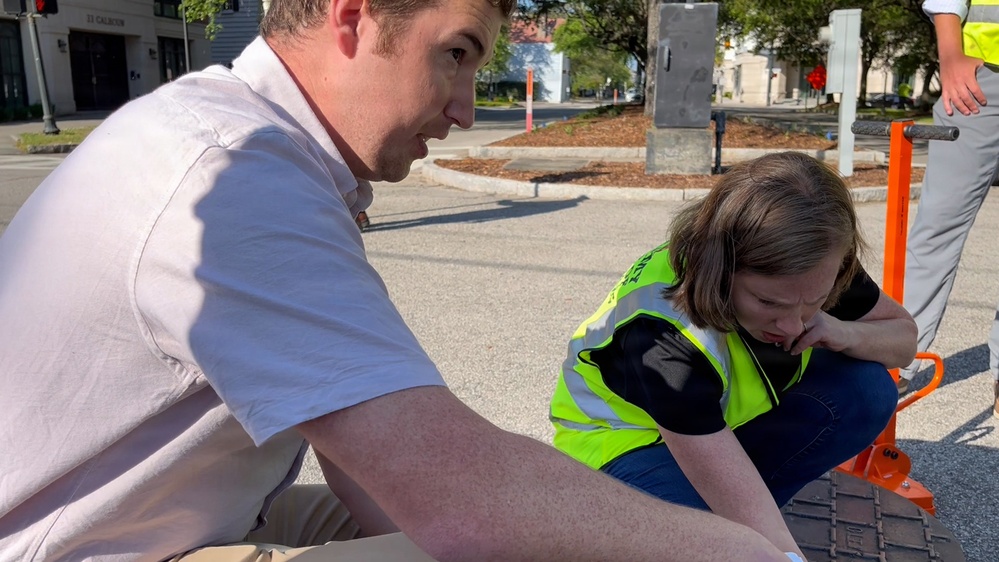
Photo By Tom Conning | Grant Eversmann, Charleston’s stormwater project manager, shines a flashlight into...... read more read more
The crewmember plops the Clemson orange magnetic lid lifter tool onto the top of the manhole cover with a clang and magnetic snap. He wrenches the metal disc out of its seal, drags it across the asphalt with a scrape as a pungent odor billows through the air. The stench makes the crew, and other observers take a step back. As sunlight permeates the opening, a surprised palmetto bug – the “cute” colloquial name for a cockroach that South Carolinians have adopted – scampers its way into a crevasse between red bricks. The smell and bug indicate this section must be connected to the sewer, as opposed to the stormwater drainage system below the streets in downtown Charleston.
The group again steps to the edge of the manhole and peers down as Grant Eversmann, Charleston’s stormwater project manager, shines a flashlight into the dank subterranean system. They’re all trying to get a glimpse of city’s historic brick arches, which it built in the 1800s to remove wastewater after a severe yellow fever epidemic. Now, the structures help move stormwater away from the city; however, the nearly 200-year-old system is aging.
“It was important to get out on an inspection with the City of Charleston and the Corps of Engineers to look at a joint project we have going on, our lining the brick arches,” said Eversmann. “When they deteriorate, they could cause safety concerns with potholes and things like that,” he said. “So, we try to line them before that happens.”
This reinforcement and rehabilitation effort is the reason why the group from the city and the U.S. Army Corps of Engineers (USACE), Charleston District was out inspecting some of the arches, April 15, 2026. USACE is partnering with the city to help rehab the infrastructure, which span more than 10 miles underneath the city streets. This project is a small piece of a larger effort to reduce flooding in Charleston, according to Wes Wilson, Charleston District project manager.
“We’ve had a strong partnership with the City of Charleston for quite a while,” said Wilson. “By rehabilitating these structures, it will provide a much-needed benefit for stormwater conveyance through these areas and improve flood mitigation,” he explained. “First, they’re going to go in and clean them and then they’re going to take out any intrusive utilities.”
After that, crews will install a fiber-reinforced shotcrete that will form a new independent pipe, will allow stormwater conveyance to pass through more freely. However, there are several steps USACE needs to take before it can begin work. Army staff need to clear environmental considerations through the National Environmental Policy Act and ensure it meets requirements set by the National Historic Preservation Act (NHPA). When federal funds are used on projects that could impact historic properties, agencies must consult under section 106 of the NHPA, according to Andrea Farmer, USACE archaeologist on the project.
“The site inspection was helpful in allowing us to see the variations in the brick arch system access points,” said Farmer. “We are in the process of developing a Memorandum of Agreement, so the site visit provided information that we needed on the site conditions and the capabilities that we can and cannot employ to document the historic brick arch system,” she said. “It was eye-opening to see beyond the roadway into such an integral part of the City’s underground history.”
The group ended up looking at three different arches, two that need the rehab and another one that the City of Charleston has already re-lined.
“We needed to see what we were doing and see how we can work together more,” said Eversmann. Again, the goal is to make them better to convey stormwater and make them safer for the public, he reiterated.
Wilson expects to begin construction in fall 2026 and complete construction in 2027 and says the project should cost $12.625 million.
| Date Taken: | 04.21.2026 |
| Date Posted: | 04.21.2026 08:44 |
| Story ID: | 563205 |
| Location: | CHARLESTON, SOUTH CAROLINA, US |
| Web Views: | 50 |
| Downloads: | 0 |

This work, Exploring the dark, dank underbelly of Charleston’s historic brick arches stormwater removal system, by Tom Conning, identified by DVIDS, must comply with the restrictions shown on https://www.dvidshub.net/about/copyright.


No keywords found.





