
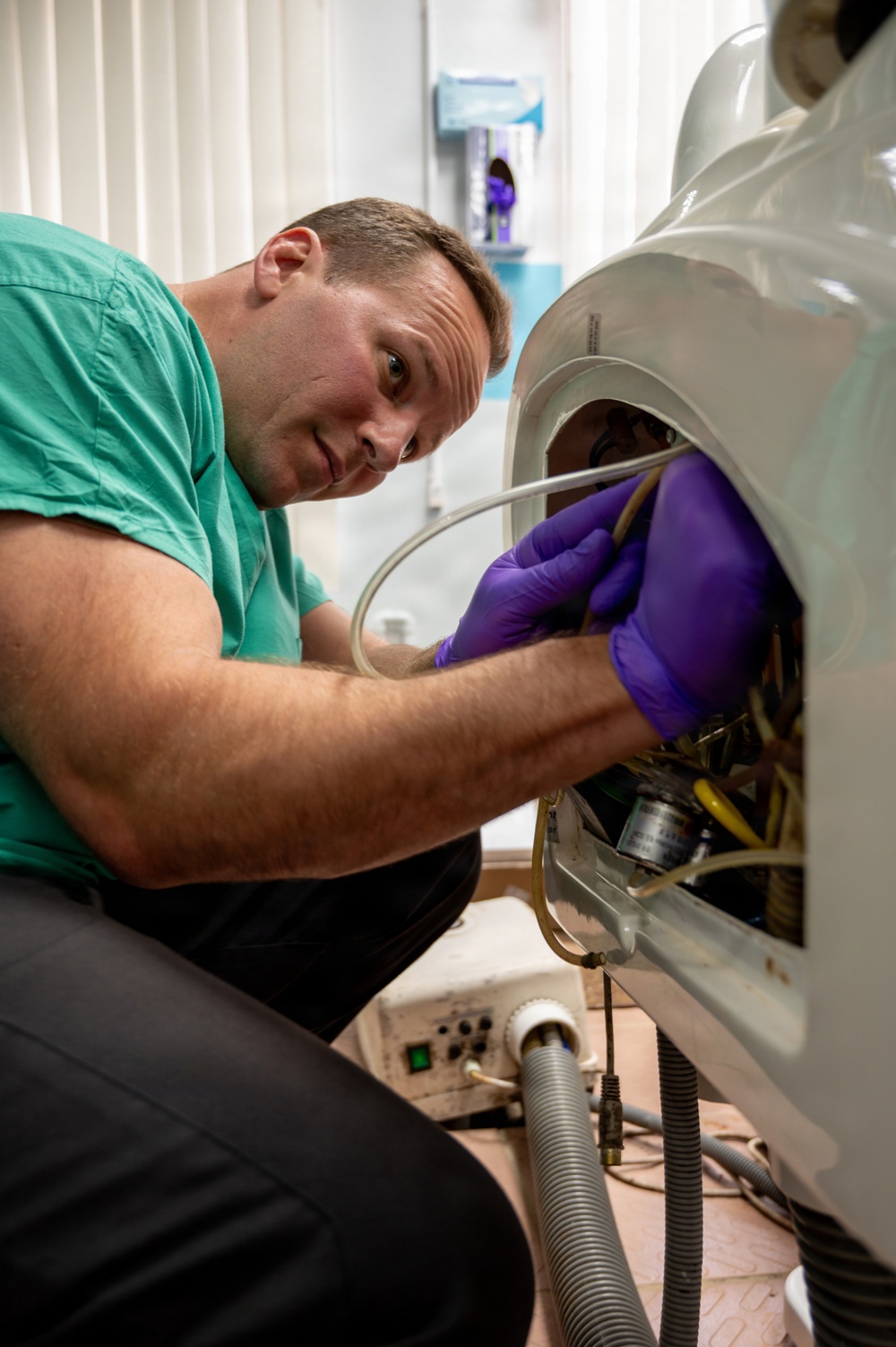
Photo By Maj. Stephani Schafer | U.S. Air Force Tech. Sgt. Jonathan Rousseau, 920th Aeromedical Staging Squadron...... read more read more
 Subscribe
Dental care doesn’t start with the patient, it starts with the equipment.
Before a patient settles into the chair or a filling begins, U.S. Air Force biomedical equipment technicians are already at work in clinics and hospitals across Guyana, restoring and maintaining the systems that keep care moving.
“There’s a great need for people like us here,” said Master Sgt. Matthew Chouinard, a biomedical equipment technician assigned to the 920th Aeromedical Staging Squadron. “The equipment age, the condition and the amount of use creates a lot of wear and tear. Without consistent maintenance, physicians don’t have an effective way to treat their patients.”
Chouinard and his team are helping restore critical equipment across Guyana as part of the Lesser Antilles Medical Assistance Team 2026, a U.S. Air Forces Southern-led mission that brings U.S. and partner nation medical professionals together to deliver care and strengthen regional health capacity.
Equipment repair supports more than patient care, it enables more efficient treatment while strengthening healthcare capacity alongside Guyana Ministry of Health partners.
“The equipment that gave us problems most of the time is the chair and the air-water syringe,” said Nikita France, a dental assistant with the Guyana Ministry of Health at Cheddi Jagan Dental School. “Sometimes if the air-water syringe is damaged, when we try to get air, water would come out with it. Since it was fixed, we’re not getting that problem anymore.”
For France, the impact of the partnership went beyond repairs.
“This is what I like about the team, they didn’t come and do it their way,” France said. “They came to try to understand how we would do it here.”
Biomedical equipment technicians serve as the link between medical capability and mission execution, diagnosing, repairing and restoring the systems Guyanese doctors and support staff depend on every day.
“As a BMET, we fix all sorts of medical equipment for physicians and nurse staff so they can diagnose and take care of their patients,” Chouinard said. “When that equipment doesn’t function well, we are called to repair it and get it back to a level where they can continue patient care.”
In Guyana, that demand spans multiple facilities from diagnostic systems to dental chairs and patient monitoring devices — all critical to sustaining care.
At dental clinics, those repairs are already changing how care is delivered.
“The team worked on one of the chairs that we had in the clinic,” said Neiomie Harris Singh, a dental assistant with the Guyana Ministry of Health. “It wasn’t working for some time.”
“The doctor may have had to move to another chair, or they would have to take turns,” Harris Singh added. “That was quite a challenge, having to move the patient around. Now, because it’s fixed, they don’t have to move people around anymore.”
In environments where equipment gaps can slow care, restoring capability means restoring access. For patients, those changes are immediate.
“To me, the patients seem much more comfortable,” Harris Singh said. “It was better for them not to have to move around, so it was pretty much easier for the patient.”
The mission also focuses on how teams solve problems in real time and improve processes. The team worked alongside local technicians to streamline how equipment issues are identified and repaired. By introducing more efficient troubleshooting methods and reducing reliance on external support, the collaboration will help local teams restore equipment faster and maintain consistent patient care.
“We have established a new process for them,” Chouinard said. “They’re learning ways to fix things that will help them move faster and not have to wait as long for support.”
That collaboration stood out to the dental team, not just for what was fixed, but how it was done.
“The LAMAT team works with respect,” France said. “They try to understand how we work, and they adapt.”
France added that the team was welcoming and open to questions, allowing her to learn new techniques while working alongside them.
For Chouinard, one of the most rewarding aspects of the mission has been working alongside Guyanese medical professionals and sharing perspectives.
“Even though we’re not directly providing treatment, we’re still part of everything that’s happening,” Chouinard said. “It’s an open cultural experience. We’re blending, working together and sharing best practices.”
As LAMAT 2026 continues in Guyana, patient care remains the visible measure of success. But behind every procedure is something less visible– restored capability and partnerships that extend beyond patient care.
“I do hope that the LAMAT team comes again,” Harris Singh said. “We’re really happy to have them here.”
| Date Taken: | 03.20.2026 |
| Date Posted: | 03.20.2026 23:29 |
| Story ID: | 561060 |
| Location: | GY |
| Web Views: | 21 |
| Downloads: | 0 |

This work, BMETs keep dental care moving during LAMAT 2026 in Guyana, by Andrea Jenkins, identified by DVIDS, must comply with the restrictions shown on https://www.dvidshub.net/about/copyright.


No keywords found.




