
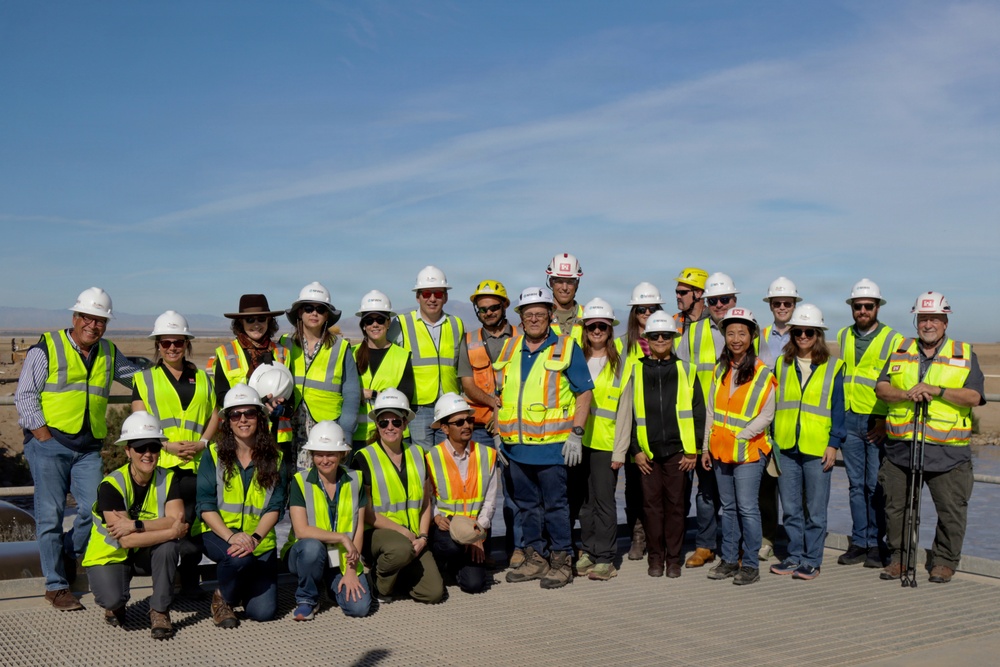
Photo By Shawn Davis | U.S. Army Corps of Engineers senior leaders join California state agency partners and...... read more read more
IMPERIAL COUNTY, Calif. — Senior leaders and project delivery team members with the U.S. Army Corps of Engineers joined key partners for a meeting and site tour of the Salton Sea Feb. 22-23 in Imperial County.
The interagency teams met to discuss updates on the Imperial Streams and Salton Sea Aquatic Ecosystem Restoration Feasibility Study and provide leaders with a deeper familiarity of the issues surrounding the Salton Sea.
USACE Los Angeles District and its partners — the California Department of Water Resources and Salton Sea Authority — signed a cost-share agreement in December 2022 for the feasibility study, aimed at identifying potential ecosystem, flood-risk management or other land- and water-resource projects and actions for the long-term restoration of the sea.
The purpose of the study is to evaluate solutions to address the degradation of the sea and its tributaries, as well as ecological and public health concerns.
“This Tier 1 meeting brings together our most senior leaders on the oversight committee,” said Lindsay Floyd, water resources planner with USACE’s Sacramento District. “It gives us a chance to talk about study progress, challenges, issues and ways to resolve problems in a timely manner. It’s also a good opportunity to communicate study successes with senior leaders.”
Joining the study team for the meeting and tour were Tambour Eller, programs director, and Josephine Axt, chief of planning, both with USACE’s South Pacific Division, along with Col. Andrew Baker, LA District commander, and Andrew Goodall, LA District acting deputy district engineer.
The USACE group was joined by representatives from both the Salton Sea Authority and the California Natural Resources Agency, which also includes the Department of Water Resources and the California Department of Fish and Wildlife.
THE CHALLENGE
“I think this might be the only study like this in the U.S. Army Corps of Engineers’ portfolio,” Floyd said. “It’s a really interesting landscape, and it’s just so different than what the Corps is used to working on.”
The Salton Sea is California’s largest lake by area, but it is shallow and receding due to evaporation and recent water transfers. Its main source of inflow is agricultural runoff, which is not enough to sustain its footprint. The lake is classified as an endorheic, or terminal, lake, meaning it has no outlet. As the water recedes, the lake’s salinity only increases while the exposed playa emits dust that contains potentially hazardous pollutants.
“We’re looking to improve the quality, quantity and complexity of the aquatic habitat at the Salton Sea and its tributaries, and we’re looking for opportunities to improve human health and reduce the amount of emissive seabed that is becoming exposed as the Salton Sea recedes,” Floyd said.
A key part of the study is addressing the declining aquatic habitat, including an estimated 400 species of birds that rely on the lake. In the last 30 years alone, the lake has shrunk by more than 60 square miles.
“It’s no longer habitable for most fish species, and it’s an important stopover for birds along the Pacific flyway,” Floyd said. “Migrating birds use this as an important stopover for resting, feeding and nesting. And, it’s an important regional resource because we’ve developed a lot of area that used to be historic wetlands.”
Taking action on the Salton Sea goes beyond ecological and public health concerns, Eller said, also indicating that national security and economic factors are intertwined.
“The Salton Sea has significant national importance,” she said. “From a national security perspective, the lithium resources here are among the most significant known domestic opportunities in the country. When developed responsibly, it could help support America’s energy and manufacturing future.”
The effort also goes beyond the environment to focus on people and the communities around the sea, Eller added, which can “strengthen the regional economy — from agriculture to small businesses — and create opportunities tied to potential affordable housing, workforce development and long-term growth across California.”
USACE is addressing all of this without losing sight of disaster-risk mitigation, she said, adding that “preparing the area to withstand extreme weather events is essential to protecting lives, infrastructure and the investments being made in this region.”
EVALUATING SOLUTIONS
Numerous proposals have been on the table for years as part of restoration efforts. They include individual and combinations of proposals for water pumping, an updated lake perimeter, a divided sea concept, water recycling, dust suppression, water optimization and others.
Floyd said nearly all the proposals, or alternatives, are drawn from the Salton Sea Management Program’s long-range planning effort. The project delivery team members, federal sponsors, participating agencies and senior leaders are evaluating 12 alternatives from the long-range plan, along with another USACE-developed proposal and a “no action” alternative.
“Various agencies at the federal level, state level and universities have been studying the Salton Sea for decades, and there have been lots of proposals to restore it,” Floyd said. “But the Army Corps is unique in that we have this mechanism to recommend projects for construction: the feasibility study process, which ultimately ends in a recommendation for construction. We are looking at everything that’s been done over the past few decades and determining if any of those restoration proposals are feasible, cost effective and are in the federal interest.”
Floyd said the decision-making process is methodical and requires careful consideration of a range of criteria, including four that are mandatory for evaluation and screening: effectiveness, completeness, efficiency and acceptability from technical, financial and legal standpoints.
“In addition to those four mandatory criteria, we also looked at the time to realize ecological benefits,” Floyd said. “We looked at mitigation requirements, and we’re looking at operation and maintenance requirements.”
From among these alternatives, study participants will soon determine a recommended plan that is supported by USACE leadership, nonfederal sponsors and the community.
Corrie Stetzel, plan formulation regional technical specialist with USACE’s Sacramento District, said she is happy to see the high level of engagement from community members and groups.
“They’ve organized very well, and there are lots of nonprofit organizations dedicated to restoring and understanding the sea,” Stetzel said. “They’re collecting scientific data, like citizen scientists. I think it’s awesome they have a voice in this and are directly saying what they want to see happen.”
The study team is working with subject-matter experts in the fields of hydrology, biology, agriculture and water and land use policy to develop a hydrologic and hydraulic model of the Salton Sea to help them make a risk-informed decision in selecting the recommended plan.
Eller said it was important for her and fellow senior leaders to be on the ground together to see the study area in person, especially during such a dynamic time in the study process.
“When you see it firsthand, it changes the conversation,” Eller said. “It helps us bring together the strengths of partners like the California Department of Water Resources, the Salton Sea Authority and the U.S. Army Corps of Engineers and strengthen how we move these efforts forward together.”
| Date Taken: | 02.27.2026 |
| Date Posted: | 03.11.2026 16:44 |
| Story ID: | 560322 |
| Location: | CALIFORNIA, US |
| Web Views: | 143 |
| Downloads: | 0 |

This work, Salton Sea feasibility study progress takes center stage during ‘Tier 1’ meeting, by Stephen Baack, identified by DVIDS, must comply with the restrictions shown on https://www.dvidshub.net/about/copyright.


No keywords found.





