
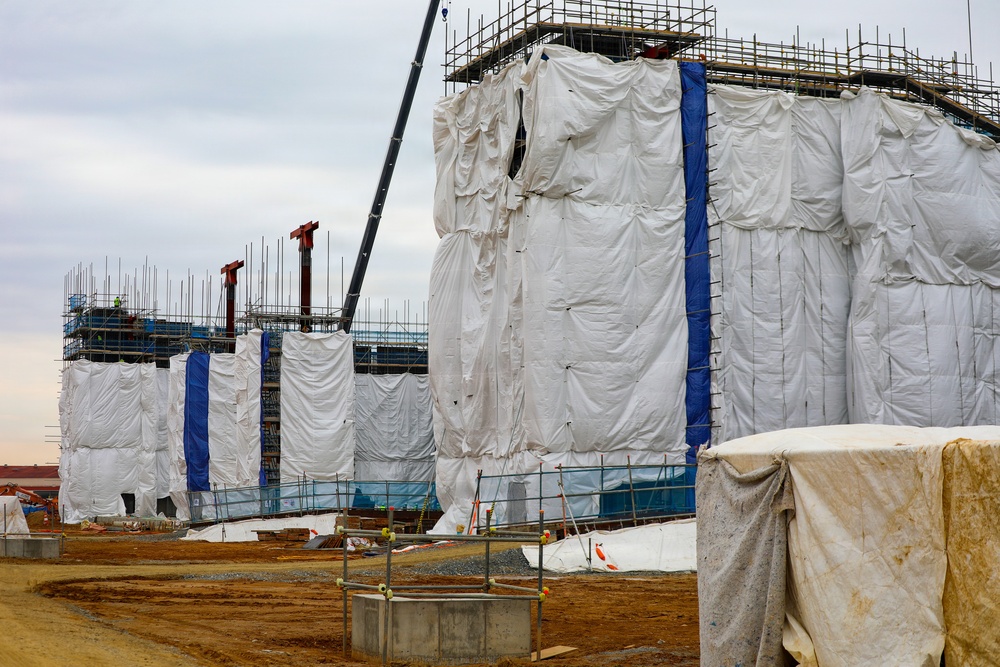
Photo By Monique Freemon | A $115 million, 2-story project underway by the U.S. Army Corps of Engineers – Far...... read more read more
CAMP HUMPHREYS, South Korea – The U.S. Army Corps of Engineers – Far East District’s $115 million, 2-story project at Camp Humphreys, South Korea, will be the future home of aircraft operating. Right now, though, it is a complex series of activities such as surveying the soil improvement through surcharging and monitored by surveying methods, interior mechanical and electrical item installation interior finishing, roof waterproofing and concrete placement.
With the simultaneous work underway, location and nature of the project, it needs detailed planning and coordination to be successful.
“Working near an active airfield raises the bar for safety, coordination and timing,” said Michael Joiner, Civil and Project Engineer, Pyeongtaek Resident Office, USACE FED.
Despite chilly temperatures, work does not stop during the winter months as construction activities are modified to withstand the cold weather in a process known as winterization. For instance, to paint the walls inside the project, all openings are covered with vinyl to keep the area warm. Then, heaters are used to raise the temperature of the room to the manufacturer’s requirements for the paint to set correctly. To ensure safety, fire extinguishers, carbon monoxide detectors and ventilation fans are to safeguard air circulation and remove fumes are nearby.
The project encompasses five bays for maintenance and repair, meeting and work rooms, wash rack, storage, equipment rooms, a multipurpose training room, a maintenance test office, showers and locker rooms, large testing areas, a simulation room and an equipment shop.
To make all those features a reality, concrete placements are underway. For winterization, a tent covers the area where the concrete placement occurs to protect from weather and maintain internal temperature for the required concrete curing threshold.
A portion in construction involves installing revetment walls or “cells” that are five meters (about 16 feet) tall. These walls are crucial safety for testing and maintenance of aircraft as since the block flying debris, reduce noise and air pressure and prevent high-speed flying objects during testing of aircraft.
Intense air flows can cause debris such as gravel or loose items to hurl towards cars and personnel; as well as being sucked up by the aircraft’s engine. For instance, helicopters generate a high-speed of flow that blast back (known as prop wash) or can generate high-velocity air that is pushed down and out (known as rotor wash).
Once the cells are constructed, they will be filled with sand instead of concrete, which is more effective at absorbing the energy from an impact as the force is distributed among the grains. Also, it does not shatter nor crack when hit by an object as opposed to concrete that can cause secondary shrapnel. It is cheaper, easier to transport, and sand does not a have to cure like concrete.
When the cells are filled, they are sealed with a concrete cap to prevent rain from washing the sand away or turning it into mud.
As constructing facilities adds a lot of weight to the ground, FED’s Geotechnical survey team is on site to ensure the ground remains stable. To test the soil, they loaded temporary soil, known as surcharge, to in the area to measure the movement of the ground near the wash rack in a technique called preloading. This testing measures compression over time and is replicated in many areas throughout the project site since the beginning of construction to ensure a strong foundation.
The process forces settlement of the area before construction begins, preventing structural issues later on. Settlement plates placed at the bottom of the surcharge physically sink along with the ground. Once installed, the survey team will monitor daily during the fill period. These surveys transition to once a week and then once every two weeks after various milestones to reach the allowable residual settlement.
The testing informs the district and the contractor when the soil is finished settling to continue construction. The data also helps the team modify construction timelines and identify methods to mitigate any issues.
“On [this project], even routine construction activities require additional controls and a strong emphasis on quality, because the finished work must safely support future airfield operations and equipment,” Joiner said.
After the concrete foundation is completed, the next steps on this project include (in order): 1) installation of steel plate supports, 2) installation of stringer (panels), 3) placement of gravel & filter fabric, 4) installation of middle section of stringer panels, 5) fill with sand inside, 6) install final stringer panels and 7) install the concrete cap.
For more information and updates on USACE FED projects, check out our website athttps://www.pof.usace.army.mil/.
| Date Taken: | 01.14.2026 |
| Date Posted: | 01.14.2026 20:44 |
| Story ID: | 556240 |
| Location: | CAMP HUMPHREYS, KR |
| Web Views: | 176 |
| Downloads: | 0 |

This work, Behind the Build: A look at a $115 Million Camp Humphreys Project Under Construction, by Monique Freemon, identified by DVIDS, must comply with the restrictions shown on https://www.dvidshub.net/about/copyright.


No keywords found.





