
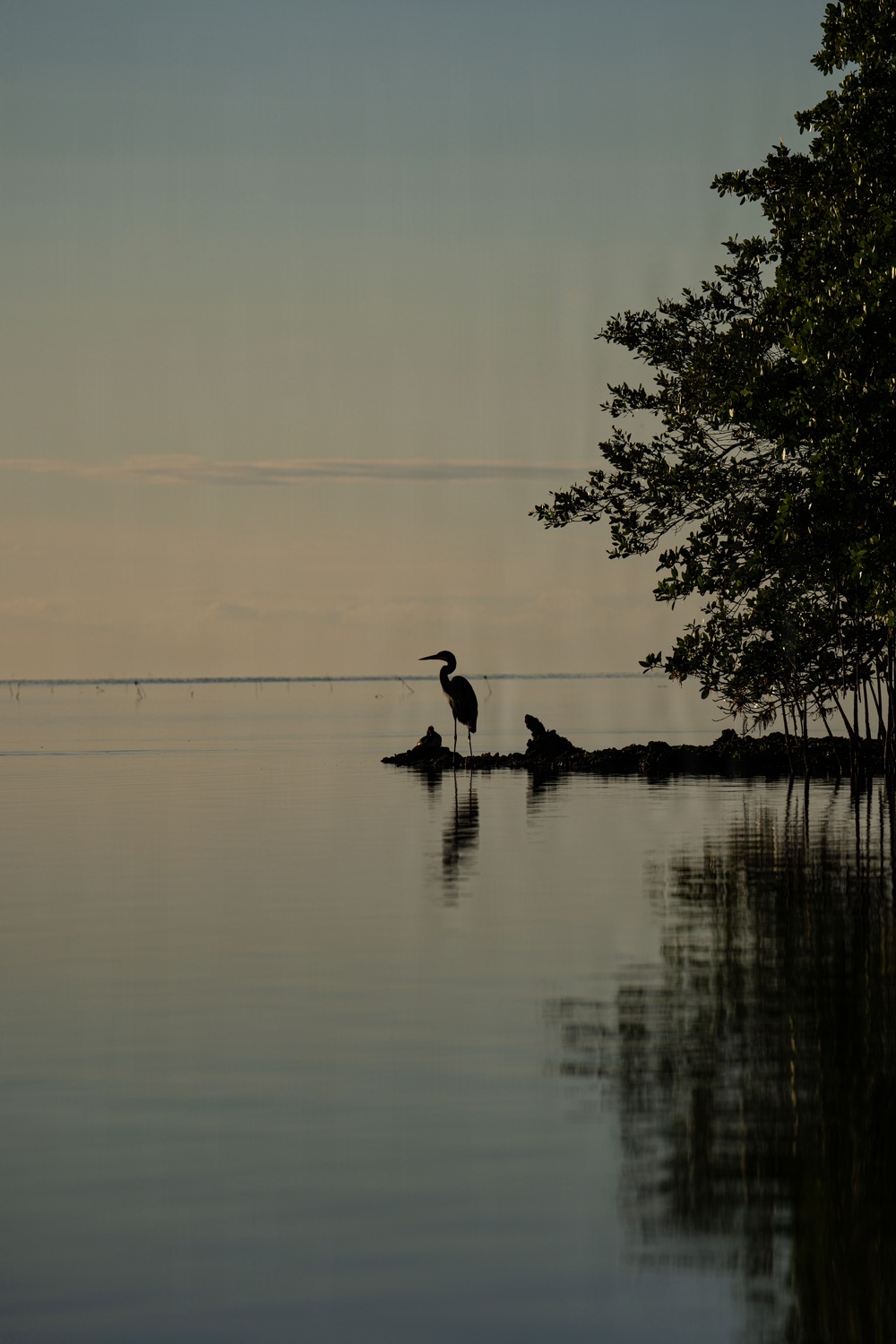
Photo By Brigida Sanchez | A Great Blue Heron stands alongside other wading birds as the sun rises over Biscayne...... read more read more
The brackish water was still as glass. As the sun rose from beneath a glaucous, marbled blanket of clouds, it saluted those waiting to see her display her fiery red-orange dress. If you focused solely on the magic transpiring in the bay, you could almost forget the traffic building nearby as 2.7 million residents set about their daily lives.
I was there to document why Biscayne Bay is so vital. To my unpracticed eye, the bay seemed to be thriving: birds feeding in the distance, itsy-bitsy fish darting by my feet, a small duck diving for its morning meal.
However, Reynolds and Grossenbacher were there to educate me on the reality beneath the surface and the importance of the Biscayne Bay Coastal Wetlands (BBCW) project. The two have spent decades planning and advocating for the bay; today’s project would finally -connect the dots- from concrete pump stations to these wild waters.
A Plumbed Ecosystem
Biscayne Bay and its coastal wetlands are integral to the Everglades ecosystem. Historically, the bay received freshwater that flowed over the land, filtered through wetlands and coastal ridges, and seeped beneath the surface as groundwater.
Close your eyes and travel with me back in time. Imagine water moving down the Florida peninsula from the Kissimmee River through Lake Okeechobee—all the way down, with no canals, no highways, and no homes. Nothing but saturated, living land.
This water eventually reached the bay, producing a salinity gradient that supported a diverse habitat. But that changed in the early 1800s. As the nation expanded, speculators were eager to buy Florida land. The soil was rich and the climate was perfect, but there was one problem: an abundance of water. To solve it, early settlers and the government began digging canals under the Federal Swamp and Overflowed Lands Act of 1850.
The canals worked for a time, but they couldn't truly control the water. Following the death and destruction of the 1926 and 1928 hurricanes—which claimed nearly two thousand lives—the state and federal governments implemented a massive flood protection plan and called the U.S. Army Corps of Engineers into action.
The Blowout
When Reynolds and Grossenbacher arrived, we launched our kayaks and paddled toward wading birds on a distant sandbar.
"When I think of the BBCW and what this project will do, I think of these birds feeding behind us," Reynolds said, gesturing toward them. "One of the problems with Biscayne Bay is that we have channelized everything. When freshwater flows out of those canals, it 'blows out' all the nursery fish. The birds then struggle to find anything to eat."
As Florida developed, its natural filtration system—the wetlands—disappeared. Water was drained into canals and moved straight to the sea. This modified hydrology threw off the quality, quantity, and timing of the water, inundating the bay with nutrients and sudden bursts of freshwater.
We moved to a monitoring station that collects water quality data. Reynolds noted that these points are integral; without them, there is no baseline to understand how the system is responding.
Restoring the bay is a massive undertaking, coordinated with the broader Everglades Restoration Project. A NOAA paper titled "Using Spatial Variability in the Rate of Change of Chlorophyll a to Improve Water Quality Management in Subtropical Oligotrophic Estuary”" underscores the challenge. My eyes crossed a bit at the title, too, but the core message is clear: data from 48 stations over 20 years identifies a trend toward eutrophication.
Eutrophication is an excessive richness of nutrients in a body of water, often due to runoff. It causes dense plant growth (like algae blooms) and the death of animal life due to lack of oxygen. It is exactly what Reynolds called a -Blowout.
The Vanishing Past
As we paddled south, Grossenbacher encouraged me to take in the vast expanse of the mangroves. The transformation of this landscape began long before our time.
"Prior to drainage, around 1900, Biscayne Bay was not the saltwater estuary we know today. It was actually a freshwater body," Grossenbacher explained. "Tremendous amounts of freshwater came into the bay through the mangroves and groundwater."
I tried to imagine a freshwater bay, and honestly, I couldn't. I scoured the National Archives and the Florida Memory Project for a glimpse of that pristine state. I found drawings and grainy videos, but they mostly showed the city growing in the background. There was little record of the original environment—the density of the birds, crocodiles and fish, or the true expanse of the mangroves.
Birds are our indicator species. By the time scientists began accurate counts of wading birds, the populations had already been devastated—first by the fashion industry’s demand for feathers, and later by locals collecting eggs for food.
In the 1830s, John J. Audubon noted that Great White Heron flocks of "a hundred or more" were a regular occurrence. By contrast, the 2024 Audubon Christmas Bird Count reported that out of 62 species observed, only five Great Blue Herons (white form) were spotted in Biscayne Bay. This wading bird is just one of many species impacted by our need to redirect water.
The Path Forward
This is why the BBCW project is critical.
"The reason we built these three smaller pump stations is to ensure that we distribute the water evenly over time, and it replicates the natural sheet flow of water that used to come from Lake Okeechobee," explained Jorge Cancio-Bello, a civil engineer with the U.S. Army Corps of Engineers. "The water is pumped through the stations and flows into a spreader canal that then filters it through the Bays Coastal Wetlands."
This project will see the revitalization of 190 acres of wetlands. "It will be exciting to see a balance of freshwater to saltwater, and an increase in nursery fish and rookeries along this coast," Reynolds said as we neared the mangroves.
If the environmental plea doesn't move you, consider the economics. "What is this estuary worth?" Grossenbacher asked passionately. "If the bay dies, recreation and fishing plummet. Real estate values follow. We would see a severe collapse of our entire economy—not just in Miami, but statewide. Biscayne Bay and the Everglades are a UNESCO site."
A 2023 study showed that Biscayne Bay-related activities produce an astonishing $64 billion in economic output.
A few miles west of the bay, three pump stations are now ready. A ceremony was recently held to celebrate the completion of Phase I. Looking east from the pumps, you can see the water slowly working its way through the canals and into the wetlands, providing a habitat that can finally sustain life.
"Within this bay lies Biscayne National Park, the largest marine park in our national park system, where 95% of its 172,000 acres are submerged... creating a sanctuary for diverse ecosystems—mangroves, coral reefs, and seagrass beds," said Col. Brandon Bowman, U.S. Army Corps of Engineers, Jacksonville District Commander, addressing an audience with a collaborative spirit and the drive to conserve such a precious resource.
"These ecosystems are not only vital for the health of our environment but also for the communities that rely on them for livelihoods."
As the sun set on this restoration milestone, the team prepared for Phase II. For now, Biscayne Bay has a fighting chance to recover, ensuring its ecological and economic vitality for the people of Florida.
| Date Taken: | 12.30.2025 |
| Date Posted: | 12.31.2025 13:10 |
| Story ID: | 555434 |
| Location: | CUTLER BAY, FLORIDA, US |
| Hometown: | HOMESTEAD, FLORIDA, US |
| Hometown: | JACKSONVILLE, FLORIDA, US |
| Hometown: | MIAMI, FLORIDA, US |
| Web Views: | 120 |
| Downloads: | 0 |

This work, Restoring Biscayne’s Delicate Balance, by Brigida Sanchez, identified by DVIDS, must comply with the restrictions shown on https://www.dvidshub.net/about/copyright.


No keywords found.





