
Courtesy Photo | By summer 2026, more than 2,000 Army Reserve soldiers and roughly 500 full-time...... read more read more
 Subscribe
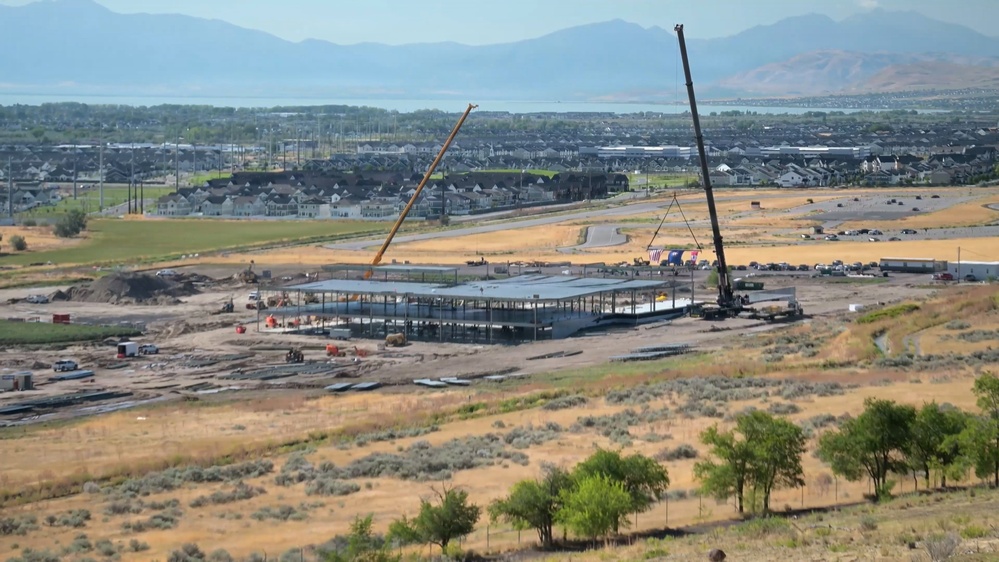
Looking west along the Jordan River banks, a beautiful massive new brick building shades the landscape of the southern end of Camp Williams. The U.S. Army Reserve Center (ARC), serves as the centerpiece of what State Command Sergeant Major Rick Thalman, who doubles as the Senior Project Manager, describes as “generational change” for the Utah National Guard and the post itself.
By summer 2026, more than 2,000 Army Reserve soldiers and roughly 500 full-time personnel currently stationed at historic Fort Douglas in Salt Lake City will move south and call Camp Williams home. The move consolidates three major Army Reserve commands onto the growing training post south of the Point of the Mountain, marking the largest single influx of new personnel in Camp Williams’ modern history.
“It’s not just growth in numbers,” said Thalman. “It’s growth in capability, partnerships, and opportunity. We’re bringing Reserve Component excellence right into the heart of what the Utah Guard already does so well.”
The state-of-the-art ARC — built by Jacobsen Construction — is on track for substantial completion in April 2026. The first Army Reserve units are expected to begin arriving as early as May 2026, with the full transition from Fort Douglas complete by the end of fiscal year 2026. The facility itself pays homage to Fort Douglas’ red-brick heritage while embracing modern design: abundant natural light, high-tech collaborative workspaces, and a maintenance shop that rivals private industry standards. Adjacent to the site, a newly created ethno-botanical study area — developed in partnership with tribal nations — will feature walking paths highlighting native plants and cultural history, inspired by Red Butte Garden in Salt Lake City.
An innovative three-way partnership—Army Reserve Installation Management Directorate, the State of Utah, and the University of Utah—enabled this project. The University received 49.7 acres of Fort Douglas land to connect its main campus, medical center, and research park in exchange for funding and constructing a new Reserve Center on Camp Williams. This deal gives the Army Reserve a modern, consolidated home for the next century, earning the project the 2025 Army Community Partnership Award, one of only five national awards presented at the Pentagon in December 2025.
The ARC is the anchor of what leaders now call “Lower Garrison”, the area of Camp Williams directly south of the main post, adjacent to Redwood Road. In addition to the ARC, lower garrison currently hosts the Aaron Butler Readiness Center and the staging area for the 19th Special Forces Group (Airborne). Due to traffic concerns, and a changing footprint around Camp Williams, the decision to open a brand new main gate for the installation is already in design, with groundbreaking planned for 2026 and completion targeted for late 2027 or early 2028. Once open, the current Redwood Road gate will become a secondary entrance. The new gate will approach Camp Williams traveling north from 2700 North in Lehi.
Eventually, Mountain View Corridor (MVC), which is under construction alongside the western portion of Camp Williams, will serve as a feeder road to the main gate of the post. These efforts will significantly reduce traffic and congestion along Redwood Road (SR-68) in Saratoga Springs, Lehi, Bluffdale, and Riverton. “This isn’t just about moving the gate,” explained Thalman. “It’s about safety, force protection, and efficiency for everyone who uses this installation — Soldiers, Airmen, civilians, and families.”
Upgrades to Camp Williams are only a part of the growth of the Utah National Guard. State-supported infrastructure upgrades, new readiness centers and maintenance facilities in Nephi, Manti, Cedar City, and St. George, plus ongoing renovations in Draper and West Jordan, demonstrate sustained investment across the Utah Guard enterprise.
“We just finished the first 100 years of Camp Williams,” said Thalman. Now we’re building the next 100 — and it’s going to be even better for our Soldiers, our families, and the communities we serve.”
For Utah National Guard members, expect 2026 to bring construction dust across the state, more vehicles on Camp Williams, new faces around the installation and the parking lots, and a few growing pains. But leaders insist the payoff will be worth it: stronger training partnerships, new capabilities, and a Camp Williams ready to serve the state and nation for generations to come.
| Date Taken: | 12.01.2025 |
| Date Posted: | 12.15.2025 14:40 |
| Story ID: | 554208 |
| Location: | CAMP WILLIAMS, UTAH, US |
| Web Views: | 557 |
| Downloads: | 0 |

This work, Army Reserve Center on Camp Williams Signals Generational Change for the Utah National Guard, by SFC Tim Beery, identified by DVIDS, must comply with the restrictions shown on https://www.dvidshub.net/about/copyright.


No keywords found.




