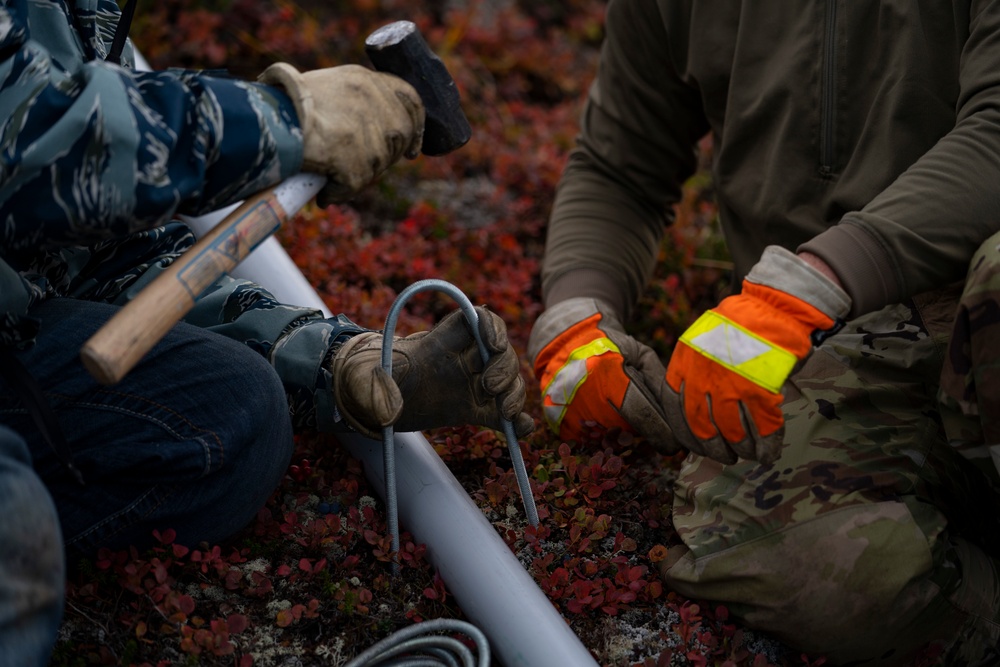
Photo By Senior Airman Shelimar Rivera-Rosado | Electricians assigned to the 773d Civil Engineer Squadron perform maintenance work on the star at Mount Gordon Lyon, Alaska, Aug. 30, 2022. Every year, members of the 773d CES maintain and renovate as required on the 300-foot-wide star that's become an Anchorage landmark from Thanksgiving until the last Iditarod musher makes it to Nome. The 773d CES inherited this responsibility when Fort Richardson and Elmendorf Air Force Base merged in 2010. (U.S. Air Force photo by Airman 1st Class Shelimar Rivera Rosado) see less
| View Image Page
JOINT BASE ELMENDORF-RICHARDSON, ALASKA, UNITED STATES
Joint Base Elmendorf-Richardson's 773d Civil Engineer Squadron will activate the star on Arctic Valley's Mount Gordon Lyon Nov. 25, 2022 at 8 a.m. via remote transmitter for the first time in history.
The 773d CES recently installed the remote module with a transmitter/receiver to reduce the challenges of maintenance during the star's active months.
The star sits 4,000 feet above sea level on a steep slope of Mount Gordon Lyon. Getting there to do maintenance requires the use of snow machines and snowshoes, and creates a possible safety concern. The newly installed transmitter is expected to reduce the number of trips in the winter.
The star will be turned on the day after Thanksgiving to signal the start of the holiday season, and remain on until the last musher int eh Iditarod makes it to the burled arch in Nome.
The tradition of the star began in 1958 when U.S. Army Capt. Douglas Evert placed a 15-foot star on top of the Site Summit gatehouse. In 1970, the star was expanded to 117 feet, making it visible from Anchorage, and it was expanded again in 1989 to its present size.
More information on the installation of the remote module can be found here:
https://www.dvidshub.net/news/428969/773d-ces-gives-arctic-valley-star-new-lights

 Subscribe






