
Photo by Airman 1st Class Kaitlyn Ergish | 386th Air Expeditionary Wing | 02.17.2021
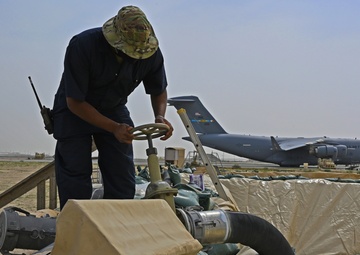
A U.S. Air Force Airman assigned to the 386th Expeditionary Logistics Readiness Squadron transfers fuel into an empty fuel bladder at Ali Al Salem Air Base, Kuwait, Feb. 17, 2021. Fuel bladders are capable of holding up to 210,000 gallons of fuel, ensuring continuous flight operations. (U.S. Air Force photo by Airman 1st Class Kaitlyn J. Ergish)...
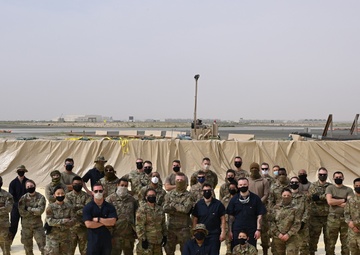
Photo by Airman 1st Class Kaitlyn Ergish | 386th Air Expeditionary Wing | 02.17.2021
Airmen assigned to the 386th Air Expeditionary Wing pose for a photo in a fuel cell at Ali Al Salem Air Base, Kuwait, Feb 17, 2021. These Airmen assisted the 386th Expeditionary Logistics Readiness Squadron in the set up of a new fuel bladder. (U.S. Air Force photo by Airman 1st Class Kaitlyn J. Ergish)...
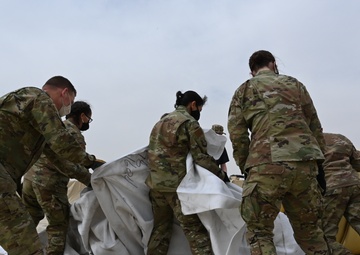
Photo by Airman 1st Class Kaitlyn Ergish | 386th Air Expeditionary Wing | 02.17.2021
U.S. Air Force Airmen assigned to the 386th Air Expeditionary Wing assist in the setup of a fuel bladder at Ali Al Salem Air Base, Kuwait, Feb. 17, 2021. Fuel bladders are replaced every three to four years after they become unserviceable. (U.S. Air Force photo by Airman 1st Class Kaitlyn J. Ergish)...
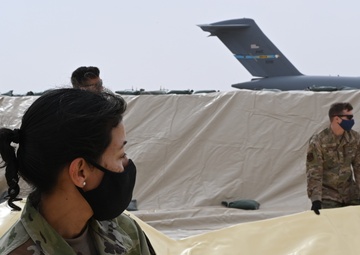
Photo by Airman 1st Class Kaitlyn Ergish | 386th Air Expeditionary Wing | 02.17.2021
A U.S. Air Force Airman assigned to the 386th Air Expeditionary Wing assists in the setup of a fuel bladder at Ali Al Salem Air Base, Kuwait, Feb. 17, 2021. Fuel bladders are replaced every three to four years after they become unserviceable. (U.S. Air Force photo by Airman 1st Class Kaitlyn J. Ergish)...
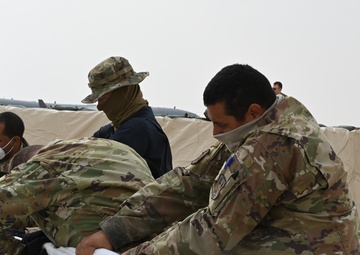
Photo by Airman 1st Class Kaitlyn Ergish | 386th Air Expeditionary Wing | 02.17.2021
A U.S. Air Force Airman assigned to the 386th Air Expeditionary Wing assists in the setup of a fuel bladder at Ali Al Salem Air Base, Kuwait, Feb. 17, 2021. Fuel bladders are replaced every three to four years after they become unserviceable. (U.S. Air Force photo by Airman 1st Class Kaitlyn J. Ergish)...
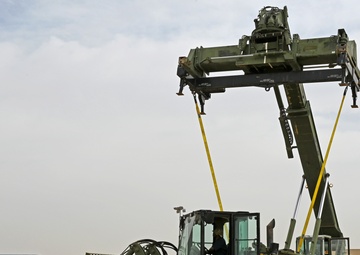
Photo by Airman 1st Class Kaitlyn Ergish | 386th Air Expeditionary Wing | 02.17.2021
U.S. Air Force and U.S. Army machinery operate together to transfer a fuel bladder into a fuel cell at Ali Al Salem Air Base, Kuwait, Feb 17, 2021. An empty fuel bladder can weigh as much as 4,600 pounds. (U.S. Air Force photo by Airman 1st Class Kaitlyn J. Ergish)...
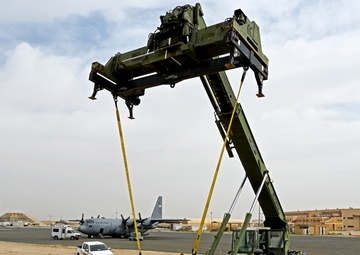
Photo by Airman 1st Class Kaitlyn Ergish | 386th Air Expeditionary Wing | 02.17.2021
U.S. Air Force and U.S. Army machinery operate together to transfer a fuel bladder into a fuel cell at Ali Al Salem Air Base, Kuwait, Feb 17, 2021. An empty fuel bladder can weigh as much as 4,600 pounds. (U.S. Air Force photo by Airman 1st Class Kaitlyn J. Ergish)...
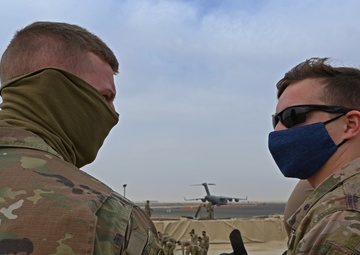
Photo by Airman 1st Class Kaitlyn Ergish | 386th Air Expeditionary Wing | 02.17.2021
U.S. Air Force Airmen assigned to the 386th Air Expeditionary Wing assist in the setup of a fuel bladder at Ali Al Salem Air Base, Kuwait, Feb. 17, 2021. Fuel bladders are replaced every three to four years after they become unserviceable. (U.S. Air Force photo by Airman 1st Class Kaitlyn J. Ergish)...




