This podcast accompanies the Italian Air Force History Museum, located on Aviano Air Base.
Episodes
Italian Air Force History Museum - English: Banner 1
The Aviano school was established in 1911 as the first major expansion of Italy's pioneering flight training program, quickly becoming a national hub for aspiring pilots. At the time, aviation was a service within the Royal Army, and pilots came from various military branches like the Alpini and Cavalry. The school played an early role in military history when its pilots were deployed to Libya during the Italo-Turkish War, one of the first instances of aircraft being used for observation in a conflict. The banner also highlights the early infrastructure, including the command buildings and the creation of the first weather station to ensure flight safety.
03/31/2026
Italian Air Force History Museum - English: Artifacts
The key artifacts on display showcase the evolution of aviation technology and pilot gear.
Torpedo: An original torpedo used by the legendary Savoia-Marchetti SM.79 "Sparrowhawk" during World War II, symbolizing the daring missions of Italian torpedo bombers.
Flight Gear: The evolution of pilot attire is shown through mannequins, starting with the early white summer flight suits, moving to the thermal bomber pilot suits of WWII, and advancing to the fire-retardant, anti-G survival... read more
The key artifacts on display showcase the evolution of aviation technology and pilot gear.
Torpedo: An original torpedo used by the legendary Savoia-Marchetti SM.79 "Sparrowhawk" during World War II, symbolizing the daring missions of Italian torpedo bombers.
Flight Gear: The evolution of pilot attire is shown through mannequins, starting with the early white summer flight suits, moving to the thermal bomber pilot suits of WWII, and advancing to the fire-retardant, anti-G survival suits of the jet age. A modern display features a Tornado pilot's gear, including an original control stick and navigator's monitor.
F-104 Ejection Seat: The powerful and complex ejection seat from an F-104 "Starfighter" is on display, representing a critical emergency system for pilots flying at speeds exceeding Mach 2 during the Cold War.
SM.79 Machine Gun: A 7.7 caliber machine gun from the dorsal turret of an SM.79 is featured. This weapon's position created a distinctive hump, earning the aircraft the nickname "Gobbo Maledetto" (Damned Hunchback) from enemy pilots.
show less
03/31/2026
Italian Air Force History Museum - English
In 2011, Aviano was central to Operations Unified Protector/Odyssey Dawn during the Libyan revolution. Its strategic location and advanced infrastructure enabled rapid support for the arms embargo and the No-Fly Zone. The base provided essential logistical and operational support for a multinational fleet, solidifying its role as a cornerstone for Mediterranean security and highlighting the effective cooperation between Italy and the United States within NATO.
03/31/2026
Italian Air Force History Museum - English: Balkan and Libyan Crisis Panels
Aviano Airport served as a critical strategic hub for NATO during two major international crises.
03/31/2026
Italian Air Force History Museum - English: In-depth Panel A: The Balkan Crisis (1992 – 2004)
During the dissolution of Yugoslavia, Aviano became the primary base for NATO's peacekeeping and peace-enforcement missions. From 1992 to 2004, it was the main launching point for significant operations, including Deny Flight, Deliberate Force, and Allied Force. From 1994 to the end of Balkan Operations, the 31st Fighter Wing’s two F-16 squadrons alone flew almost 12,000 total sorties. In addition, the base hosted hundreds of allied aircraft, supported humanitarian efforts, and became known internationally as "the gateway to the Balkans."
03/31/2026
Italian Air Force History Museum - English: Panel 7 - From Rubble to Rebirth – Aviano in the Cold War and the Modern Era
The seventh banner details Aviano Airport's dramatic transformation from World War II to its role as a NATO stronghold. After the armistice between Italy and the Allies in September 1943, German forces occupied the airport, deporting Italian personnel and integrating some remaining pilots into the Luftwaffe. Nine Allied air attacks between 1943 and 1945 subsequently razed the infrastructure, leaving the base significantly damaged by the end of the war. As late as March of 2026, unexploded ordnance from these attacks was still being unearthed at Aviano.
03/31/2026
Italian Air Force History Museum - English: Banner 6 - 1939 – The Bombardment Academy and Torpedo Bombers
In 1939, Aviano Airport was designated the headquarters for the prestigious Royal Bombardment School, transforming it into a premier training center for Italian bomber crews.
The most iconic aircraft of this period was the Savoia-Marchetti S.79 "Sparviero," which, though originally a bomber, became legendary as a torpedo bomber used in famous long-range missions against targets like Gibraltar. An original torpedo from this era is highlighted as a key historical artifact.
The school utilized a varied fleet for comprehensive training, which also included other notable aircraft such as the CANT Z.1007 "Alcione," the Caproni Ca.310 "Libeccio," and the Savoia-Marchetti SM.81 "Pipistrello."
03/31/2026
Italian Air Force History Museum - English: Banner 5 - 1937 – Towards Conflict: The 18th Land Bombardment Wing
In 1937, Aviano Airport transformed from a training school into a fully operational combat hub with the establishment of the 18th Land Bombardment Wing. This marked its entry into the modern era of strategic bombing as international tensions rose before World War II.
The base housed a variety of advanced Italian aircraft, including the Savoia-Marchetti S.81 "Pipistrello" and the all-metal Fiat BR.20 "Cicogna". Aviano became a military citadel, with crews constantly training for formation flying and precision bombing, upgrading its infrastructure to support the large bombers and hundreds of specialists, and preparing the base for its role in the upcoming war.
03/31/2026
Italian Air Force History Museum - English: Banner 4 - The Eagle and its Eaglets – The Aviano Fighter School
This section of the exhibition focuses on the identity of the Aviano Fighter School between the World Wars. The school's insignia, an eagle protecting its "eaglets," symbolized its mission to train young pilots for Italy's Royal Air Force.
Key training aircraft of the era included the Fiat CR.20 biplane for basic aerobatic and combat instruction, and its more powerful evolution, the Fiat CR. Asso. At this time, Aviano was considered an "academy of courage" where pilots honed advanced combat tactics and perfected the art of formation flying, a skill that would bring Italian aviators international fame.
03/31/2026
Italian Air Force History Museum - English: The Great War and the Myth – The Era of Giants and the Bard
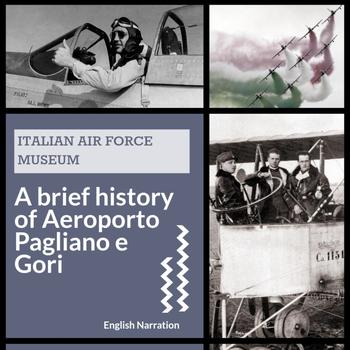
During World War I, Aviano Air Base transformed into a vital military hub as the airplane evolved into a tactical weapon. It became the deployment site for squadrons of the Caproni Ca.3, Italy's first true bomber. The famous poet Gabriele D'Annunzio arrived at the base, forming a close bond with pilots Maurizio Pagliano and Luigi Gori. The two (along with their Mission Commander, Aurelio Barbarisi) became national heroes after their daring May 1917 raid on an enemy naval base at Pula. The... read more
During World War I, Aviano Air Base transformed into a vital military hub as the airplane evolved into a tactical weapon. It became the deployment site for squadrons of the Caproni Ca.3, Italy's first true bomber. The famous poet Gabriele D'Annunzio arrived at the base, forming a close bond with pilots Maurizio Pagliano and Luigi Gori. The two (along with their Mission Commander, Aurelio Barbarisi) became national heroes after their daring May 1917 raid on an enemy naval base at Pula. The two pilots were killed in action that December. D'Annunzio successfully campaigned to have the base officially named "Pagliano e Gori" in their honor in 1920.
The base was also where the famous Flight over Vienna was secretly planned and tested by D'Annunzio and his comrades. Following the defeat at Caporetto in October 1917, Italian forces were forced to retreat, destroying their own aircraft to prevent capture. The base was then occupied by Austro-Hungarian troops, and the Italians subsequently bombed their own former base to weaken the enemy.
show less
03/31/2026
Italian Air Force History Museum - English: Banner 3 - The Birth of the Blue Air Force and the Era of the Regia Aeronautica
On March 28, 1923, the Regia Aeronautica (Royal Air Force) was established as an independent branch of the Italian military, and Aviano became a key training center. The base solidified its role as a Fighter Flight School, notably training the first officer cadets of the new Air Force Academy's "Aquila Course."
The base's strategic importance grew, attracting visits from high-profile figures like King Victor Emmanuel III and aviator Italo Balbo. This period also marked a visual transformation, with the introduction of the iconic blue uniforms of the Air Force and the specialized work attire for maintenance crews, distinguishing them from the old army uniforms.
03/31/2026
Italian Air Force History Museum - English: Introduction
The Exhibition Hall of the Aviano Airport Command was created in 2012 to commemorate the airport's centenary. It serves as a historical journey, documenting the airport's evolution from its beginnings to its current strategic role. The exhibition is structured into seven chronological sections, each introduced by a dedicated banner. Through a curated selection of historical photographs, it highlights the technological, architectural, and human changes that have shaped the airport over the last century. The hall is intended to be a link between the Airport Command and the local community, celebrating a shared history and providing context for understanding the airport's present-day identity.