
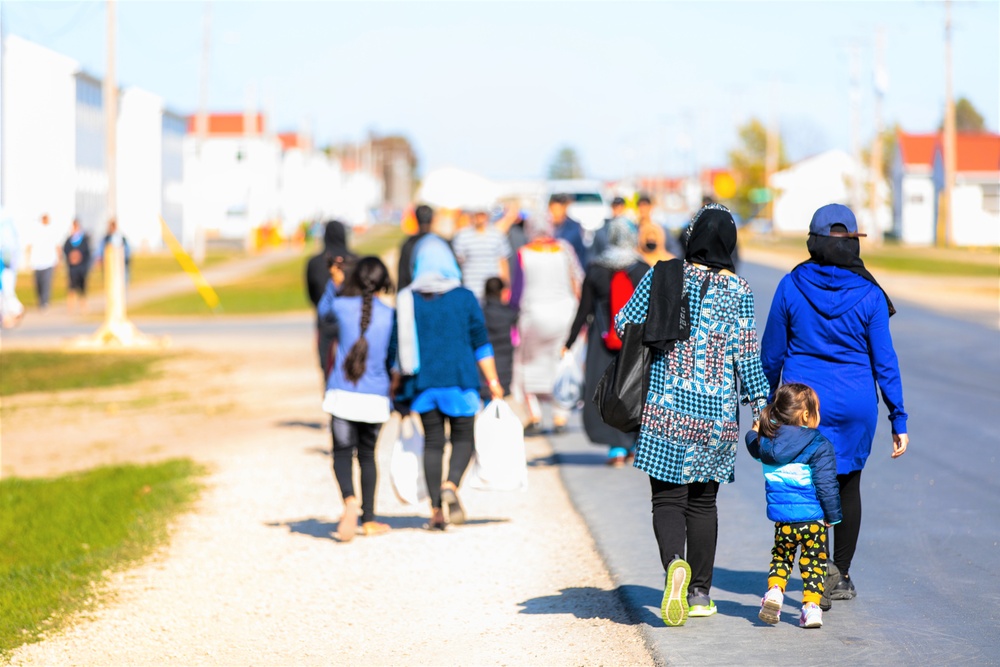
Photo By Sgt. Froylan Grimaldo | Afghan evacuees walk back to their barracks Oct. 19, 2021, at Fort McCoy, Wis., as...... read more read more
 Subscribe
Five years ago in August 2021, Fort McCoy began receiving thousands of Afghan evacuees as part of one of the most significant humanitarian missions in the installation’s modern history.
On Aug. 22, 2021, Fort McCoy began receiving Afghan guests as part of Operation Allies Welcome (OAW) — a federal effort to support Afghan nationals evacuated from Afghanistan following the end of U.S. military operations there.
Over the next nearly six months, Fort McCoy became a temporary home and processing center for approximately 12,600 Afghan guests which transformed the installation from primarily a military training center into a massive humanitarian-support operation.
According to the Fort McCoy Public Affairs Office’s Feb. 25, 2022, end-of-mission report, the last Afghan guests departed Fort McCoy at approximately 8 a.m. Feb. 15, 2022, officially ending the installation’s OAW mission.
The same news report stated that more than 4,000 people representing 35 federal, state, local, nongovernmental and volunteer organizations participated in the operation. Angie Salazar, the Department of Homeland Security lead for OAW at Fort McCoy, described the scale of the operation in the Fort McCoy PAO’s end-of-mission coverage.
“We literally put up an entire city with a population of approximately 15,000,” Salazar said. That description illustrates just how dramatically Fort McCoy changed during the six-month operation.
A different mission for Fort McCoy
The Department of Homeland Security led Operation Allies Welcome, while the Department of Defense supported the effort through U.S. Northern Command and Task Force McCoy.
Fort McCoy was one of eight U.S. military installations selected to temporarily house and support Afghan evacuees while they completed required processing and prepared for resettlement throughout the United States.
For Fort McCoy personnel, the mission required the rapid establishment of services and infrastructure that were significantly different from the installation’s normal military training mission.
Then-Fort McCoy Garrison Commander Col. Michael Poss described the challenge during the early stages of the operation in the same report.
“We’re pretty good at the away game in other countries. This is a new mission,” Poss said.
Poss also described the pace of the effort by saying, “We’re still building the plane while flying it.”
Those comments captured the reality facing Fort McCoy in August and September 2021 as the installation simultaneously received Afghan guests, established support operations and continued preparing for military training activities.
Fort McCoy organizations ranging from the Directorate of Public Works and Directorate of Emergency Services to the Network Enterprise Center; Logistics Readiness Center; Army Community Service; Religious Support Office; Directorate of Family and Morale, Welfare and Recreation; and more became involved in supporting the mission.
Feeding thousands every day
The scale of OAW can perhaps be seen most clearly through the food-service operation.
In a Feb. 24, 2022, Fort McCoy Public Affairs news report, Fort McCoy Food Program Manager Andy Pisney described the food-service mission as a monumental undertaking.
According to Pisney, the food-service operation supported nearly 13,000 Afghan guests and almost 2,000 Task Force McCoy personnel during the operation.
The reports states that 31 of Fort McCoy’s 34 dining facilities were used during OAW.
Fort McCoy’s Food Program Management Office and Subsistence Supply Management Office ordered, received, issued and accounted for approximately $19.3 million in subsistence, according to figures provided by the Fort McCoy food-service team. The food-service operation also received 2,171,448 cans and bottles of water.
Food-service personnel sourced and catalogued approximately 120 new subsistence items, including halal-certified proteins and other culturally appropriate foods. The report also states that the food-service team conducted 279 surveillance inspections during the operation.
At the height of OAW, the food operation received approximately eight semitrailer loads of food each day. The daily food requirements were equally significant.
According to the Fort McCoy food-service team, approximately 9,700 pounds of protein, more than 8,000 pounds of rice and potatoes, and more than 8,000 pounds of vegetables were served each day. Reports also show that dining facility 2472 was serving approximately 4,500 people per meal, despite having a normal design capacity of 1,428 people.
Another dining facility in the 1800 block was serving more than 3,800 people per meal, according to Fort McCoy food-service officials cited in 2022 news reports.
“Right away we knew we would have a monumental challenge before us,” Pisney said, according to the Fort McCoy Public Affairs Office’s Feb. 24, 2022, article.
Caring for the whole person
OAW involved much more than providing food and shelter.
According to Angie Salazar, as reported, the temporary community included 12 informal schools conducting approximately 70 classes each day.
Afghan guests also participated in recreation and quality-of-life activities that included arts and crafts, movies, sports, sewing programs, tea rooms and community-care centers.One of the memorable recreational events was a production of The Nutcracker.
Medical personnel also played a major role.
According to Fort McCoy PAO reporting based on Task Force McCoy information, approximately 87,000 vaccinations were administered to Afghan guests during the operation. Those vaccinations included routine childhood vaccinations as well as COVID-19 and influenza vaccinations. The effort resulted in 100 percent of the Afghan guest population becoming fully vaccinated.
The operation also addressed educational needs.
According to Salazar, more than 100 female Afghan university students were connected with universities offering full scholarships so they could continue their education in the United States. Wisconsin officials also assisted families during the operation.
Also, 65 birth certificates were issued for babies born during the mission.
Surrounding community responds
While thousands of military and civilian personnel worked inside Fort McCoy, the installation’s surrounding communities also became an important part of the OAW response.
Local organizations, businesses, churches, schools, health care providers, nonprofit organizations, community groups and individuals donated supplies and provided assistance to Afghan families.
At the conclusion of the operation, Maj. Gen. Robert Whittle, who commanded Task Force McCoy during the mission, recognized the importance of that support.
In remarks published by the Fort McCoy Public Affairs Office, Whittle said it was an “honor and privilege” to welcome Afghan guests after their difficult journey and help them begin a new chapter in the United States.
Whittle specifically credited the local community for its support, stating that one of his “fondest memories” of the mission was the “overwhelming generosity of the local community.”
Poss also recognized the Fort McCoy workforce and community after the mission concluded. According to the Fort McCoy PAO’s Feb. 24, 2022, report, Poss thanked the Fort McCoy Garrison, tenant organizations, and Team McCoy workforce for supporting OAW while continuing to provide services for Fort McCoy’s regular military training customers.
Poss also thanked Task Force McCoy Soldiers, interagency partners, nongovernmental organizations, local communities and the public.
“We would not be successful without that support,” Poss said.
A mission that affected the installation’s regular workload
The OAW mission also occurred while Fort McCoy continued supporting its traditional military training mission. According to Fort McCoy’s fiscal year 2022 year-in-review reporting, the installation supported 77,421 military personnel during fiscal year 2022, compared with 116,053 military personnel in fiscal year 2021.
The decrease occurred while Fort McCoy was simultaneously supporting the large OAW population and the extensive infrastructure and manpower requirements associated with the mission.
The experience demonstrated that Fort McCoy could support a major humanitarian mission while continuing to provide facilities, ranges, training areas and services for military units.
From current mission to Fort McCoy history
Five years after the first Afghan guests arrived, Operation Allies Welcome has transitioned from an active mission into an important chapter of Fort McCoy history. That history is now being preserved at the Fort McCoy History Center.
In 2026, Fort McCoy established a permanent OAW exhibit featuring artifacts and memorabilia from the operation. According to Fort McCoy historical and Public Affairs officials, the exhibit includes items collected during the mission that help tell the story of the thousands of people who lived and worked at Fort McCoy during OAW.
The exhibit debuted during Fort McCoy’s 2026 Armed Forces Day Open House, providing visitors an opportunity to learn about the mission and the people who supported it.
For Fort McCoy, the exhibit represents an important transition. In August 2021, Operation Allies Welcome was an immediate national requirement. Fort McCoy personnel were building facilities, establishing services, coordinating organizations and solving problems in real time. Five years later, those same efforts are being preserved as part of the installation’s permanent historical record.
Remembering the numbers — and the people
The statistics tell the story of the operation’s enormous scale.
— Approximately 12,600 Afghan guests came through Fort McCoy.
— More than 4,000 people from 35 organizations participated in the mission.
— Approximately 87,000 vaccinations were administered.
— Twelve informal schools conducted approximately 70 classes each day.
— More than 100 Afghan female university students received assistance continuing their education.
— Sixty-five birth certificates were issued.
— The food-service operation accounted for approximately $19.3 million in subsistence and more than 2.17 million cans and bottles of water.
But five years later, the legacy of Operation Allies Welcome is about more than statistics. It is about the Fort McCoy Soldiers, Army civilians, contractors, and volunteers who adapted to a mission unlike anything most had previously experienced.
It is about the federal, state and local agencies that worked alongside the military. It is about the nonprofit organizations and volunteers who provided assistance. And it is about the communities surrounding Fort McCoy that responded with donations, encouragement, and support.
The mission also demonstrated something fundamental about Fort McCoy. The installation is built to support military readiness, but its infrastructure and workforce can rapidly adapt when the nation requires something different. Operation Allies Welcome demonstrated that capability on an enormous scale.
As Fort McCoy preserves the story through its History Center exhibit, the events of 2021 and 2022 are no longer simply memories of a recent mission. They are now part of the installation’s history.
Five years later, the numbers remain impressive. But the lasting legacy of Operation Allies Welcome at Fort McCoy may be found in the people who came together — military and civilian, government and nongovernmental, local and national — to accomplish a mission none of them expected when the first Afghan guests arrived on Aug. 22, 2021.
| Date Taken: | 09.09.2026 |
| Date Posted: | 09.09.2026 14:35 |
| Story ID: | 574188 |
| Location: | FORT MCCOY, WISCONSIN, US |
| Web Views: | 22 |
| Downloads: | 0 |

This work, 5-Year Anniversary: Fort McCoy remembers Operation Allies Welcome — mission that changed installation, by Scott Sturkol, identified by DVIDS, must comply with the restrictions shown on https://www.dvidshub.net/about/copyright.


No keywords found.




