
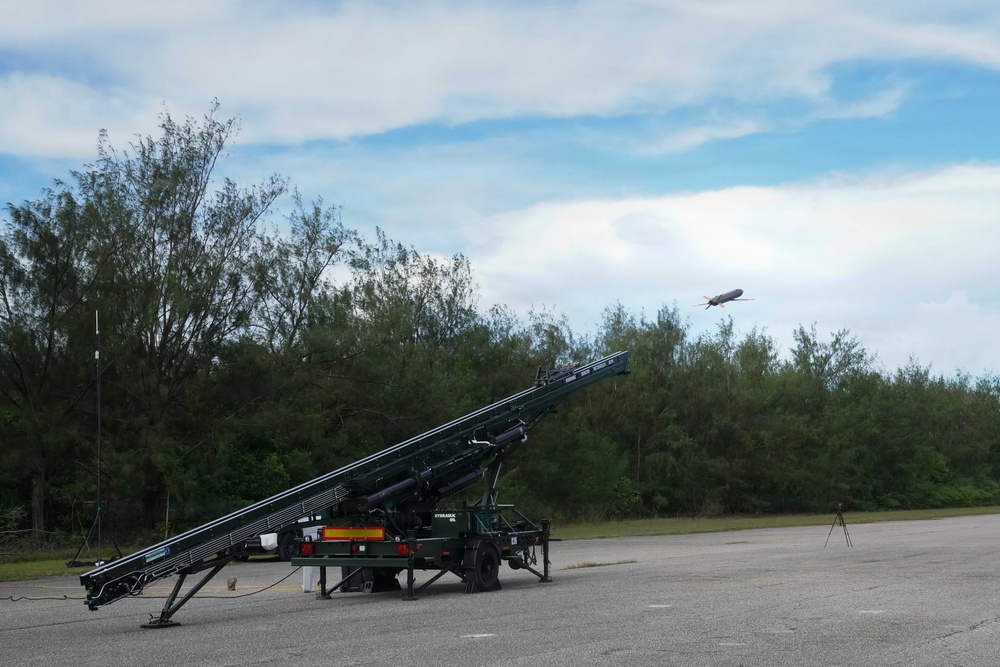
Photo By Sgt. 1st Class Ondirae Abdullah-Robinson | A Red Wolf launched effect platform launches from a Kontio pneumatic launcher during a...... read more read more
NAVAL BASE GUAM, Guam - On the sweltering concrete of Orote Airfield\, a crowd of military assessors\, tech executives\, and Soldiers stood in an anxious huddle\, sweat cutting tracks through the dust on their faces. On the pneumatic launcher sat the Coriolis\, a low-cost\, long-endurance autonomous platform designed to push non-kinetic effects deep into contested spaces. The countdown was moving. Then\, the system flashed an environmental error.
The heavy, oppressive Guam heat and near-total humidity had claimed its first technical casualty.
Instead of scrubbing the mission or triggering a multi-month programmatic review, the crew pivoted. U.S. Soldiers assigned to the 3d Multi-Domain Effects Battalion (3d MDEB), 3d Multi-Domain Task Force, headquartered at Fort Shafter, Hawaii, alongside commercial engineering teams, unbolted the troubled platform, hauled it off the rail, swapped it with a fresh backup, adjusted their workflows, and kept pushing.
This grit-and-glue reality defines the U.S. Army’s "Transform in Contact" initiative, an operational philosophy testing the limits of cheap, dispensable technology during Exercise Valiant Shield 2026. Rather than relying on immaculate, million-dollar exquisite weapon systems, this demonstration proved that the future of multi-domain warfare relies heavily on low-cost, attritable platforms, some literally held together with heavy-duty tape on the flight line, to maximize non-kinetic effects while minimizing the fiscal burden.
"In a lab environment or even at a private test range, everything is controlled," said Zach Williams, the head of strategy at Icarus, the manufacturer of the Apollo R glider platform. "At an exercise, you're constrained by space and time. It drives mission planning, and it drives the vehicle to operate at its margins, at its absolute limit."
These environmental and mechanical hurdles are precisely what the unit traveled to the Marianas to find. By forcing operators to stress-test tactics, techniques, and procedures (TTPs) in punishing equatorial conditions, the 3d MDEB is deliberately hunting for breaking points.
"The old way of doing things meant waiting years for a perfect piece of gear that might be obsolete by the time it reached the field," said Lt. Col. John Cumbie, the commander of the 3d Multi-Domain Effects Battalion. "Transforming in contact means we want our Soldiers to push these systems until they fail right here on the flight line. If an autonomous launch sequence throws a heat error or a platform requires field-expedient modifications to fly, that is a win for us. We find the breaking point, adapt our TTPs, work with the vendor to patch the system, and build a resilient workflow before the next crisis."
This bottom-up feedback mechanism relies entirely on the technical assessments executed daily by junior operators and specialized observers struggling against the elements.
"The integration we are doing out here bridges the gap between what a system can do on paper and how it actually functions in a dynamic environment," said 1st Lt. Alexis Madrigal, a military utility assessor with the U.S. Army Space and Missile Defense Command's concepts and workings branches. "Our Soldiers are troubleshooting on the fly, coordinating directly with tech engineers, and finding out what works when you are operating out of an austere theater like Guam. It gives our teams real ownership over the future of our force's capabilities."
Capt. Samantha Mohr, the commander of the Extended Range Sensing and Effects Company, 3d MDEB, emphasized that managing these hardware realities directly builds frontline proficiency. "Our satellite communication systems operator-maintainers and crew members are building high-level tactical proficiency under realistic Pacific conditions," Mohr said.
Industry partners on the flight line agreed that watching their systems encounter real-world friction alongside troops is the fastest way to refine low-cost technology.
"Working directly with the 3d Multi-Domain Effects Battalion allowed us to see exactly how our vertical-launch capabilities integrate with a tactical unit in an austere environment," said Jason Douglas, the vice president of defense programs at Dragoon, the manufacturer of the Cinder and Coriolis platforms. "The feedback we received on the flight line is critical for refining autonomous operations in confined littoral positions."
Kevin Lord, an advanced electronic warfare strategy and requirements lead for L3Harris Technologies, mirrored the sentiment. "The direct feedback from the 3d MDEB team was invaluable in helping us understand their requirements and capability gaps, ensuring we are developing, designing, and deploying solutions that truly meet their needs," Lord noted.
As Exercise Valiant Shield 2026 continues through July 1, the lessons learned at Orote Airfield prove that innovation is not always sterile. By treating climate challenges and mechanical failures as valuable operational data points, the Army ensures its formations are manned by agile Soldiers who know how to adapt, overcome, and win with the tools on hand.
| Date Taken: | 06.25.2026 |
| Date Posted: | 08.28.2026 17:41 |
| Story ID: | 573404 |
| Location: | NAVAL BASE GUAM, GU |
| Web Views: | 7 |
| Downloads: | 0 |

This work, Valiant Shield 26: Hands-On Flight Line Testing Validates Low-Cost Multi-Domain Systems, by SFC Ondirae Abdullah-Robinson, identified by DVIDS, must comply with the restrictions shown on https://www.dvidshub.net/about/copyright.


No keywords found.





