
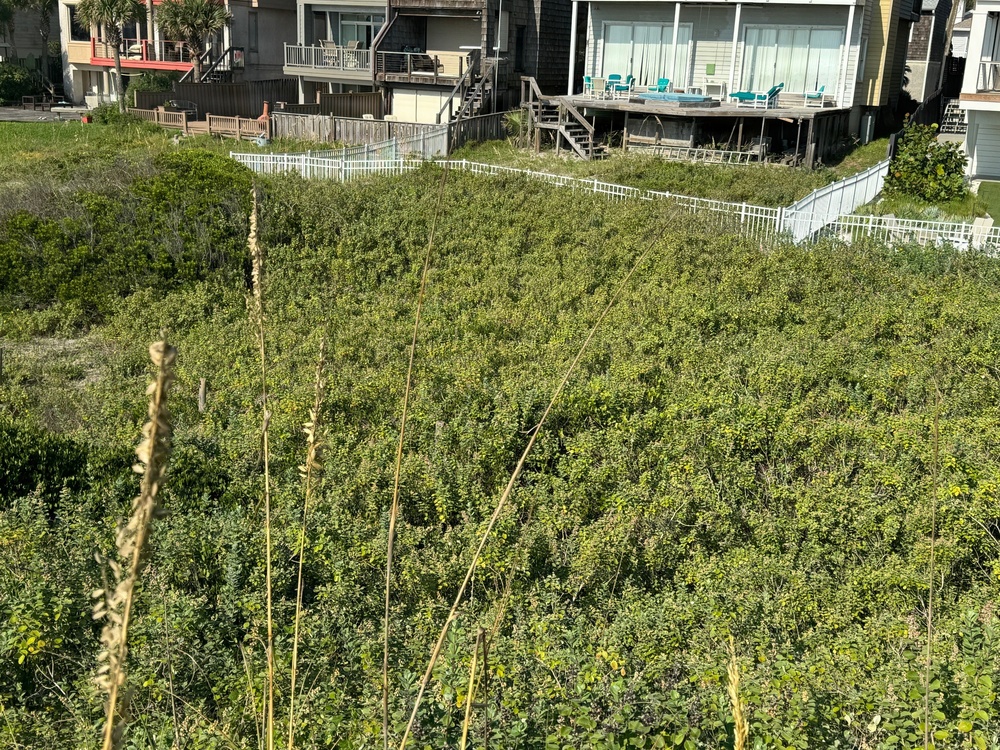
Courtesy Photo | 240822-A-A1411-1005 Dense beach vitex (Vitex rotundifolia) covers a dune in Atlantic...... read more read more
U.S. Army Corps of Engineers Partnership Protects Atlantic Beach Dunes
Early detection and rapid response to beach vitex help protect dune stability, strengthen coastal resilience and support the long-term performance of a coastal storm risk management project.
ATLANTIC BEACH, Fla. — An effort to control an invasive plant in Atlantic Beach shows how environmental stewardship supports the U.S. Army Corps of Engineers’ coastal storm risk management mission.
The City of Atlantic Beach detected beach vitex (Vitex rotundifolia) in 2024 during a beach renourishment project. The city contacted the U.S. Army Corps of Engineers (USACE) Jacksonville District for assistance, and Jessica Spencer, a biologist with the district’s Invasive Species Management Branch, led the Early Detection and Rapid Response effort.
“The partnership we established with the Jax District for dealing with the beach vitex provided the expertise and equipment to rapidly get the areas colonized by beach vitex under control and eventually eradicate it from these areas altogether,” said Steve Swann, city engineer for Atlantic Beach. “This would not have happened without the help of Jessica and other Jax District personnel.”
The goal was to contain and eliminate the isolated population before it could spread through the dune system, displace native vegetation and create a long-term threat to coastal resilience.
At its peak, beach vitex had formed a dense stand across portions of the dune system. The plant spreads through thick, horizontal runners that can produce new roots and woody stems at each node, making it difficult to control once established.
“Since this is a small, relatively isolated population, it was important to eliminate it before it had a chance to spread,” Spencer said. “Early detection and rapid response to this population have prevented it from spreading to the point that it would require long-term management in perpetuity.”
Protecting the dune system Controlling beach vitex is more than a vegetation-management task. It helps protect dunes, which are an important part of the coastal system that reduces storm risk. Native dune plants help hold sand in place, allowing dunes to better withstand erosion from storms and waves. When invasive plants replace native dune vegetation, they can reduce a dune’s ability to stabilize sand and make it more vulnerable during storm events.
“Managing invasive species in the dune system is critical with respect to providing native species such as sea oats and railroad vine the ability to flourish,” Swann said. “This, in turn, provides excellent coastal habitat while reducing storm risk impacts to the city.”
“The impacts of beach vitex involve its displacement of native dune vegetation,” Spencer said. “As the vitex spreads, it outcompetes native vegetation for the limited resources in the dunes and quickly forms a dense monoculture.”
Beach vitex can also spread toward the beach, where its long, woody runners may interfere with sea turtle nesting and trap hatchlings as they move toward the ocean.
Because the population was near a Jacksonville District coastal storm risk management (CSRM) project and within an Atlantic Beach renourishment area, controlling the plant also helped prevent future construction, maintenance or renourishment activities from unintentionally spreading it to new locations.
The effort directly supports USACE’s coastal storm risk management mission. Executive Order 13112 directs federal agencies to prevent the introduction and spread of invasive species, respond rapidly when populations are detected and avoid actions that could promote their spread.
“Since this is a small, relatively isolated population, it was important to eliminate it before it had a chance to spread,” Spencer said. “Also, since it was growing right along the edge of one of our CSRM projects, our future work in the area could have contributed to the spread of the plant, which goes against Executive Order 13112.”
A difficult plant to control The initial population was difficult to treat. Two foliar, or leaf-applied, herbicide treatments reduced visible growth but did not adequately reach the extensive underground runners. Spencer said some buried runners were as large as her arm, allowing the plant to resprout within months.
“Although foliar treatments were much easier and faster to apply, not enough herbicide was reaching the underground runners to effectively control them,” Spencer said. “There would be dieback of the above-ground material, but it would quickly resprout.”
A contract crew eventually cut and treated the dense strand in a labor-intensive operation. Jacksonville District personnel and contractors then returned to treat resprouts emerging from runners hidden beneath previously treated vegetation.
Signs of progress The effort is producing encouraging results. During a July 8, 2026, site visit, Spencer found and treated only 10 resprouts. Recent visits also identified new seedlings that could be hand-pulled before they developed the runners that make beach vitex difficult to manage.
“The quick response of Jax District personnel to this problem when we first contacted them, along with their persistence in seeing this project through, was key to success,” Swann said. “The most encouraging result so far is that areas of beach vitex we did find are under control, and we have not found any additional areas of it becoming established.”
“It is encouraging to see that the only beach vitex plants that I had to control on this last site visit were seedlings that could be hand pulled,” Spencer said. “It is much easier — and uses zero herbicide.”
This progress demonstrates the value of early detection and rapid response: identifying a threat early, acting quickly and protecting the natural features that support a coastal storm risk management project.
“Working with invasive species, it is rare to be able to eradicate a population,” Spencer said. “But catching a population early enough gives us that rare opportunity.”
Monitoring continues Jacksonville District will continue monitoring the site because beach vitex had likely been established for years, leaving a seedbank in the soil. The site may need several years without new plants appearing before the population can be considered eradicated.
The City of Atlantic Beach and adjacent property owners have agreed to report new plants, providing additional local support for the district’s long-term management effort.
“This effort demonstrated that working together can result in a very efficient use of tax dollars to prevent a problem that could end up severely impacting the coastal dune system if left unchecked,” Swann said.
Beach vitex is found in only a few places in Florida and was recently added to the state’s Noxious Weed List, which prohibits its sale, growing, transport or planting.
By preventing beach vitex from replacing native dune vegetation, Jacksonville District and the City of Atlantic Beach are helping protect dune function, preserve coastal storm risk management investments and strengthen shoreline resilience over time.
For additional information about the Jacksonville District, visithttp://www.saj.usace.army.mil/.
-30-
| Date Taken: | 08.10.2026 |
| Date Posted: | 08.10.2026 13:47 |
| Story ID: | 571973 |
| Location: | ATLANTIC BEACH, FLORIDA, US |
| Web Views: | 20 |
| Downloads: | 0 |

This work, U.S. Army Corps of Engineers Partnership Protects Atlantic Beach Dunes, by Peggy Bebb, identified by DVIDS, must comply with the restrictions shown on https://www.dvidshub.net/about/copyright.


No keywords found.





