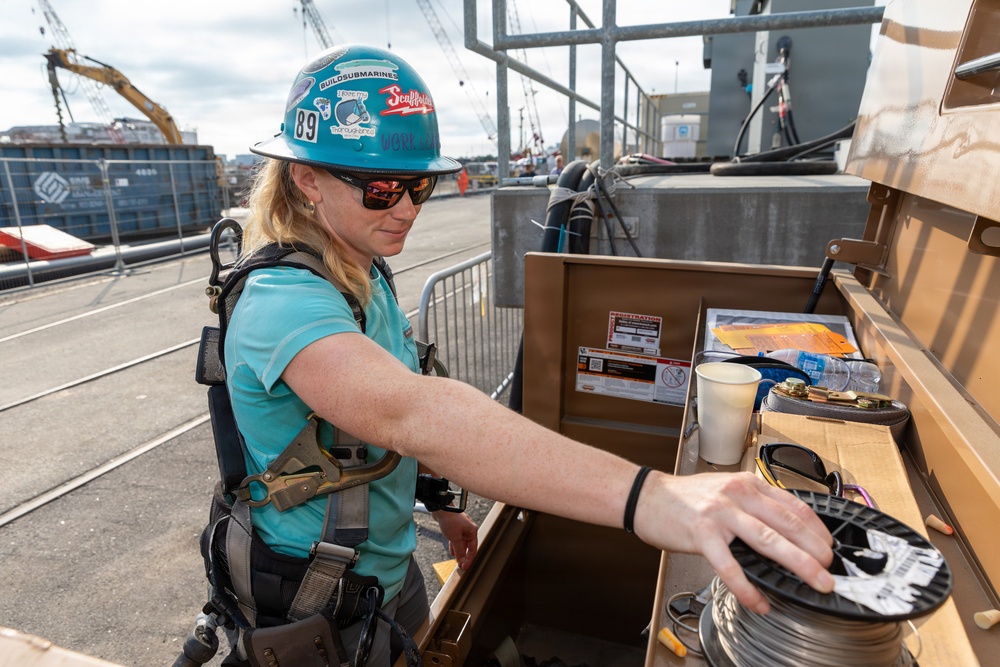
Photo By Petty Officer 1st Class Christian Victor Bautista | Shop 89 Work Leader Megan Asbell gathers her equipment from a tool locker before beginning a shift on the New Hampshire project. Asbell, who has been at the shipyard for nearly seven years, leads her team in executing complex containments and scaffolding layouts. "I like being outside, the flexibility with hours, and just not having to sit at a desk all day," said Asbell. "Our job is to establish the handrails, build the scaffolding, and set up the keel blocks so the boat can sit in dry dock. Nobody does a job on the waterfront unless we are there first to make it safe." see less
| View Image Page
During the "Age of Sail," stretching to the mid-19th century, shipwrights at the Gosport Shipyard—now known as Norfolk Naval Shipyard (NNSY)—were the backbone of wooden shipbuilding. Armed with hand saws, historic cutting tools known as adzes, and raw muscle, these master craftsmen carved towering oak hulls, laid massive wooden keel blocks, and caulked seams to keep the young nation's fleet afloat. They were the physical architects of wood, molding raw timber into instruments of global maritime power.
Today, while those wooden hulls have been replaced by the high-strength steel and nuclear propulsion of modern warships, the vital role of the shipwright remains unchanged in Portsmouth, Virginia. As members of NNSY's Fabric Worker and Shipwright Shop (Shop 89), today’s shipwrights no longer shape timber with hand tools, but they still lay the massive concrete and steel keel blocks that support powerful warfighting vessels in dry dock. Serving as the premier architects of waterfront safety, they design and build the complex scaffolding systems that allow all other trades to safely repair and modernize the U.S. Navy's fleet.
"We have a saying: 'First ones in, last ones out,'" said Donny Brezina, a Shop 89 Shipwright Supervisor on the USS New Hampshire (SSN 778) project. "We’re the ones that have to get the boat going, in a sense, before other trades—welders, pipefitters, machinists, shipfitters—can even get on the boat. We have to establish what they need so they can go to work."
For the approximately 25 shipwrights assigned to the New Hampshire project, the daily grind involves establishing handrails, setting up secure brows, and constructing heavy-duty scaffolding. Known as "The Granite Ghost," the Virginia-class nuclear-powered fast-attack submarine New Hampshire arrived at NNSY in Sept. 2025, to begin a Depot Modernization Period (DMP). This midlife availability spans a large scope of maintenance and refurbishment for the submarine to meet its full service life, but these critical repairs cannot begin until the shipwrights first build the pathway.
This availability is not business as usual; it marks several historic, first-of-its-kind "wins" for NNSY’s in-house workforce.
"One thing that's happened recently that we haven't done in a very long time is all the scaffolding on this boat is ours," Brezina explained. "There are no contractors; there's no group from another entity that's coming in to help. It's just us."
This self-reliance is coupled with a revolutionary containment system. Historically, the shipyard relied on contractors to build weather enclosures around submarines. On the New Hampshire, Shop 89 is entirely responsible for constructing a highly modernized, fully enclosed roof and wall-panel containment system designed to keep the work area dry, while the Temporary Services Department (Code 990) pumps in cooled air to combat summer heat.
The team has also achieved remarkable engineering wins, bridging unprecedented distances between scaffolding structures to allow multiple maintenance evolutions to occur at once. They successfully managed the complex scaffolding required to remove the submarine’s Lightweight Wide Aperture Sonar (LWAS) arrays.
"With scaffolding, you have to assist by building scaffolding, then removing it, tearing it down, and then people want to continue scaffolding over top so they can do their work," Brezina said. "It’s a constant back and forth, but we’ve been able to make some good progress."
"A shipwright is a twofold job," said Malik Davis, a Shop 89 Shipwright on the New Hampshire project. "The first part of scaffold builders, providing access to mechanical parts that normal means can't reach. The second part is carpentry work, coping oak wood caps for keel blocks and covering fall hazards with wood or metal boards."
The sheer complexity of modern shipwright work requires far more than physical strength; it demands meticulous planning and absolute trust. Because scaffolding is recognized as one of the most hazardous jobs in the shipyard, Davis emphasizes that trust and teamwork are non-negotiable.
"You cannot build a scaffold by yourself," Davis said. "Trust is very important when it comes to a team factor. You have to have it."
That blend of mental agility and physical coordination is what draws new talent to the trade, such as Taylin Williams, a fourth-year apprentice.
"I love my job because it's fun," Williams said. " I look at it like adult Legos. It's a great workout, so I don't have to go to the gym after work.."
For Williams, he is drawn to the job’s intellectual challenge.
"Shipwright is all about building, using your brain. It's not all muscle," Williams added. "You have to figure out a way to build things in small areas, big areas, putting whatever you can together safely for others to use... and building it so that it can be removed rapidly once the work is done.."
As the New Hampshire project team continues its vital work toreturn the boat to the fleet, the shipwrights of Shop 89 continue to stand watch from the very beginning to very end of the submarine's overhaul journey. Although the modern tools of the trade have evolved from white oak and adzes to steel pipe and modular panels, the core spirit of the shipwright remains unaltered. They are still the pioneers of the dry dock, setting the stage and carving out the framework for American naval dominance—just as their historic predecessors did under the towering masts of the Age of Sail.