
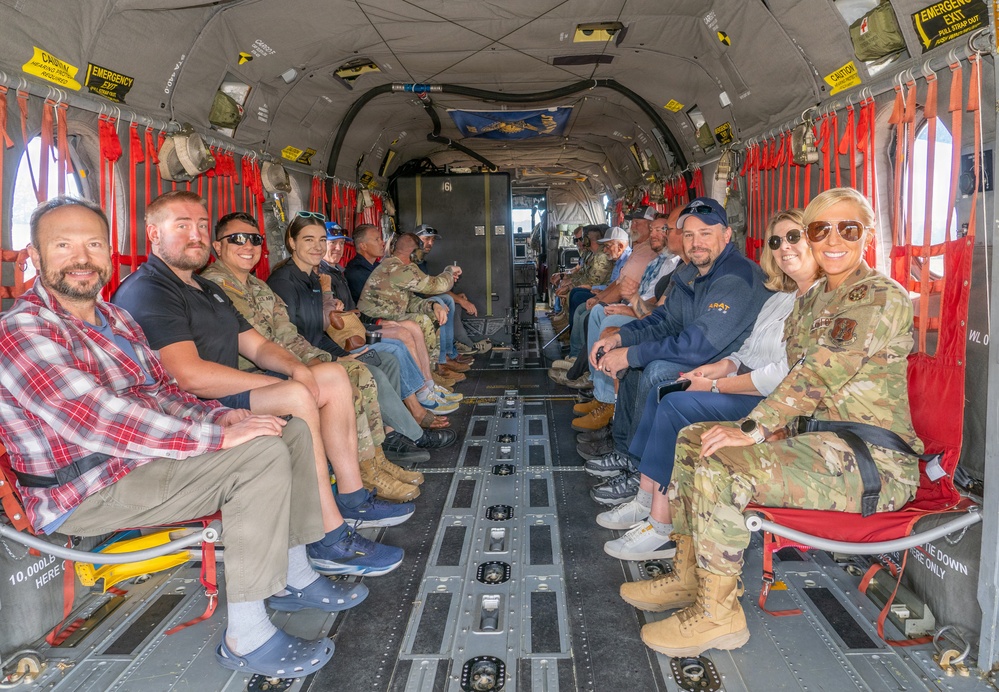
Photo By Maj. Wayne Clyne | Civilian employers and their Oregon National Guard employees board a CH-47 Chinook...... read more read more
As technology reshapes the workplace and experienced employees retire, employers are searching for professionals who can adapt, lead and solve problems. Guard and Reserve members often bring those qualities through the experience of balancing successful military and civilian careers.
According to leadership expert Dr. Jeffrey Magee in the May/June 2026 issue of National Guard magazine, today's National Guard members have an opportunity to become the kind of professional every employer is looking for who consistently delivers results, adapts to change and strengthens every team they join. He describes them as the workplace "unicorn" because they bring experiences that many organizations cannot develop on their own.
That same principle extends beyond the National Guard to America's Reserve forces.
Members of the Guard and Reserve develop leadership, discipline, resilience and technical expertise through military service while simultaneously building careers in the civilian workforce. Those two roles do not compete with one another. When approached intentionally, they reinforce one another.
Military service teaches leadership under pressure, accountability, mission focus, planning and teamwork. Civilian careers expand technical knowledge, communication skills, customer service experience and business expertise. Together, those experiences create professionals who can solve problems, lead diverse teams and adapt to rapidly changing environments. "Oregon employers consistently tell us they value Guard and Reserve employees because they bring maturity, leadership and a mission-first mindset to the workplace," said Cecil Owens, Oregon ESGR State Chair.
"The skills developed through military service don't stay in uniform. They strengthen businesses and improve organizations. When employers support military service, they're investing in employees who have proven they can perform under pressure and continue learning throughout their careers."
Dr. Magee notes that organizations are searching for employees who produce reliable results, communicate effectively, adapt to change and help others succeed. Those qualities are reinforced throughout military service, where service members are expected to lead, solve problems, manage risk and accomplish the mission regardless of changing conditions.
Military experience also provides opportunities that many civilian employees may not encounter early in their careers. Guard and Reserve members often supervise personnel, manage valuable equipment, coordinate logistics, oversee safety programs and make time-sensitive decisions with significant consequences. Learning to lead in those environments prepares them to make meaningful contributions in civilian organizations.
But military service alone is not what makes someone an exceptional employee.
Guard and Reserve members must intentionally connect what they learn in uniform to their civilian careers. Rather than simply listing military schools, deployments or rank on a résumé, service members should explain the results they achieved leading teams, managing resources, improving efficiency, solving complex problems or developing other leaders. Translating military experience into business language helps employers understand the value military service brings to their organizations.
Balancing military and civilian responsibilities also requires trust and communication.
Successful Guard and Reserve employees keep employers informed about military training and deployment schedules as early as possible, communicate how work responsibilities will be covered during absences, and work to minimize disruption whenever possible.
While the Uniformed Services Employment and Reemployment Rights Act (USERRA) provides important legal protections, long-term employer support is built through communication, planning and mutual respect.
Service members also benefit from strong time management. Military schools, annual training, deployments and family responsibilities can create competing demands. Planning ahead, protecting personal well-being, continuing professional development and asking for help before challenges become crises all contribute to success in both careers.
"Employer support is essential for our readiness," said Brig. Gen. Alan R. Gronewold, The Adjutant General, Oregon. “In return, employers gain professionals who have demonstrated leadership, accountability, adaptability and the ability to succeed in challenging environments."
Dr. Magee encourages service members to view every assignment, training opportunity and leadership challenge as preparation for future success. Rather than treating military service and civilian employment as separate careers, Guard and Reserve members can intentionally transfer lessons between both, continuously building knowledge, skills and experience that benefit their employers, military units and communities.
Employer Support of the Guard and Reserve exists to strengthen these partnerships. ESGR recognizes employers who support military service, educates employers and service members about USERRA and promotes communication that benefits both organizations and the men and women who serve.
When employers support Guard and Reserve service, everyone benefits. Businesses gain experienced, adaptable employees. Service members build stronger civilian careers. Military units become more capable through the expertise members bring from their civilian professions. Together, those partnerships strengthen Oregon's workforce, communities and the Nation. About the author: Cory Grogan serves as the Oregon ESGR Public Affairs Director while also serving as a public affairs senior noncommissioned officer in the Oregon Army National Guard and working in civilian public affairs.
| Date Taken: | 08.05.2026 |
| Date Posted: | 08.05.2026 17:47 |
| Story ID: | 571688 |
| Location: | OREGON, US |
| Web Views: | 41 |
| Downloads: | 0 |

This work, Why Guard and Reserve service creates the employees every organization needs, by SFC Cory Grogan, identified by DVIDS, must comply with the restrictions shown on https://www.dvidshub.net/about/copyright.


No keywords found.





