
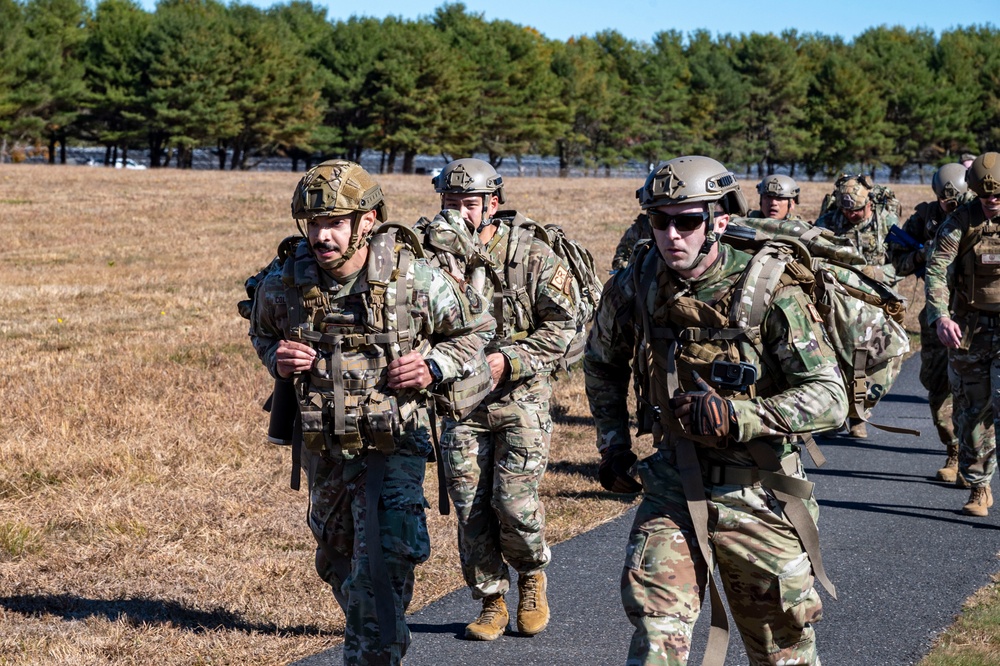
Photo By Master Sgt. Tristan McIntire | Capt. Jose Colon-Franco, Air Advisor with the 818th Mobility Support Advisory...... read more read more
 Subscribe
Contingency response operations demand more than technical expertise. Whether opening an austere airfield, supporting humanitarian assistance or enabling combat operations, Airmen must understand how every specialty contributes to mission success. The 621st Contingency Response Wing’s Devil Development Course, a one-week course conducted at either Travis Air Force Base, California or Joint Base McGuire-Dix-Lakehurst, New Jersey, is designed to build that foundation.
The multi-day professional development course introduces Airmen to the full scope of the contingency response enterprise, combining instruction on mission command, contingency response doctrine, Agile Combat Employment, readiness, force generation, mission planning and the roles of each specialty within the wing. The goal is to develop Airmen who understand not only their own responsibilities, but also how to integrate with teammates in rapidly evolving operational environments.
“The goal is for students to leave the Devil Development Course with a broader understanding of what contingency response does,” said U.S. Air Force Capt. Andrew DiCicco, Training & Programs flight commander. “When they go on their first contingency response team, contingency response element or airfield assessment team, I want them to remember two things: learn each other’s jobs and always have a good attitude.” That broader perspective resonated with students throughout the course.
“I’ve been in the contingency response group my whole career, and I thought, ‘We open and close ports—that’s what we do,’” one student said during the course’s closing discussion. “This course helped me understand how every function across the wing contributes to opening and operating those ports.”
That shared understanding is increasingly important as contingency response Airmen prepare to deploy in small, decentralized teams capable of operating independently in austere locations. Rather than relying on detailed instructions from higher headquarters, those teams must exercise disciplined initiative while understanding how their decisions affect the larger mission.
“It is amazing,” said Chief Master Sgt. Dennis Flanagan, 621st Air Mobility Advisory Group senior enlisted leader. “I can’t think of another Air Force organization that would send a staff sergeant or technical sergeant out to lead a small team at an austere location. That’s a huge amount of trust in our enlisted force and our officer corps.” Flanagan encouraged graduates to view the course as the beginning of their professional development rather than its conclusion.
“This isn’t just a couple-day course,” Flanagan said. “It’s a foundation to build on. Take what you learn back to your unit, find somebody who needs help, bring them along with you and build them up.”
Throughout the week, instructors emphasized that contingency response readiness extends beyond equipment and technical proficiency. Airmen discussed leadership, discipline, trust and resilience alongside historical case studies and current operational challenges, reinforcing the importance of preparing both themselves and their teams before the next mission begins.
For Col. Justin Ballinger, commander of the 621st Contingency Response Wing, that preparation is what enables contingency response forces to remain agile around the globe.
“When you give folks at the lowest echelon the opportunity to make decisions and do great things, they create great things,” Ballinger said.
As the wing continues supporting operations around the world—from humanitarian assistance and disaster relief to expeditionary airfield operations—the Devil Development Course provides Airmen with the common understanding needed to integrate diverse specialties, exercise mission command and execute contingency response missions wherever they are called.
| Date Taken: | 08.03.2026 |
| Date Posted: | 08.03.2026 16:03 |
| Story ID: | 571443 |
| Location: | JOINT BASE MCGUIRE-DIX-LAKEHURST, NEW JERSEY, US |
| Web Views: | 71 |
| Downloads: | 1 |

This work, Devil Development Course prepares Airmen for the demands of contingency response, by Capt. Michael Hong, identified by DVIDS, must comply with the restrictions shown on https://www.dvidshub.net/about/copyright.


No keywords found.




