
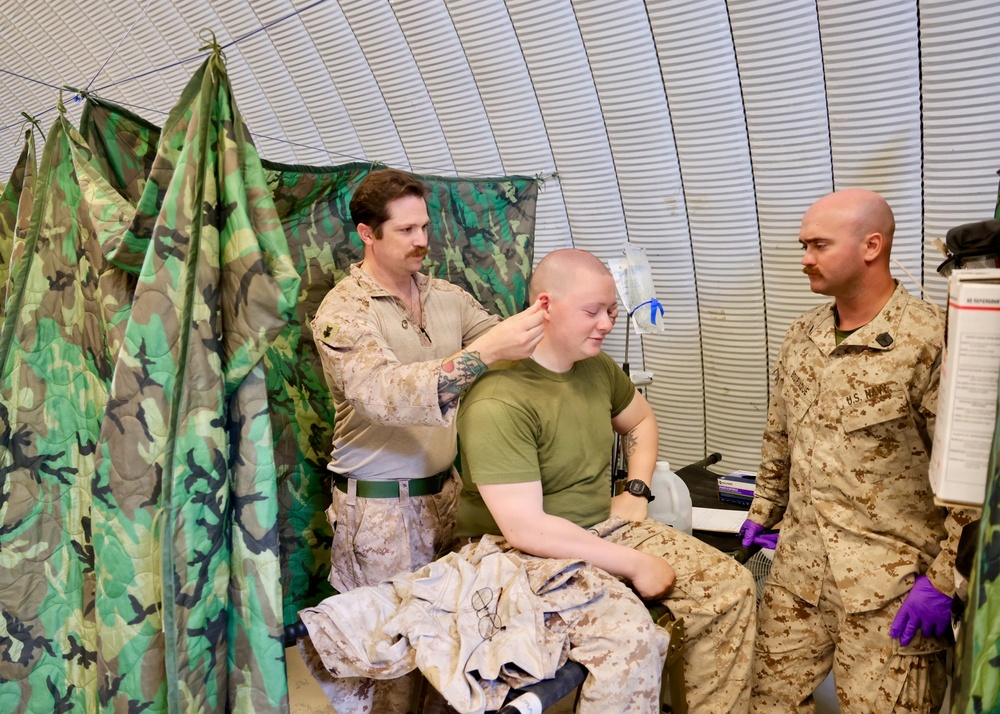
Photo By Christopher Jones | Hospital Corpsman 1st Class James C. Radecki (left), assigned to Navy Medicine...... read more read more
TWENTYNINE PALMS, Calif. — Hospital corpsmen assigned to Navy Medicine Readiness and Training Command (NMRTC) Twentynine Palms joined corpsmen from commands across the country to provide around-the-clock medical support during Integrated Training Exercise (ITX) 3-26, held June 2-17 at Marine Air-Ground Task Force Training Command/Marine Corps Air Ground Combat Center (MAGTFTC/MCAGCC) Twentynine Palms, ensuring Marines and Sailors remained healthy and mission ready throughout one of the Marine Corps Reserve's premier live-fire combined arms training events.
As the Marine Forces Reserve's premier live-fire combined arms training event, ITX prepares Marine Air-Ground Task Forces to meet Strategic Reserve Mobilization Requirements by evaluating units in realistic, combat-focused environments. The exercise places thousands of Marines and Sailors in demanding desert conditions where extreme temperatures, strenuous physical activity and live-fire operations create unique medical challenges.
Supporting those training forces at Camp Wilson's Consolidated Aid Station (CAS), Hospital Corpsman 1st Class James C. Radecki, a Lancaster, California, native assigned to NMRTC Twentynine Palms, served as one of the independent duty corpsmen responsible for delivering immediate medical care throughout the exercise.
Radecki's path to Navy Medicine began before his military service. Having previously worked as an emergency medical technician (EMT), he joined the Navy to expand his medical expertise while serving around the world.
"I was an EMT before joining," said Radecki. "I wanted to further my medical experience and travel the world."
When not supporting ITX, Radecki serves as an independent duty corpsman at the Adult Medical Care Clinic, providing primary medical care for active-duty service members. During ITX, however, his mission shifted to supporting Marines and Sailors training in an austere operational environment where rapid access to medical care can make a critical difference.
Additional medical personnel from Naval Hospital Twentynine Palms, the command’s military treatment facility were requested to augment the medical team supporting the exercise, helping ensure continuous medical coverage throughout the nearly three-week training event.
Each day at the CAS followed a demanding operational tempo designed to keep Marines and Sailors healthy while remaining prepared to respond to medical emergencies at any hour.
"A typical day consisted of morning sick call, training, evening sick call and 24-hour emergency care," Radecki said.
The aid station served as the primary source of medical care for Marines and Sailors participating in the exercise, treating routine illnesses and injuries while maintaining the capability to stabilize and respond to more serious emergencies resulting from the challenging training environment.
The medical team supporting ITX reflected Navy Medicine's ability to rapidly integrate personnel from across the fleet. Corpsmen assigned to the CAS represented commands from across the United States, bringing together a diverse range of operational experience and clinical expertise.
"We had corpsmen from all over the country, including Alaska, Jacksonville, Florida, and Yuma, Arizona," Radecki said.
Working together in a high-tempo operational environment required seamless communication, standardized medical practices and teamwork to ensure every patient received timely, high-quality care regardless of where individual corpsmen were normally assigned.
Although the aid station remained prepared to treat a broad range of medical conditions, many patients presented with injuries and illnesses directly related to the demanding nature of the exercise and the Mojave Desert environment.
"We saw a wide variety of ailments, but among the most common were musculoskeletal injuries and heat and dehydration injuries," Radecki said.
Southern California's desert climate, combined with prolonged physical exertion and continuous field operations, places significant physical demands on Marines and Sailors. Corpsmen continuously monitored service members for signs of heat-related illness while treating injuries and providing education on hydration, recovery and injury prevention to help keep units training safely.
Radecki said maintaining a medical presence close to the training area is essential because of the hazards inherent to the exercise.
"ITX is a highly kinetic training evolution which has numerous hazards, including live fire and extreme physical exertion, all in an austere environment," he said. "It is imperative to have medical personnel and facilities close in order to treat injured Marines and Sailors as quickly as possible."
Positioning medical personnel near training areas reduces response times and allows injured service members to receive immediate assessment and treatment. Whether treating a minor injury, evaluating heat illness or responding to a medical emergency, corpsmen provide a critical link between frontline training and higher levels of medical care when needed.
Although this was Radecki's first ITX serving as a provider, it was not his first experience supporting the exercise.
"This was my first ITX as a provider," he said. "Previously I attended one ITX as a line corpsman with 3rd Battalion, 1st Marines in 2016."
That previous experience gave Radecki valuable insight into the operational demands Marines face during large-scale training exercises and helped prepare him for the increased responsibility of serving as an independent duty corpsman during this year's exercise.
For corpsmen interested in supporting future iterations of ITX, Radecki said preparation begins well before arriving at Camp Wilson.
"I would recommend studying up on heat injuries and treatments and working on physical fitness and conditioning," Radecki said.
Preparing for the environmental and operational challenges of ITX enables corpsmen to confidently provide medical care in austere conditions while supporting Marines during one of the Corps' most demanding training events.
Throughout ITX 3-26, Navy Medicine corpsmen worked alongside Marines in one of the military's most realistic training environments, delivering timely medical care that enabled units to continue training safely while preparing Marine Air-Ground Task Forces for future operational missions.
Navy Medicine's 44,000+ talented and ready forces optimize health readiness, deliver quality healthcare, and provide global expeditionary medical support to warfighters.
| Date Taken: | 07.29.2026 |
| Date Posted: | 07.29.2026 12:30 |
| Story ID: | 571011 |
| Location: | TWENTYNINE PALMS, CALIFORNIA, US |
| Hometown: | LANCASTER, CALIFORNIA, US |
| Web Views: | 212 |
| Downloads: | 0 |

This work, Twentynine Palms corpsmen keep Marines mission ready during ITX 3-26, by Christopher Jones, identified by DVIDS, must comply with the restrictions shown on https://www.dvidshub.net/about/copyright.


No keywords found.





