
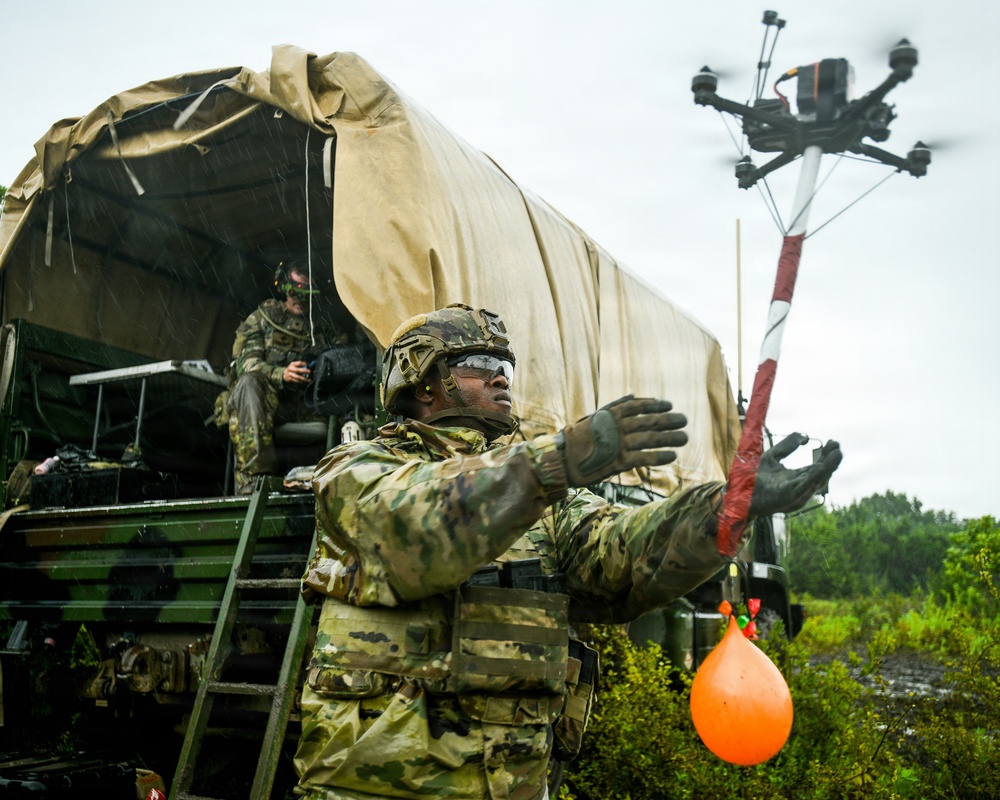
Photo By Master Sgt. Luisito Brooks | Sgt. Jaleel Bodden and Spc. Ian Zinsmeister, both assigned to 2nd Battalion, 5th...... read more read more
 Subscribe
FORT HOOD, Texas - Soldiers assigned to D Company, 2nd Battalion, 5th Cavalry Regiment, 1st Brigade Combat Team, 1st Cavalry Division, tested a newly adapted counter-unmanned aerial system qualification designed to prepare troops for one of the fastest-growing threats on the modern battlefield: drones.
The qualification is part of Pegasus Charge, the 1st Cavalry Division’s transforming in contact initiative, an effort designed not only to evaluate emerging equipment, but also to challenge and evolve how the division thinks, organizes, trains, and operates.
During the training event, Soldiers had to detect, track and engage the UAS using standard infantry weapons while providing drone operators the opportunity to maneuver aircraft in realistic combat scenarios.
“We had two primary purposes of being out here,” said Capt. Avery Fields, platoon leader for the Armored Strike Platoon, D Company, 2-5 Cavalry. “The first was to test a new counter-UAS qualification that we adapted from a qualification developed by the 101st Airborne Division. The second was to give our drone operators the opportunity to fly their drones in a realistic scenario where they are being engaged by small-arms fire while maneuvering toward a target.”
The qualification consists of five progressively difficult engagements that replicate the types of drone threats Soldiers could encounter during combat operations. Participants begin by engaging a stationary drone at 100 meters before advancing to moving targets and ultimately fast-moving strike scenarios where drones fly directly toward the firing position.
According to Fields, the battalion adjusted portions of the original qualification after evaluating current battlefield trends and lessons learned during recent training exercises.
“One of the biggest adaptations we made was increasing the speed of the drones,” Fields said. “Based on our experience over the last several months, drones are often conducting strikes at speeds exceeding 60 miles per hour. We wanted the qualification to be as realistic as possible.”
Supporting the qualification was Spc. Ian Zinsmeister, a first-person view strike drone operator assigned to D Company. Long before joining the battalion’s drone formation, Zinsmeister developed a passion for unmanned systems and expanded his expertise through self-study, hands-on experience, and military training. His dedication led him to attend the Unmanned Advanced Lethality Course at Fort Novosel, Alabama, where he excelled among his peers.
Today, he applies that knowledge to help train fellow Soldiers and advance the integration of drone capabilities throughout the formation.
“My experience with drones started several years ago and steadily gained momentum throughout my career,” Zinsmeister said. “After my first operational experience with drones, I bought my own FPV drone to continue training. It became something I wanted to pursue professionally in the Army.”
The growing role of drones has significantly changed how units gather information, identify targets and conduct operations.
“Drones greatly increase a unit’s ability to gather information, complete missions and prosecute targets,” Zinsmeister said. “Because of that, Soldiers need to understand both how to employ them and how to defend against them.”
Training conditions added another level of complexity. Instead of the extreme heat commonly associated with Central Texas summers, Soldiers encountered heavy rain, mud and high humidity throughout the week.
“We don’t want to be a unit that can only operate when conditions are perfect,” Fields said. “Training in the rain forces us to learn how to protect our equipment, manage power systems and continue accomplishing the mission despite difficult conditions.”
The weather created challenges for both operators and equipment. Drone teams were required to troubleshoot electronic systems affected by moisture while maintaining flight operations and supporting the qualification. “Every time I get hands-on with these systems, there’s more to learn,” Zinsmeister said. “Weather, terrain, wind and distance all affect how the drone performs and how the operator has to respond.”
To conserve limited drone resources while maintaining realistic training, Soldiers developed an innovative solution using water balloons attached beneath the drones to simulate critical components typically targeted during engagements. The adaptation allowed shooters to identify successful hits without destroying aircraft after every iteration.
Fields said the qualification is part of a larger effort to build a capable counter-drone force within the battalion and prepare Soldiers for future collective training exercises.
“Everybody is going to have access to drones, including our enemies,” Fields said. “We need to learn how to engage those drones and protect our force. While there are advanced systems designed to defeat drones, every Soldier has access to an M4 or a shotgun. This qualification helps us determine what works and gives Soldiers the skills they need regardless of what equipment is available.”
As part of the battalion’s ongoing Transformation in Contact initiatives, Soldiers also worked alongside industry partners testing emerging technologies, including swarm drone capabilities and artificial intelligence-enabled target recognition systems. These efforts help leaders evaluate new tools while developing tactics that can be integrated into future operations.
For Zinsmeister, the training reinforces a simple but important principle: technology is only as effective as the Soldiers employing it.
“The way I see it, it’s similar to land navigation,” he said. “We have advanced systems that can help us, but if those systems fail, Soldiers still need the fundamental skills to accomplish the mission.”
As unmanned systems continue to shape modern warfare, Soldiers from the 1st Cavalry Division are working to ensure they remain prepared to employ, counter and adapt to the technologies that will define future battlefields.
| Date Taken: | 07.17.2026 |
| Date Posted: | 07.17.2026 16:12 |
| Story ID: | 570221 |
| Location: | FORT HOOD, US |
| Web Views: | 240 |
| Downloads: | 0 |

This work, 1st Cavalry Division Troopers refine counter-drone tactics during qualification, by MSG Luisito Brooks, identified by DVIDS, must comply with the restrictions shown on https://www.dvidshub.net/about/copyright.


No keywords found.




