
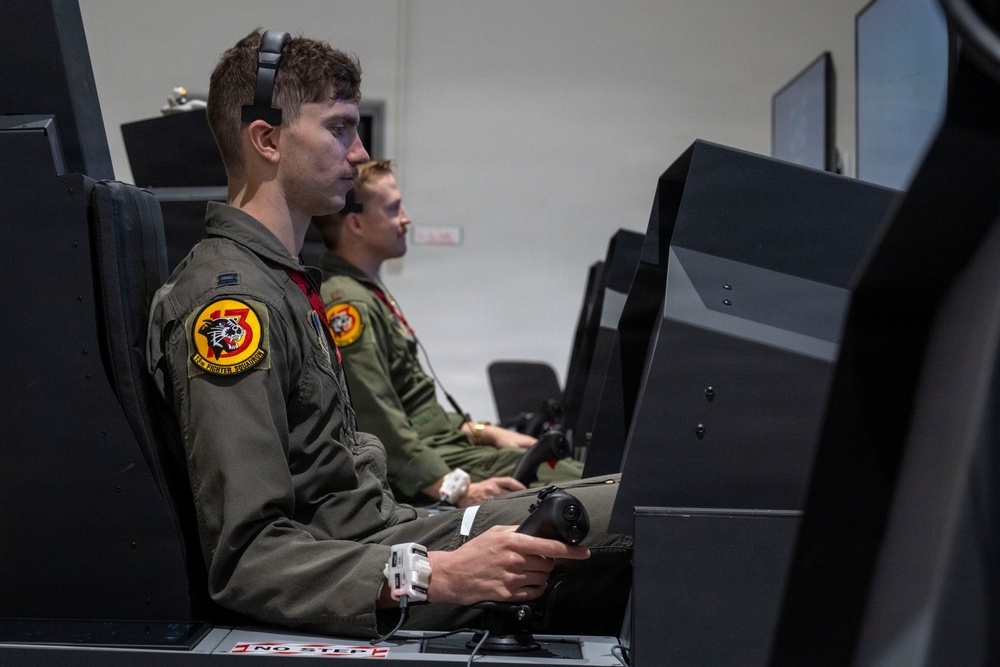
Photo By Senior Airman Patrick Boyle | U.S. Air Force Capt. Daniel Lee, left, and Maj. Matthew Presutti, 13th Fighter...... read more read more
 Subscribe
MISAWA AIR BASE, Japan — F-35 pilots assigned to the 13th Fighter Squadron (FS) used F-35 Emulated Non-Operational Flight Program Interoperability Experience (FENIX) simulators during Exercise VALIANT SHIELD 2026 from June 22–30 at Misawa Air Base, Japan, connecting the squadron to a distributed training environment spanning the Pacific and allowing aircrew to rehearse complex missions alongside geographically separated forces.
For the first time, FENIX simulators at Misawa were linked to the training environment in Guam, enabling pilots to participate in live, virtual and constructive training scenarios during the exercise. The integration allowed pilots to operate within a shared simulated battlespace while coordinating with controllers and other training assets located hundreds of miles away.
The training included nine pilots from the 13th FS, along with two pilots from Luke Air Force Base and two pilots from Hill Air Force Base.
The FENIX simulators provided pilots opportunities to train in a flexible environment while participating in complex mission scenarios that would be difficult to replicate through live flying alone.
"They bring our F-35 capability from Misawa to the interconnected simulated battlespace," said U.S. Air Force Lt. Col. John Widmer, 13th FS commander. "We've been doing cruise missile defense and ballistic missile defense of Guam, integrating with other controllers and other simulators. There's command and control architecture attached as well, so we're actually radioing in simulated communication with the controllers over there while we're in our simulator."
The training was conducted as part of a broader effort to connect forces across the Pacific through live, virtual and constructive capabilities. During VS26, pilots at Misawa operated within the same virtual battlespace as other exercise participants without leaving Japan.
The exercise allowed participants to operate in scenarios that would be difficult to replicate through routine local training alone.
"The simulator used today allowed joint interoperability between multiple platforms across multiple domains, coordinating kinetic fires," said U.S. Air Force Maj. Matthew Presutti, 35th Fighter Wing Weapons and Tactics chief. "It's important for tactical command and control to have the opportunity to control multiple different platforms in a complex area of operations."
The capability was enabled through the Pacific Multi-Domain Training and Experimentation Capability (PMTEC), an initiative that links ranges, resources and warfighters across the Pacific through advanced live, virtual and constructive training technologies. The VS26 integration incorporated a Japan-based virtual capability into the exercise, directly connecting the 35th Fighter Wing to a broader distributed training network operating across the theater
"These scenarios allowed pilots to practice crewed and uncrewed training— an operational concept central to the future of air power and human-machine warfighting operations," said Dr. Andre Stridiron, PMTEC program manager.
Beyond its role in large-scale exercises, the simulator environment provides opportunities to conduct training scenarios that would be difficult to replicate through routine flying operations. By allowing crews to rapidly reset events and repeat mission sets, the capability supports additional repetitions and tactical development without many of the constraints associated with live aircraft operations.
"We can stay in them as long as we want; there's no gas limitation, no weapon limitation and no adversary limitation," Widmer said. "We can run against as many adversaries as we need, reset the scenario and do it again. It's a lot easier to schedule, and it's a lot easier to get repetition."
As the capability continues to expand, the simulator network is expected to support future exercises and routine training events, providing additional opportunities for pilots to refine tactics and strengthen interoperability in a realistic, interconnected training environment. The increased training opportunities afforded by the FENIX simulators help ensure 35th FW F-35 pilots remain prepared to operate alongside joint and allied forces in support of regional security and stability throughout the Pacific.
| Date Taken: | 07.02.2026 |
| Date Posted: | 07.15.2026 22:45 |
| Story ID: | 570045 |
| Location: | MISAWA AIR BASE, JP |
| Web Views: | 469 |
| Downloads: | 0 |

This work, 13th Fighter Squadron integrates FENIX simulators into Valiant Shield 26, by SrA Patrick Boyle, identified by DVIDS, must comply with the restrictions shown on https://www.dvidshub.net/about/copyright.


No keywords found.




