
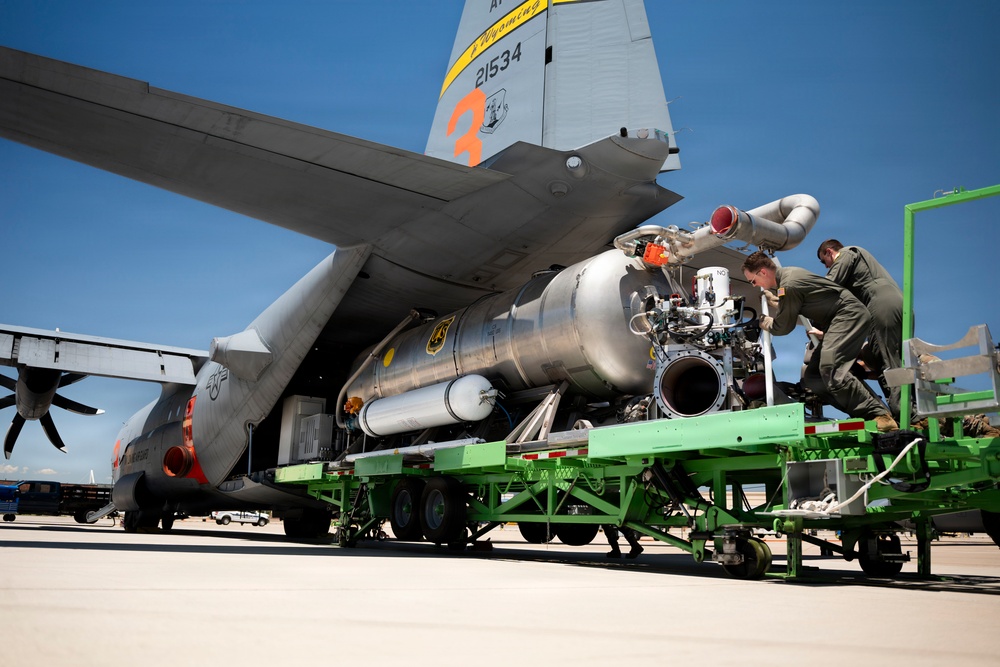
Photo By Staff Sgt. Zachary Herold | U.S. Air Force loadmasters assigned to the 153rd Airlift Wing guide a Modular Airborne...... read more read more
 Subscribe
CHEYENNE, Wyo., July 14, 2026 — The Wyoming Air National Guard’s 153rd Airlift Wing was activated Monday to support wildland firefighting operations in the western United States, wing officials announced.
The National Multi-Agency Coordinating Group at the National Interagency Fire Center in Boise, Idaho, requested four MAFFS-capable C-130s from the Department of Defense in response to increased wildfire activity across several western states.
The nation reached National Preparedness Level 4, the second-highest level, on June 29, with significant fire activity in the Southwest, Great Basin, Rocky Mountain and Northwest geographic areas. Fire potential is expected to increase because of extremely dry fuels, excessive heat and forecast dry lightning.
The wing is deploying two C-130 Hercules aircraft — one equipped with a Modular Airborne Firefighting System, known as MAFFS, and one support aircraft — along with approximately 20 airmen, including aircrews, maintenance personnel and support staff. Crews are scheduled to be operational and ready to receive launch orders by Wednesday. The activation is expected to last through Aug. 10.
The aircraft will initially operate from the San Bernardino Air Tanker Base in San Bernardino, California. A second staging location will be announced once it is identified.
“Our airmen train year-round alongside the U.S. Forest Service and our interagency partners for exactly this mission,” said Col. Brian Diehl, 153rd Airlift Wing commander. “When the nation calls, the 153rd is ready to answer, and we are proud to stand with the firefighters working to protect lives, property and public lands across the West.”
MAFFS is a self-contained aerial firefighting system owned by the USDA Forest Service that can discharge up to 3,000 gallons of fire retardant in less than 10 seconds across a quarter-mile line. The system slides into the cargo bay of a military C-130, and retardant is released through a nozzle on the rear left side of the aircraft.
MAFFS-equipped military aircraft provide a critical surge capability to bolster wildfire suppression efforts when commercial airtankers are fully committed or not readily available.
“This is one of the most visible and rewarding missions we perform,” said Maj. Randi Carpenter, a navigator with the 153rd Airlift Wing serving as mission commander for the activation. “Our crews understand that every drop they make helps a firefighter on the ground, and they take that responsibility seriously.”
"The flying gets most of the attention, but a mission like this runs on the people behind the scenes — the maintainers, aerial porters and support airmen who keep that aircraft ready for every launch order," said Master Sgt. Nathaniel Sobieski, a crew chief assigned to the 153rd Airlift Wing. "Fire season doesn't wait on maintenance, so our job is to make sure the airplane is always ready. When it launches and helps protect a community, every one of us owns a piece of that."
The 153rd Airlift Wing is one of four military airlift wings that perform the MAFFS mission. The others are the California Air National Guard’s 146th Airlift Wing, the Nevada Air National Guard’s 152nd Airlift Wing and the Air Force Reserve’s 302nd Airlift Wing at Peterson Space Force Base, Colorado. The units operate under the MAFFS Air Expeditionary Group when activated for wildland firefighting.
The NIFC serves as the nation’s primary coordination center for wildland firefighting efforts, comprising eight key agencies and organizations, including the Bureau of Land Management, Bureau of Indian Affairs, U.S. Fish and Wildlife Service, National Park Service, U.S. Forest Service, National Weather Service, U.S. Fire Administration, National Association of State Foresters, and various state emergency response agencies.
For more information about the MAFFS program, visit https://www.fs.usda.gov/managing-land/fire/planes/maffs. For photos and video of MAFFS operations, visit www.dvidshub.net/feature/MAFFSAEG.
| Date Taken: | 07.14.2026 |
| Date Posted: | 07.14.2026 17:28 |
| Story ID: | 569948 |
| Location: | CHEYENNE, WYOMING, US |
| Web Views: | 544 |
| Downloads: | 3 |

This work, Wyoming Air National Guard activated for wildland firefighting | 153rd Airlift Wing deploying MAFFS-equipped C-130 to California, by MSgt Jonathon Alderman, identified by DVIDS, must comply with the restrictions shown on https://www.dvidshub.net/about/copyright.


No keywords found.




